

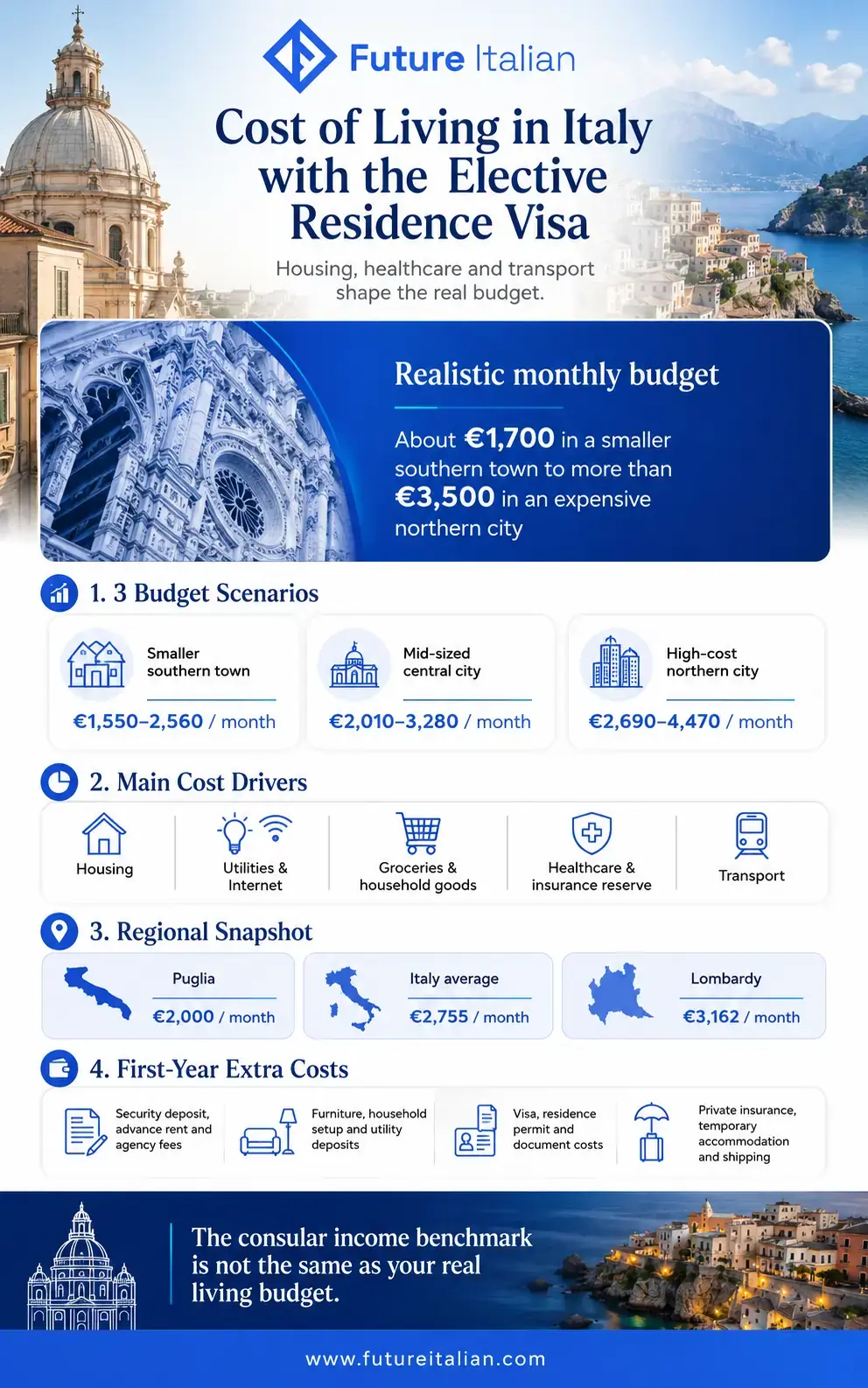
For one adult renting a modest apartment, our illustrative monthly budgets run from €1,550–2,560 in a smaller southern town to €2,690–4,470 in a high-cost northern city. A mid-sized central city falls around €2,010–3,280. Rent, insurance and transport explain most of the difference; income tax and initial relocation costs are separate.
A €31,000 yearly income benchmark equals about €2,583 per month before tax and expenses. Compare the money actually available after taxes with the annual living budget, rather than treating the visa figure as monthly spending money.
This article focuses on expenditure rather than visa eligibility. The requirements and application process are covered in the Italy Elective Residence Visa complete guide and on the Elective Residence Visa service page.
The table below models one adult renting a modest one-bedroom apartment, with ordinary utilities, food and household goods, local transport, leisure and a healthcare reserve. These are planning estimates rather than measured city averages. They exclude income tax, international flights, property purchases and major medical costs. The transport allowance does not fund the purchase of a car, and the healthcare reserve must be replaced with your actual insurance quote.
| Expense | Smaller southern town | Mid-sized central city | High-cost northern city |
|---|---|---|---|
| Rent | €550–800 | €850–1,250 | €1,300–2,000 |
| Utilities and internet | €180–260 | €200–300 | €230–350 |
| Groceries and household goods | €350–500 | €400–550 | €450–650 |
| Transport | €100–300 | €120–350 | €150–450 |
| Healthcare and insurance reserve | €120–250 | €140–280 | €160–320 |
| Dining, leisure and personal costs | €250–450 | €300–550 | €400–700 |
| Indicative total | €1,550–2,560 | €2,010–3,280 | €2,690–4,470 |
The National Average Is Only a Starting Point
ISTAT reported average household spending of €2,755 per month in 2024 and a median of €2,240. Regional averages ranged from €2,000 in Puglia to €3,584 in Trentino-Alto Adige; Lombardy averaged €3,162. These are household statistics, not a one-person relocation budget.
The regional comparison comes from ISTAT’s 2024 household-spending survey. The relocation table in this guide is a separate planning model.
How to Adapt the Monthly Budget to Your Household
These are planning scenarios, not official price lists. The low end assumes modest housing and limited car use; the high end allows more space, private services and frequent leisure spending.
For a couple, start with a quote for the apartment you will share rather than doubling the rent. Increase food, transport, healthcare and travel for the second person; utilities will depend on the home and usage. Keep household living costs separate from the consulate’s income requirement for each applicant.
Housing Usually Determines the Budget
Rent is normally the largest variable. The Agenzia delle Entrate OMI database publishes local rental ranges by municipality, zone, property type and semester, which is more useful than a national average when evaluating a specific address.
The €550–800 southern-town rent allowance is a planning range with room for variation between available properties. The cheaper-town guide instead multiplies a municipality’s average advertised rent per square metre by 60 m², producing examples around €317–470 in several towns. Those calculations describe different measures and do not price a specific available apartment. Replace either estimate with the actual annual lease you can secure.
A lower advertised rent does not always produce a lower total cost. Rural properties may require a car, heating oil, repairs or longer trips to hospitals and administrative offices. Coastal and historic towns can also have seasonal rental markets that make long-term contracts harder to secure.
The property must also work for the visa file. A cheap informal arrangement can create immigration risk if the applicant cannot prove stable accommodation. The most common housing problems are explained in the Elective Residence Visa rejection guide.
Utilities, Internet and Seasonal Costs
Electricity, gas, water, condominium charges and internet often total €180–350 per month, but the annual pattern can be uneven. Poor insulation, electric heating, air conditioning and large detached homes can push winter or summer bills well above the monthly average.
Before signing a lease, request recent utility bills and confirm whether condominium charges, heating, water or waste tax are included. Comparing only the monthly rent can hide a substantial part of the real housing cost.
Food, Dining and Everyday Services
The one-adult model allocates €350–650 a month to groceries and household goods, depending on location. For a couple, use your current shopping habits and local prices rather than doubling every item. Imported foods, premium supermarkets and frequent restaurant meals can increase the total.
Daily services are often less expensive outside major tourist centres, but availability can be narrower. The cheapest town is not necessarily the best value if the resident must travel for healthcare, language classes, banking or specialist shopping.
Affordability is only one part of the decision. Our guide to the pros and cons of retiring in Italy examines healthcare access, transport, language, bureaucracy and distance from family before you choose a destination.
Healthcare and Insurance
Private health insurance is normally required for the visa stage. Premiums depend heavily on age, exclusions, deductible, medical history and geographic scope, so a universal annual price is not reliable.
For eligible residents without mandatory SSN entitlement, ordinary voluntary enrollment has an income-based contribution of at least €2,000 per calendar year, equivalent to about €167 a month for budgeting. It expires on 31 December and is not prorated. The table’s €120 lower healthcare reserve is not an SSN price: use your actual private-insurance quote or the SSN contribution calculated by your ASL.
Transport: Public Transit or a Car
A resident in Milan, Turin, Bologna or another well-connected city may rely on public transport and occasional taxis. In smaller towns, a car may be essential and can add fuel, insurance, maintenance, parking, road tax and depreciation to the budget.
When comparing regions, calculate the cost of reaching the nearest airport, hospital and railway station. Lower rent can be offset by two cars or frequent long-distance travel.
Puglia, Tuscany and Lombardy Compared
Puglia: Lower Household Spending, Greater Location Sensitivity
ISTAT recorded the lowest 2024 average household expenditure in Puglia at €2,000 per month. Inland towns can offer lower rents, while established coastal and tourist destinations may cost substantially more and have tighter long-term rental supply.
Tuscany: Large Differences Between Tourist Centres and Smaller Towns
Florence and highly visited areas are not representative of the entire region. Smaller Tuscan municipalities can offer moderate rents, but heating, car dependence and limited housing stock should be included in the comparison.
Lombardy: Higher Costs, Stronger Infrastructure
ISTAT reported average monthly household expenditure of €3,162 in Lombardy in 2024. Milan and Lake Como can be considerably more expensive, while cities such as Pavia or some provincial areas may offer a lower entry point with access to strong transport and healthcare networks.
Initial Relocation Costs Are Separate from Monthly Spending
The first year usually costs more than a stable year of residence. Applicants may need to fund:
- Security deposit, advance rent and agency fees.
- Furniture, household setup and utility deposits.
- Visa, residence-permit and document costs.
- Private insurance before any later healthcare arrangement.
- Temporary accommodation, international shipping and return travel.
A relocation reserve of several months’ normal expenditure prevents the applicant from relying on the full annual income for recurring costs immediately after arrival.
Taxes Must Be Budgeted Separately
Tax liability cannot be estimated from the monthly living-cost table. Italian tax residence, worldwide income, foreign assets and any special regime require a separate analysis. U.S. retirees should consult the guide to the U.S.–Italy tax treaty and 7% pensioner regime.
A low-cost municipality may be fiscally attractive for some pensioners, but the tax regime should not be allowed to choose the home by itself. Healthcare access, transport, climate and long-term suitability remain part of the real cost.
Build a Budget Around the Life You Will Actually Live
The useful question is not whether Italy is cheap, but whether the applicant’s stable income can support the chosen municipality, household and level of mobility after tax. A modest town can make the Elective Residence Visa financially comfortable; an expensive destination can make the same income fragile.
A defensible plan uses current local rent data, a full annual healthcare estimate, transport costs and a contingency reserve. That budget is more valuable than any national average or headline monthly figure.
Frequently Asked Questions
Sources
- 1
- 2Agenzia delle Entrate — Consultazione quotazioni OMI
www1.agenziaentrate.gov.it
- 3
- 4Consulate General of Italy in Boston — Elective Residency
consboston.esteri.it
- 5Italian Immigration Portal — Residence Permit Procedures
portaleimmigrazione.it
- 6ASL Toscana sud est: Iscrizione volontaria al SSN, contributo e anno solare
uslsudest.toscana.it