

Pensions, annuities, documented rental income, dividends and interest can qualify for Italy’s Elective Residence Visa when they are recurring and available without work. Start with the published benchmark of about €31,000 per person a year, then document the source, payment history and continuity. Savings help support the file, but an account balance and annual income are different things.
Savings, property and investment portfolios can strengthen the overall financial profile, but a large asset balance does not automatically prove recurring income. Consulates assess whether the applicant can continue paying ordinary living expenses in Italy without needing to work or liquidate assets unpredictably.
| Income source | Evidence that usually matters | Main issue to explain |
|---|---|---|
| Pension or annuity | Award or administrator letter, payment statements, tax records | Amount, frequency and duration |
| Rental income | Ownership deed, lease, payment history, tax return, expense schedule | Reliable net income after costs |
| Dividends and interest | Brokerage or bank statements, tax forms, payment history | Consistency and portfolio sustainability |
| Investment-fund distributions | Fund statements, distribution notices, tax records | Whether distributions are recurring rather than asset sales |
| Trust income | Trust instrument or trustee letter, statements, tax records | Applicant’s enforceable entitlement and payment continuity |
| Business distributions | Corporate records, audited accounts, dividend resolutions, tax returns | Income must not depend on the applicant’s daily work |
| Savings and financial assets | Bank and investment statements, adviser letter | Useful support, but not necessarily recurring income |
For a concrete official requirement, Boston’s checklist asks for more than €31,000 yearly per applicant and a detailed income summary supported by institutional letters and two years’ tax returns.
This article focuses only on income eligibility and proof. For accommodation, insurance, application steps and the residence permit, read the Italy Elective Residence Visa complete guide. Individual financial-evidence planning is available through our Elective Residence Visa service.
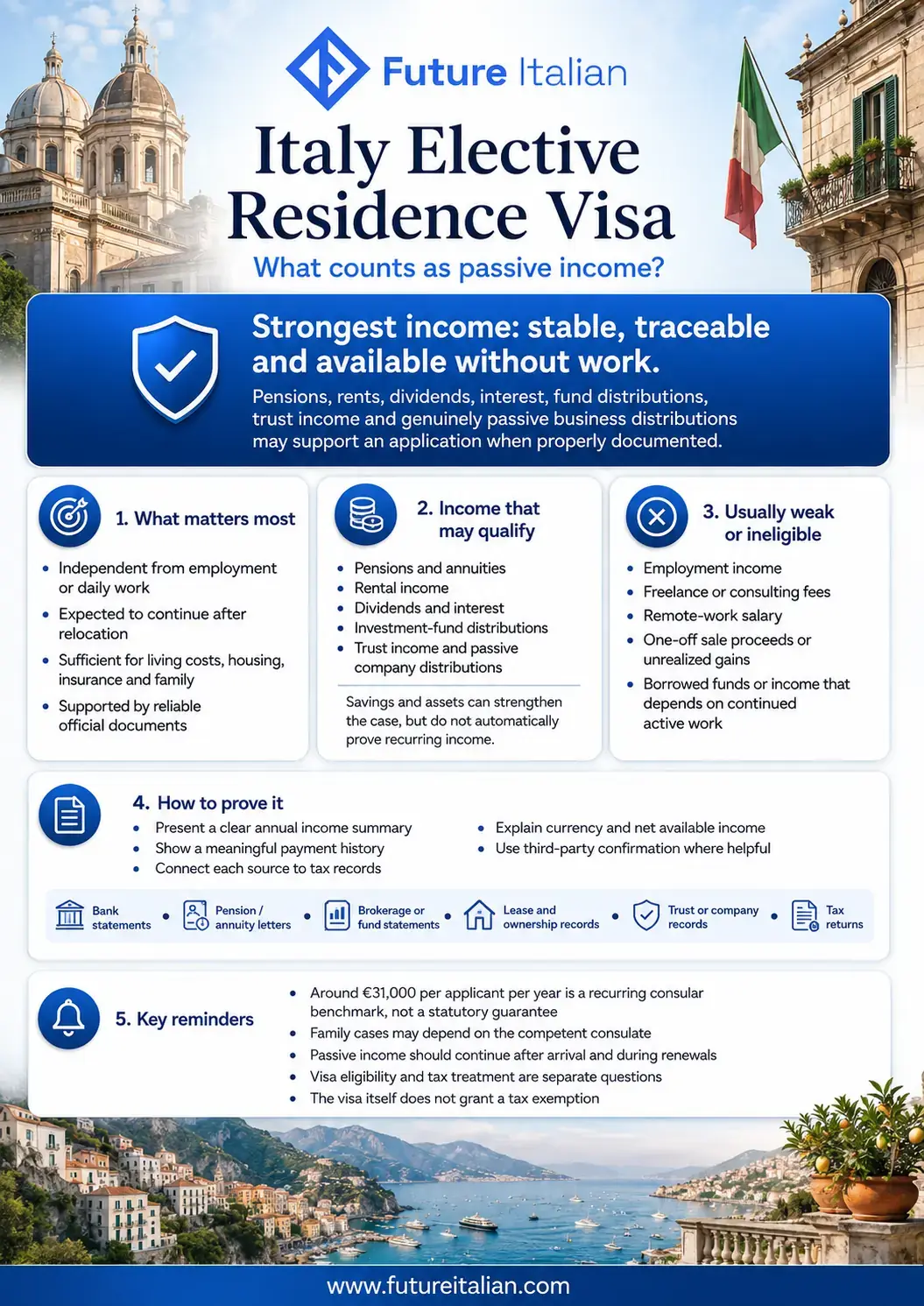
What “Passive Income” Means for the Elective Residence Visa
Italian consular pages do not rely on one universal definition of passive income. They instead refer to substantial and stable private income, pensions, annuities, property income, trusts, investment funds, securities and returns from stable economic or commercial activities.
Across those descriptions, four practical tests recur:
- Independence from work: the money must remain available without employment, self-employment or daily operational activity.
- Continuity: the source should be expected to continue after relocation and during future permit renewals.
- Sufficiency: the total resources must realistically cover the applicant, accommodation, insurance and any accompanying family members.
- Verifiability: the figures must be supported by official records, tax returns, contracts and reliable financial documents.
A source does not become acceptable merely because an applicant calls it passive. The consulate examines how the income is generated, what effort is required to maintain it and whether the evidence demonstrates a durable payment pattern.
Income Sources That May Support the Application
Pensions and Annuities
Public and private pensions are among the clearest sources because the payment schedule is usually established independently of future work. The supporting letter should identify the beneficiary, gross amount, payment frequency, commencement date and whether the benefit is lifelong or time-limited.
An annuity should be presented in the same way. A current contract value alone is less useful than documentation showing the actual periodic payment and how long that payment is expected to continue.
Rental Income
Rental income may qualify when ownership, tenancy and payments are documented. The application should distinguish gross rent from mortgage payments, property taxes, insurance, repairs, management fees and vacancy risk so the consulate can assess the dependable net amount.
A recently signed lease with no payment history is generally less persuasive than an established tenancy reflected in bank statements and tax returns. Multiple properties should be summarized individually before the net totals are combined.
Dividends, Interest and Investment-Fund Distributions
Dividends, bond interest and fund distributions can form part of the financial case when their history is visible across official statements and tax documents. A diversified, established payment record is usually more credible than a forecast based on recent market performance.
The distinction between income and capital withdrawal matters. A regular distribution generated by investments is different from repeatedly selling shares to fund living costs, particularly when the sales could deplete the portfolio or depend on volatile prices.
Trust Distributions
Trust income may be relevant when the applicant has a clear legal entitlement to distributions. The trust instrument, trustee confirmation, payment statements and tax records should explain whether distributions are mandatory or discretionary, their frequency and the expected duration.
Business Income and Company Distributions
Official consular guidance may accept income from stable economic or commercial activities, but only when the resources remain available independently of daily work. Dividends or distributions from a mature company can therefore be assessed differently from salary, management fees, consulting income or profits that depend on the applicant continuing to operate the business.
Corporate ownership should be supported by incorporation records, ownership evidence, audited or certified accounts where available, tax returns, dividend resolutions and proof of actual payments. The applicant should also explain who manages the business after relocation and why the income will continue without personal work from Italy.
Can Savings or Net Worth Replace Passive Income?
Savings and substantial assets are relevant because the visa is intended for people with strong autonomous financial resources. They can provide a safety margin, demonstrate resilience and support income that fluctuates moderately.
They should not be treated as an automatic substitute for recurring income. A portfolio worth €1 million can still produce little distributable income, while an applicant with a smaller capital base and a secure lifelong pension may present a more predictable cash-flow profile.
When assets must be sold periodically, the application should include a conservative withdrawal plan showing the expected annual amount, portfolio composition, historical withdrawals and sustainability after taxes and market changes. The consulate may still decide that the arrangement is less secure than established income.
Income That Is Usually Weak or Ineligible
Income from employment is expressly excluded in multiple official consular checklists. Freelance fees, consulting revenue, remote-work salary and compensation for managing a business are also incompatible with the visa’s no-work purpose when the applicant must continue performing the activity from Italy.
The following resources may support net worth but are normally weak when presented as the main income proof:
- One-off proceeds from selling a property, company, security or cryptocurrency.
- Unrealized gains or optimistic projections that have not produced actual payments.
- A credit limit, loan facility or borrowed funds that create repayment obligations.
- A newly created distribution arrangement with no history or credible long-term basis.
- A company profit forecast that depends on the applicant continuing to provide services or management.
How Much Passive Income Is Enough?
Example: pension plus rental income
Illustrative calculation for one applicant, before personal income tax:
| Source | Annual calculation | Proof |
|---|---|---|
| Pension | €24,000 | Pension letter and regular deposits |
| Rental income | €18,000 rent − €6,000 property expenses = €12,000 | Ownership, lease, payments and expense records |
| Total documented recurring income | €36,000 | Summary reconciled with tax returns |
This example exceeds a €31,000 reference amount, but the applicant must still satisfy the competent consulate’s requirements. The €36,000 is not an after-tax living budget. Use real receipts and expenses, not projected rent or an unexplained new transfer.
No single statutory figure guarantees approval at every consulate. Some offices publish or refer to a benchmark around €31,000 per applicant per year, while others use broader terms such as substantial, stable and adequate resources.
The number should therefore be treated as a recurring consular benchmark, not a statutory safe harbor. The competent office can consider family size, net income, accommodation costs, insurance, taxation, source quality and the applicant’s broader assets.
A useful internal calculation is to begin with the annual income genuinely available after taxes and source-related expenses, then subtract the expected Italian housing, insurance and living costs. The remaining margin should be credible for the applicant’s household and sustainable for future renewals.
How to Build a Persuasive Financial File
A strong application does not force the visa officer to reconstruct income from hundreds of pages. It presents a concise financial narrative and then provides the documents needed to verify every figure.
Prepare an Annual Income Summary
List each income source separately, identifying the payer, gross annual amount, estimated net amount, currency, payment frequency, start date and expected duration. Totals should match the supporting statements and tax returns.
Show a Meaningful History
Consular checklists vary, so there is no universal rule that every applicant must provide exactly 12 months of statements. In practice, a longer and consistent record can make recurring income easier to verify, especially for investments, rentals and business distributions.
Connect Every Source to Tax Records
Tax returns help demonstrate that the income is lawful and established. Differences between a return, bank deposits and the annual summary should be explained, particularly where withholding tax, exchange rates, expenses or timing create different totals.
Explain Currency and Net Availability
When income is paid in a foreign currency, show both the original figure and a reasonable euro equivalent using a dated, consistent exchange-rate method. The application should avoid presenting gross income as fully spendable when taxes, fees or debt payments materially reduce it.
Use Third-Party Confirmation Where Helpful
A pension administrator, trustee, financial adviser, accountant, property manager or company officer may confirm the source, amount, payment pattern and expected duration. A confirmation letter does not replace the underlying evidence, but it can make a complex file easier to understand.
Documents Commonly Used to Prove Passive Income
The exact checklist depends on the Italian consulate with jurisdiction. Depending on the income source, the financial section may include:
- Recent personal bank statements showing the actual receipt of income.
- Pension, annuity, Social Security or similar benefit letters.
- Brokerage, bond, fund and savings-account statements.
- Rental agreements, proof of ownership and property-income schedules.
- Trust instruments, trustee confirmations and distribution records.
- Corporate ownership records, accounts, dividend resolutions and payment evidence.
- Personal and, where relevant, company tax returns.
- A financial summary or cover letter reconciling all documents and currencies.
Documents may require translation, apostille or legalization only where the competent consulate or the nature of the document requires it. Do not assume that every bank or investment statement must automatically be apostilled.
Passive Income for Couples and Families
Family applications require more than adding a fixed percentage to the main applicant’s income. Some consulates may assess each spouse separately or refer to an amount around €31,000 for each applicant, while others evaluate the household’s resources more holistically.
The application should identify which income belongs to each spouse, whether accounts are individual or joint, and whether the main applicant has legal and practical access to all funds. Civil-status documents and separate insurance coverage may also be required for accompanying family members.
Applicants relying on Social Security, IRA, 401(k) or U.S. brokerage income should also read our Elective Residence Visa guide for U.S. retirees.
Passive Income Must Continue After Arrival
The financial test is not confined to the visa appointment. After entering Italy, the applicant requests the elective-residence permit and must continue satisfying the underlying conditions for renewal.
A strategy that temporarily increases income before the appointment can fail later if the source disappears, the portfolio is rapidly depleted or the applicant begins working. Financial planning should therefore cover the first visa, actual residence in Italy and annual renewal.
Taxation Can Change the Income Available to You
Immigration eligibility and tax treatment are separate questions. A pension, dividend or rental stream may be acceptable for the visa but taxed differently after the applicant becomes resident in Italy.
Italy generally taxes residents on worldwide income, subject to applicable treaties, credits and special regimes. Eligible foreign pensioners who move to qualifying municipalities may assess the 7% substitute-tax regime, while high-net-worth applicants may have different planning options. The visa itself does not grant a tax exemption. For the U.S. angle, see our Elective Residence Visa and taxes guide for American retirees.
Common Passive-Income Evidence Mistakes
- Presenting gross rental income without property expenses or debt payments.
- Treating a large bank balance as if it were an annual income stream.
- Using employment, consulting or operational business income despite the no-work restriction.
- Providing projections without an established payment history.
- Submitting statements that do not reconcile with tax returns or the financial summary.
- Ignoring exchange rates, withholding taxes or fees that reduce available income.
- Creating a temporary distribution that is not sustainable through future renewals.
These problems can affect both the credibility and sufficiency of the application. For the broader refusal analysis, read our guide to Elective Residence Visa rejection risks.
The Best Evidence Shows Income, Continuity and Independence
A persuasive passive-income file answers three questions clearly: how much money the applicant receives, why it will continue and why receiving it does not require work from Italy. Pensions, rents and investments are not evaluated by label alone; their legal structure, history and net availability matter.
The objective is not to manufacture a figure for one consular appointment. It is to demonstrate a financial structure capable of supporting genuine residence in Italy and remaining defensible when the residence permit is renewed.
Frequently Asked Questions
Sources
- 1Consulate General of Italy in New York — Elective Residency Visa Requirements
consnewyork.esteri.it
- 2Consulate General of Italy in Boston — Elective Residency
consboston.esteri.it
- 3Consulate General of Italy in Los Angeles — Elective Residency Visa
conslosangeles.esteri.it
- 4Consulate General of Italy in San Francisco — Elective Residency Visa Checklist (2025)
conssanfrancisco.esteri.it
- 5Consulate General of Italy in Chicago — Elective Residence National Visa
conschicago.esteri.it
- 6Italian Income Tax Code, Article 2 — Tax Residence
normattiva.it