

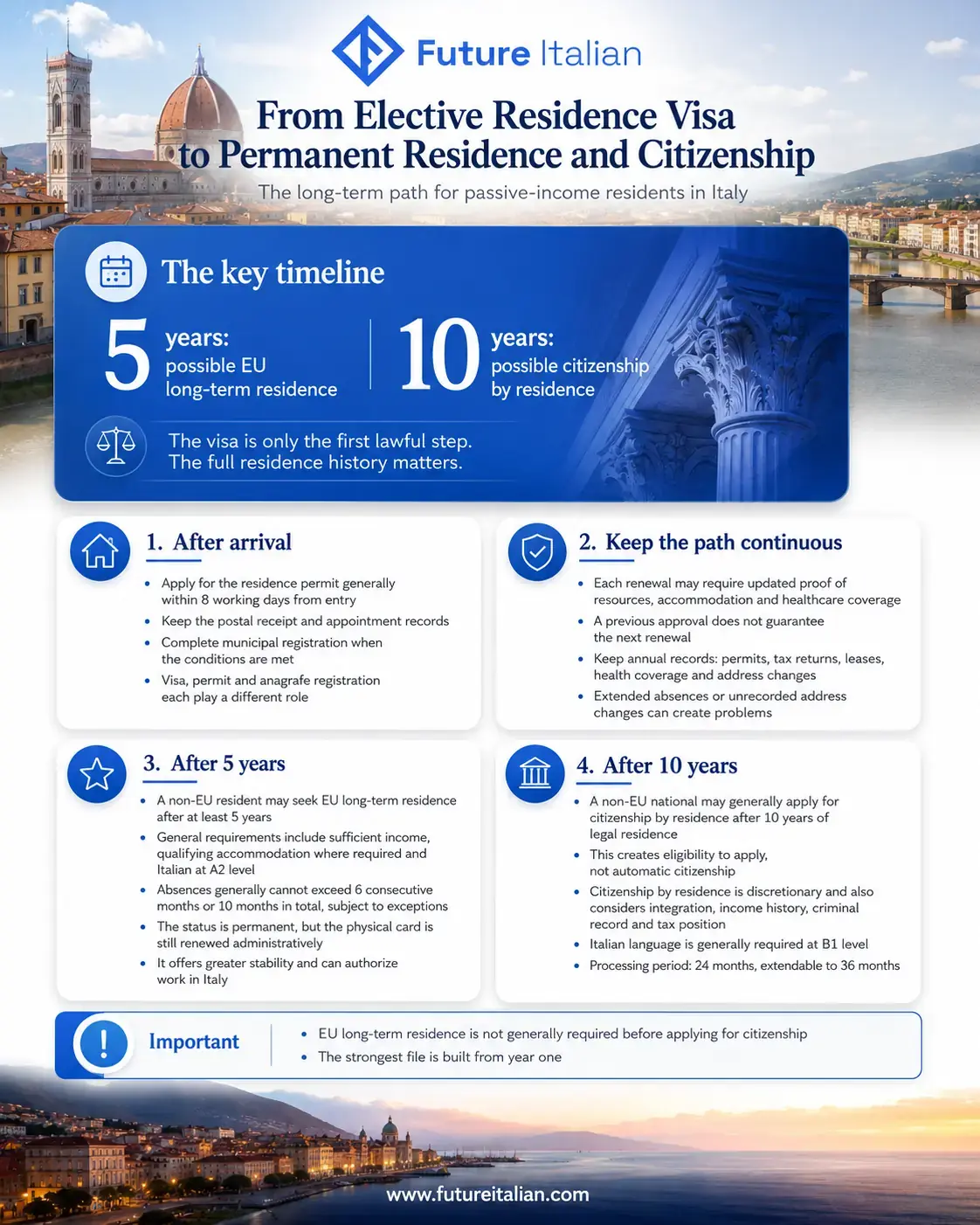
Years spent lawfully resident in Italy on an Elective Residence Visa permit can count toward EU long-term residence after five years and, for an ordinary non-EU applicant, citizenship by residence after ten years. Keep the permit valid and municipal residence registration continuous. Each later application also has its own income, language and other requirements.
The path is cumulative: the visa permits entry, the residence permit supports lawful stay, municipal registration documents legal residence, and later applications examine the entire history rather than only the permit held on the filing date.
The initial eligibility rules are covered in the Italy Elective Residence Visa complete guide and on the Elective Residence Visa service page. This article starts with the move and follows what must happen afterward.
| When | Possible step | Main condition |
|---|---|---|
| Within eight working days of entry | First elective-residence permit application | Complete the post-arrival filing |
| Before each permit expires | Renewal | Apply at least 90 days before expiry; maintain the original conditions |
| After five qualifying years | EU long-term resident status | Income, residence continuity and A2 Italian unless exempt |
| After ten years’ legal residence | Citizenship application: ordinary non-EU route | Continuous registered residence, income and B1 evidence unless exempt |
| After the citizenship application | Decision and, if granted, oath | Statutory decision period: 24 months, extendable to 36 |
Official rules: EU long-term residence · citizenship by residence. Five and ten years are filing milestones when the conditions are met; citizenship is acquired after approval and the required oath.
Path from Elective Residence to Permanent Status and Citizenship
- 1
Apply for the elective-residence permit after entry
Begin the residence-permit process within the statutory deadline and preserve the postal receipt, appointment record and issued card.
- 2
Register residence and maintain annual records
Complete municipal registration when eligible and retain permits, tax returns, leases, insurance and records of address changes.
- 3
Renew the temporary permit without gaps
Continue proving autonomous resources, accommodation and healthcare coverage before each permit expires.
- 4
Assess EU long-term residence after five years
Verify continuous lawful residence, permitted absences, income, housing and A2 language requirements before applying.
- 5
Prepare citizenship eligibility before year ten
Review the complete residence history, tax record, income, criminal documents and B1 language requirement before filing.
- 6
Submit and maintain eligibility through the decision
File through the competent online procedure and continue lawful residence, registration and compliance while the application is pending.
Stage One: Enter Italy and Apply for the Residence Permit
The national visa authorizes entry; it is not the document that maintains residence for the following years. After arrival, the holder must begin the application for the elective-residence permit within the statutory deadline, generally eight working days from entry.
The process normally includes the postal application, receipt, fingerprint appointment and issuance by the Questura. The postal receipt and appointment records should be preserved because delays in production of the physical card do not erase the importance of proving timely filing.
Municipal registration should also be completed when the factual and documentary conditions are met. Residence-permit validity and anagrafe registration are related but separate parts of the legal-residence record.
Stage Two: Maintain Renewals and Residence Continuity
Each renewal can require updated evidence that the conditions supporting elective residence continue to exist, including autonomous resources, suitable accommodation and health coverage. A previous approval does not guarantee the next renewal when the factual situation has changed.
Long-term planning requires a complete file for every year:
- Residence permits, renewal receipts and Questura communications.
- Municipal residence certificates and records of address changes.
- Tax returns, income evidence and healthcare documentation.
- Leases, property records and evidence of actual presence in Italy.
Moving between Italian municipalities does not itself restart the clock, but an unrecorded address change or cancellation from the resident population can create an evidentiary gap. Extended absences can also affect both long-term resident status and a future citizenship application.
Stage Three: EU Long-Term Residence After Five Years
Article 9 of the Immigration Code provides the EU long-term residence route for qualifying non-EU nationals who have held lawful residence in Italy for at least five years. The detailed rules are covered in the permanent residence and EU long-term residence guide and on the EU Long-Term Residence Permit service page.
The five-year period is not the only requirement. The applicant must generally demonstrate sufficient income, qualifying accommodation where required, Italian language knowledge at A2 level unless exempt, and the absence of grounds relating to public order or security.
Article 9 allows absences during the five-year qualifying period if each is shorter than six consecutive months and they total no more than ten months. Specific statutory exceptions cover documented serious reasons; keep travel records before calculating your qualifying years.
Before long-term status, your annual elective-residence permit has its own renewal rule: more than six consecutive months abroad can prevent renewal unless the absence is justified by serious, documented reasons. This comes from Article 13(4) of DPR 394/1999 and is separate from tax residence.
The status is permanent, but the physical residence card is issued with a validity period and renewed for identification and photograph updates. It is therefore inaccurate to say that the card never needs administrative renewal.
Long-term status can still be revoked after 12 consecutive months outside the EU or more than six years outside Italy under Article 9(7). These rules apply after you obtain the status and differ from the absences allowed while qualifying for it.
What EU Long-Term Residence Changes
The status provides greater stability than a temporary elective-residence permit and can authorize work in Italy. It also creates facilitated mobility rights within participating EU states, but it does not provide the same unconditional freedom of movement as EU citizenship.
A person wishing to reside or work in another EU country must comply with that country’s admission and residence rules for EU long-term residents. The Italian status is not a substitute for obtaining the required authorization in the second state.
Stage Four: Citizenship by Residence After Ten Years
A non-EU national may generally apply for citizenship under Article 9 of Law No. 91/1992 after ten years of legal residence. The full requirements and procedure are explained in the Italian citizenship by residency complete guide and on the citizenship by residency service page.
Ten years creates eligibility to apply, not an automatic right to citizenship on the anniversary date. Citizenship by residence is a discretionary grant that also considers the applicant’s integration, income history, criminal record, tax position and overall conduct.
A shorter residence route may apply if a parent or grandparent was an Italian citizen by birth: Article 9(1)(a), as amended by Law 74/2025, allows an application after two years of legal residence. This is a naturalization route with its own requirements, not automatic recognition of citizenship by descent.
Applicants must generally demonstrate Italian language knowledge at B1 level, unless an exemption applies. A holder of an EU long-term residence permit is exempt from submitting a separate B1 certificate for the citizenship application, but that does not remove the broader language and integration analysis.
Prefectures publish annual income benchmarks of €8,263.31 for an individual, €11,362.05 with a dependent spouse, plus €516.00 for each dependent child. Check the benchmark in each of the last three Italian tax years used for the application, and maintain adequate income during the procedure.
The Ministry of the Interior’s income guidance focuses on income subject to IRPEF and declared in Italy. Do not assume that a foreign pension taxed exclusively under the 7% Article 24-ter regime meets the citizenship income test. If citizenship is part of your plan, check this point before choosing the tax regime.
For applications filed from 20 December 2020, the statutory processing period is 24 months, extendable to a maximum of 36 months. This period begins with the application; it is additional to the ten years of residence required before filing.
Permanent Residence Is Not Required Before Citizenship
A non-EU applicant does not generally have to obtain the EU long-term residence permit before applying for citizenship by residence. The two applications have different legal bases and requirements.
Long-term status can nevertheless strengthen practical stability during the additional years before citizenship and while the citizenship application is pending. It also avoids relying indefinitely on annual elective-residence renewals.
What Can Interrupt or Weaken the Path?
- Late or unsuccessful permit renewals and periods without provable lawful stay.
- Cancellation from the anagrafe or unrecorded changes of residence.
- Absences that exceed the limits for EU long-term residence or undermine actual residence for citizenship.
- Income that is not declared or cannot be reconciled with the visa and renewal files.
- Criminal proceedings, convictions or public-order concerns.
A short administrative gap does not always produce the same consequence in every procedure. Its effect depends on the underlying facts, available records and the authority applying the relevant rule. Gaps should be investigated rather than hidden.
A Ten-Year Plan Must Be Managed from the First Year
The strongest long-term file is not assembled at year five or year ten. It is created through timely renewals, correct tax filings, recorded addresses, controlled absences and preserved evidence from the beginning of residence.
The Elective Residence Visa can therefore support a path to permanent status and naturalization, but only as the first lawful step. The outcome depends on maintaining a coherent residence history through every later stage.
Frequently Asked Questions
Sources
- 1
- 2Italian Immigration Portal — EU Long-Term Residence Permit
portaleimmigrazione.it
- 3
- 4Ministry of the Interior — Citizenship by Residence under Article 9
libertaciviliimmigrazione.dlci.interno.gov.it
- 5
- 6