

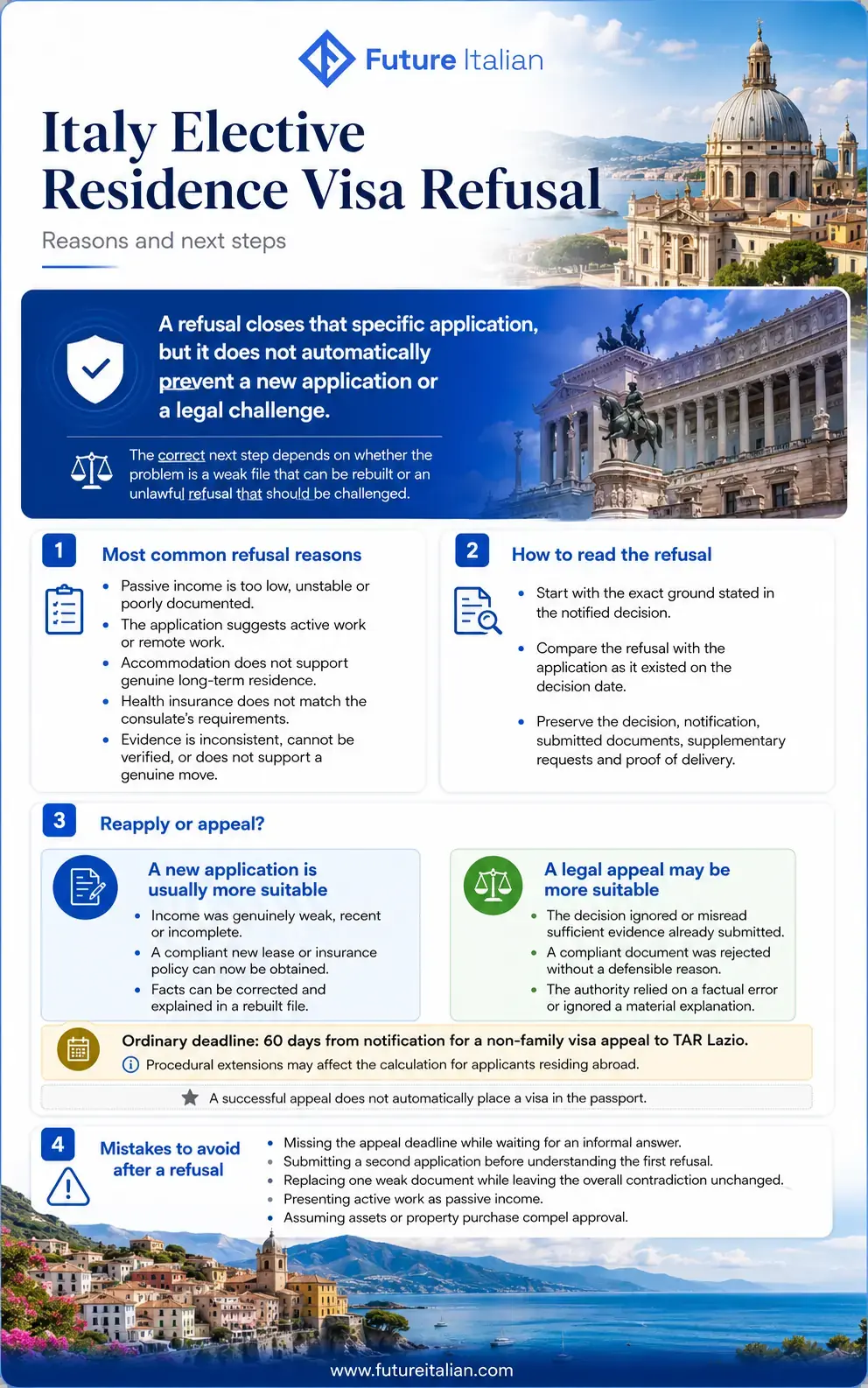
If your Italy Elective Residence Visa is refused, keep the written decision and proof of its notification date. Then decide whether to rebuild the application or challenge a legal or factual error. Reapplying does not stop the appeal clock. MAECI gives an ordinary 60-day deadline for TAR Lazio; extensions for residents abroad come from Article 41(5) of the Administrative Procedure Code.
Submitting every item on a consular checklist does not create a right to the visa. The consulate still evaluates the reliability of the income, the credibility of the relocation plan, the suitability of the accommodation and insurance, and whether the applicant genuinely intends to reside in Italy without working.
For the underlying eligibility rules, read the Italy Elective Residence Visa complete guide. Applicants rebuilding a file can also review the scope of our Elective Residence Visa service.
| Do this first | Why it matters |
|---|---|
| Save the refusal and notification record | The grounds and notification date determine the response |
| Compare each ground with the evidence submitted | Separate a missing document from a misread fact |
| Get the appeal deadline calculated promptly | Reapplying or writing to the consulate does not itself suspend it |
| Reapply with a material improvement, or assess an appeal | Choose according to the defect in the original file |
The ordinary deadline and judicial route are described in MAECI’s official visa-refusal guidance. Read the actual notified decision before choosing the next step.
What to Do After an Elective Residence Visa Refusal
- 1
Preserve the refusal and notification evidence
Keep the complete decision, notification envelope or email, application file, consular requests and proof of delivery. The notification date affects every later deadline.
- 2
Identify the exact defect
Separate a legal-eligibility problem from missing evidence, credibility concerns or a factual error in the decision.
- 3
Compare reapplication and appeal immediately
Assess whether the file can be materially rebuilt or whether the original refusal should be challenged before the TAR Lazio deadline.
- 4
Rebuild the evidence or legal argument
Correct the income, accommodation, insurance and factual record for a new application, or prepare the grounds and supporting record for an appeal.
- 5
Use the correct remedy within the deadline
Submit a genuinely improved new application or file the competent judicial challenge, then retain a complete record of every document and communication.
A Document Request Is Not the Same as a Refusal
A consulate may ask for supplementary bank records, an updated lease, clearer insurance wording or an explanation of a transaction before deciding the application. That is an opportunity to cure a perceived gap, not a formal rejection.
A refusal is a final written decision on the application that was submitted. The decision should identify the grounds and be communicated in a language the applicant understands or in one of the languages permitted by the Ministry’s rules.
Do not treat a supplementary request casually. A rushed response, unexplained replacement document or new inconsistency can turn a correctable concern into a formal refusal.
Elective Residence Visa Refusal Reasons: Income and Documents
Passive Income Is Too Low, Unstable or Poorly Documented
The central question is not whether the applicant owns assets, but whether the file demonstrates sufficient, recurring and independently verifiable resources that do not depend on working in Italy. A large account balance can strengthen the application, but it may not replace regular income. Our guide to what counts as passive income for the Elective Residence Visa explains how pensions, rents, dividends and distributions are assessed.
Files become vulnerable when deposits cannot be traced, investment distributions are discretionary, rental income is shown without leases or tax records, or projected income is presented as though it were already established.
The Application Suggests Active Work or Remote Work
The Elective Residence Visa does not authorize employment, freelancing, consulting or remote work from Italy. A professional website, current employment letter, business-management role or unexplained company income can contradict the declaration that the applicant will live solely from autonomous resources.
Business ownership is not automatically disqualifying. The file must distinguish passive ownership distributions from services, management and operational activity that the applicant intends to continue after relocation.
Accommodation Does Not Support Genuine Long-Term Residence
Housing evidence can fail because the contract is too short for the intended move, the applicant is not a party, the landlord’s authority is unclear, registration evidence is missing or the property cannot realistically accommodate the household.
There is no universal rule that every lease must have exactly the same duration or format. The competent consulate’s current checklist and the facts of the proposed residence control the analysis. Property ownership can prove accommodation, but it does not cure weak income.
Health Insurance Does Not Match the Consulate’s Requirements
A policy may be rejected or questioned if it is valid only for short tourist trips, excludes ordinary medical care, has restrictive territorial wording, starts too late or ends before the planned period of residence. A generic confirmation email may also be insufficient when the policy terms are not attached.
Coverage amounts and wording differ among consular checklists. The policy should therefore be tested against the exact requirements of the office deciding the application rather than a checklist found for another jurisdiction.
The Evidence Is Inconsistent or Cannot Be Verified
A strong application tells one coherent story across the form, cover letter, bank statements, tax returns, pension records, family documents, lease and insurance. Different addresses, unexplained name variations, conflicting income figures or transactions that appear only immediately before the appointment can undermine credibility.
Translations, apostilles and legalizations are not universally required for every document in every consular district. They should be used where the checklist or the nature of the document requires them, without making the file unnecessarily complex.
The Relocation Plan Does Not Look Credible
The visa is intended for genuine residence in Italy, not for obtaining a long-stay document while continuing ordinary life elsewhere. A file can raise concerns when the housing, family arrangements, travel history, remaining employment or stated plans do not support an actual transfer of residence.
American applicants should also ensure that Social Security, IRA, 401(k), pension and brokerage evidence is presented consistently. The required U.S.-specific documents are addressed in the Elective Residence Visa guide for U.S. retirees.
How to Read the Refusal Decision
Start with the exact ground stated in the notified decision. Do not rebuild the entire application before identifying whether the consulate questioned legal eligibility, the sufficiency of a document, the credibility of the facts or the purpose of the stay.
The refusal should be compared with the application as it actually existed on the decision date. Evidence created afterward may support a new application, but it does not necessarily prove that the original refusal was unlawful.
Preserve the decision, envelope or electronic notification, appointment receipts, all submitted documents, supplementary requests and proof of delivery. The date and method of notification affect the calculation of any appeal deadline.
Should You Reapply or Appeal the Refusal?
| Issue | A new application is usually more suitable | A legal appeal may be more suitable |
|---|---|---|
| Income evidence | Income was genuinely weak, recent or incomplete | The decision ignored or misread sufficient evidence already submitted |
| Accommodation or insurance | A compliant new lease or policy can now be obtained | The submitted document met the stated requirement but was rejected without a defensible reason |
| Inconsistencies | Facts can be corrected and explained in a rebuilt file | The authority relied on a factual error or failed to consider a material explanation |
| Timing | There is no urgent need to preserve the original application | The appeal deadline is running and the original decision should be challenged |
| Likely result | A new decision on a materially stronger application | Possible annulment and re-examination of the original application |
A new application is not an appeal and does not erase the previous refusal. It should disclose the refusal where requested and explain what has materially changed. Refiling the same documents with a longer cover letter is rarely a meaningful strategy.
An appeal challenges the legality of the administrative decision. MAECI’s public guidance identifies an ordinary deadline of 60 days from notification for a non-family visa appeal to the TAR Lazio, although procedural extensions may affect the calculation when a party resides abroad. The exact deadline must be calculated immediately by counsel. See our legal appeal service for visa refusals and the broader guide to appealing an Italian visa or residence-permit refusal.
A successful appeal does not automatically place a visa in the passport. The court can annul an unlawful refusal and require the administration to re-examine the application in accordance with the judgment.
Two examples: a stronger new file or a legal challenge?
Illustrative examples, not accounts of client cases: if a pension existed but the application included only a bank balance, a new application supported by the pension award and regular deposits may solve the evidentiary gap. If the refusal says no pension was proven even though a complete pension letter and matching payment history were submitted, an appeal may address a factual or reasoning error. The document record determines which example fits.
Mistakes to Avoid After a Refusal
- Missing the appeal deadline while waiting for an informal answer from the consulate.
- Submitting a second application before understanding the first refusal.
- Replacing one weak document while leaving the overall financial or factual contradiction unchanged.
- Presenting active work as passive income or promising to stop working without documentary support.
- Assuming that an asset balance, property purchase or professional presentation compels the consulate to approve the visa.
The objective after a refusal is not to make the file look larger. It is to resolve the precise defect, maintain factual consistency and choose the remedy capable of addressing that defect.
A Refusal Is a Decision Point, Not a Diagnosis
Some refusals reveal that the applicant was not yet eligible; others arise from evidence that was presented badly or from a decision that may not withstand legal review. The refusal letter and original file must be analyzed together before deciding what happens next.
A defensible response either produces a materially stronger new application or challenges an identifiable legal defect within the applicable deadline. Repeating the original strategy usually repeats the original risk.
Frequently Asked Questions
Sources
- 1MAECI — Visa Refusal
esteri.it
- 2
- 3Visa for Italy — General Visa Application Guidance
vistoperitalia.esteri.it
- 4Consulate General of Italy in Boston — Elective Residency
consboston.esteri.it
- 5
- 6Codice del processo amministrativo, articolo 41(5): termini per residenti all’estero
giustizia-amministrativa.it