

Italy’s Elective Residence Visa does not create a tax exemption. A U.S. retiree who becomes an Italian tax resident is generally subject to Italian tax on worldwide income, while U.S. citizenship normally continues to trigger federal filing and worldwide-income reporting in the United States.
The 1999 U.S.–Italy Income Tax Convention coordinates the two systems, assigns taxing rights to particular income categories and provides mechanisms such as foreign tax credits. It does not mean that every pension is taxed in only one country or that an American living in Italy can stop filing U.S. returns.
For qualifying recipients of foreign pensions, Article 24-ter can replace ordinary Italian income tax on qualifying foreign-source income with a 7% substitute tax for up to ten tax periods. The regime depends on the taxpayer’s pension status, prior residence and chosen Italian municipality. Holding an Elective Residence Visa alone does not establish eligibility.
This guide addresses taxation rather than visa eligibility. For the immigration rules, read the Italy Elective Residence Visa complete guide and our Elective Residence Visa guide for U.S. retirees. Cross-border filing and regime analysis are available through our tax services for foreigners in Italy.
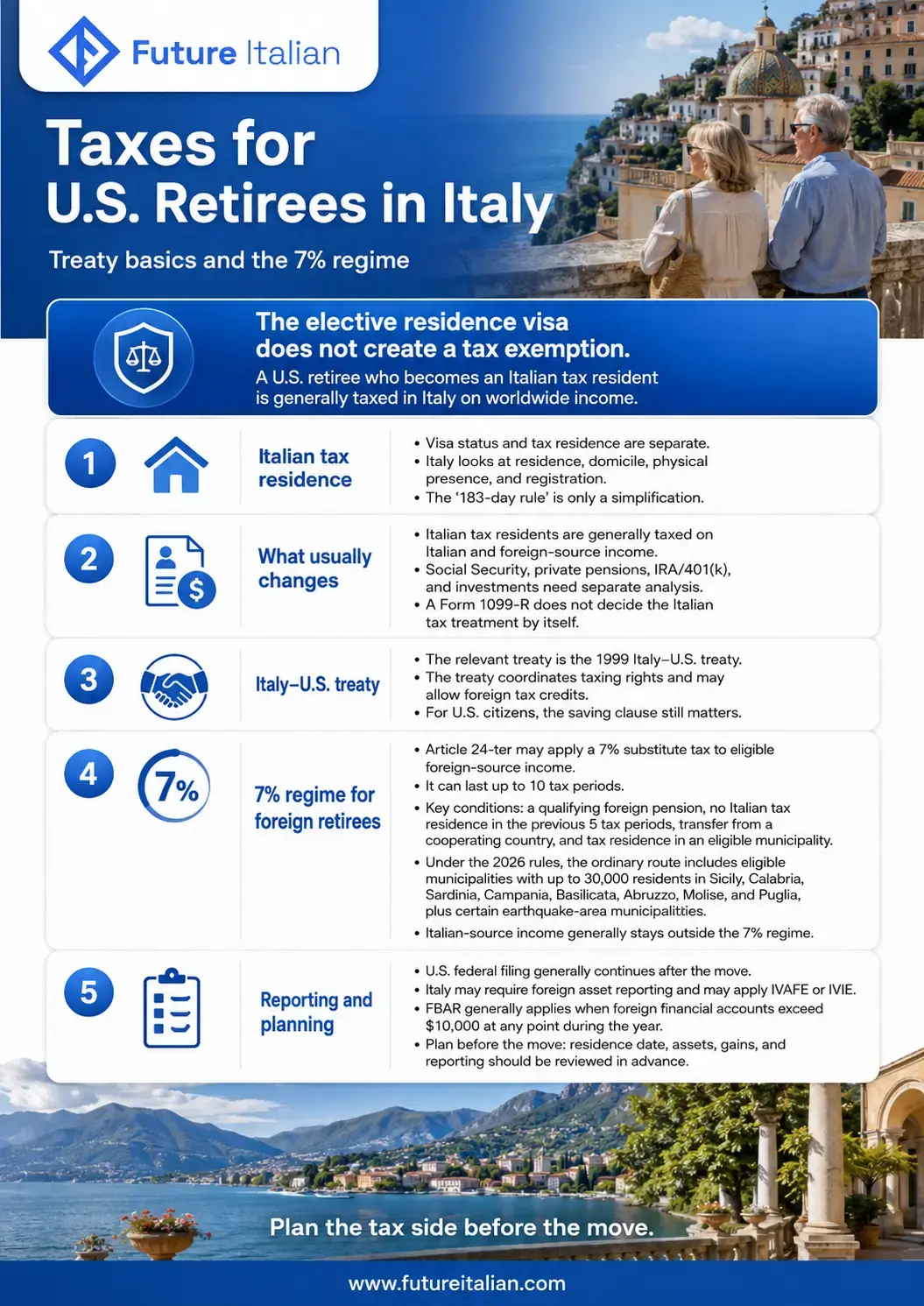
The table summarizes the starting rules for common retirement and investment income. Apply the relevant treaty rule and any valid 7% election to each income stream separately.
| Income or status | Italian starting point | U.S. consequence |
|---|---|---|
| U.S. Social Security: U.S. citizen without Italian citizenship | Residence-country taxation in Italy | U.S. taxation can remain under the saving clause |
| U.S. Social Security: dual U.S.–Italian citizen resident in Italy | Taxable only in Italy under the treaty | Protocol protects the exemption from U.S. taxation of this benefit |
| Private pension, traditional IRA or 401(k) | Generally assess the distribution as taxable pension or other income; 7% may apply if eligible | Citizen-based U.S. tax and credit coordination can remain |
| Roth IRA | A U.S. tax-free withdrawal is not automatically tax-free in Italy | Review contributions, account structure and distribution before withdrawal |
| Government-service pension | Article 19 applies separate payer and nationality rules | Classify separately from private pensions |
| Dividends and interest | Generally taxable in Italy; qualifying foreign-source income may fall under 7% | Source-country withholding and U.S. citizen taxation require credit coordination |
| Capital gains | Italian treatment depends on the asset and source; 7% may apply to qualifying foreign-source gains | U.S. capital-gains rules still need to be coordinated |
| Foreign income covered by Article 24-ter | 7% substitute tax during a valid election | U.S. filing and any remaining U.S. tax must be calculated separately |
The Visa and Tax Residence Are Separate Questions
The Elective Residence Visa authorizes entry and long-term residence in Italy without work. Tax residence is determined separately under Italian tax law by the facts of the relevant calendar year.
Receiving the visa does not automatically make a person tax resident on the issue date. Conversely, a person can satisfy Italian tax-residence tests even before completing every immigration or municipal formality. The timing of the move, physical presence, home, family relations and registration therefore need to be planned together.
When Does Italy Treat a U.S. Retiree as Tax Resident?
Under the current Article 2 of the Italian Income Tax Code, an individual is considered resident for income-tax purposes when, for most of the tax period and counting fractions of a day, at least one of the following conditions applies:
- The person has civil-law residence in Italy.
- The person’s domicile is in Italy, meaning the place where their principal personal and family relations develop.
- The person is physically present in Italy.
- Registration in the resident-population registry for most of the year creates a rebuttable presumption of tax residence.
The familiar “183-day rule” is therefore only a shorthand. Tax residence is not based exclusively on nights spent in Italy, and leap years or fractions of a day can affect the calculation. A retiree who relocates family life and a permanent home to Italy may face a different analysis from someone making an extended visit.
What Italian Tax Residence Usually Changes
An Italian tax resident is generally taxed in Italy on income from both Italian and foreign sources. For an American retiree, the relevant categories may include:
- Social Security and other public benefits.
- Private pensions, annuities, IRA and 401(k) distributions.
- Interest, dividends and investment-fund distributions.
- Capital gains, rental income, royalties and trust distributions.
- Foreign real estate, bank accounts, brokerage accounts and other assets subject to reporting or wealth-type taxes where applicable.
The applicable Italian treatment depends on the legal category of each item, not merely the label used by the U.S. payer. A payment shown on Form 1099-R, for example, still needs to be classified under Italian domestic law and the treaty.
Why U.S. Tax Filing Usually Continues After the Move
U.S. citizens generally remain subject to federal income-tax filing on worldwide income while living abroad. Moving to Italy, registering as an Italian resident or receiving an Italian residence permit does not by itself end that obligation.
The final U.S. tax payable may be reduced by foreign tax credits, treaty rules, exclusions or deductions, depending on the income. Filing and paying are different questions: a return can still be required even when credits reduce the net U.S. liability to zero.
The Foreign Earned Income Exclusion does not cover pension income, Social Security or retirement-account withdrawals such as IRA distributions. Those are not foreign earned income; coordinate the treaty and foreign tax credits instead.
State taxation requires a separate review. Some states continue to treat former residents as domiciled until they establish a sufficient break, and states are not necessarily bound to follow federal treaty treatment.
How the U.S.–Italy Tax Treaty Works
The U.S.–Italy Income Tax Convention signed in 1999 contains separate rules for pensions, Social Security, government service, investment income, real property and relief from double taxation.
The treaty also contains a saving clause that generally preserves the United States’ right to tax its citizens as if the convention did not exist, subject to listed exceptions. This is why a rule assigning primary or exclusive taxation to Italy cannot always be read in isolation for a U.S. citizen.
Article 23 then coordinates relief from double taxation, including U.S. foreign tax credits for qualifying Italian income taxes within domestic-law limits. The practical result depends on source rules, income baskets, timing and whether the same income is recognized in both countries in the same year.
How Common Retirement Income Is Usually Analysed
U.S. Social Security
For a U.S. citizen resident in Italy who is not also an Italian citizen, Italy can tax U.S. Social Security under the residence-country rule, while the U.S. saving clause can preserve U.S. taxation. For a dual U.S.–Italian citizen resident in Italy, U.S. Social Security is taxable only in Italy under the treaty and protocol.
The distinction is explained in the U.S. Treasury’s treaty technical explanation under Article 18 and the saving-clause exceptions. Exclusive Italian taxation of Social Security does not remove unrelated U.S. filing obligations.
Private Pensions, IRA and 401(k) Distributions
Private pension and retirement-account distributions generally require classification under both systems. Italy may tax the payment as pension or other income, while the United States can retain taxing rights over citizens through the saving clause.
Do not assume that an account’s U.S. tax deferral is automatically recognized in Italy. Traditional IRA, Roth IRA, 401(k), pension and annuity arrangements can receive different Italian treatment depending on their legal structure, contributions and distribution history.
Government-Service Pensions
Article 19 contains special rules for remuneration and pensions connected with government service. The payer, the nature of the former employment, residence and nationality can change the result, so a federal, state, military or local-government pension should not be grouped automatically with a private-sector pension.
Dividends, Interest and Capital Gains
Italy generally taxes investment income received by its tax residents, while the United States may impose source-country withholding or citizen-based tax. Treaty limits, Italian rates, foreign tax credits and the character of the account must be coordinated.
Capital gains can be particularly sensitive because Italy and the United States may use different cost bases, holding-period concepts and recognition dates. Selling appreciated securities before or after the move can therefore produce materially different outcomes.
U.S. Rental Property and Real Estate
Income and gains from U.S. real estate can remain taxable in the United States because the property is located there. An Italian tax resident may also need to report the income and asset in Italy, with treaty relief and foreign tax credits used to reduce double taxation where available.
Depreciation, deductible expenses and gain calculations differ between the two systems. Figures copied directly from a U.S. return are not always the correct figures for the Italian return.
Italy’s 7% Tax Regime for Foreign Pensioners: How It Works
Article 24-ter of the Italian Income Tax Code allows eligible foreign pensioners who become Italian tax residents to elect a 7% substitute tax on qualifying foreign-source income. It is often described as Italy’s 7% flat tax for retirees, although “substitute tax regime for foreign pensioners” is the more precise legal description.
The regime is separate from immigration status. An Elective Residence Visa holder may qualify, but the visa does not grant the tax benefit and a person using another lawful residence route may also qualify if every tax condition is satisfied.
Who Qualifies for the Article 24-ter Regime?
The principal statutory conditions require the taxpayer to:
- Receive qualifying pension income paid by a foreign entity.
- Transfer tax residence to Italy after not having been Italian tax resident during the previous five tax periods.
- Move from a country or territory that has an administrative-cooperation arrangement with Italy.
- Establish tax residence in a municipality that satisfies the territorial and population requirements.
Not every payment called a pension in the United States necessarily receives the same Italian classification. Social Security, private pensions, government-service pensions, annuities, IRA distributions and 401(k) withdrawals should be reviewed separately before relying on them as the qualifying foreign pension.
Which Italian Municipalities Qualify?
Under the 2026 rules, the ordinary route covers municipalities with no more than 30,000 residents in Sicily, Calabria, Sardinia, Campania, Basilicata, Abruzzo, Molise and Puglia. For the 2016–2017 Central Italy earthquake route, the limit remains 3,000 residents and the town must appear in the statutory annexes to Decree-Law 189/2016.
Eligibility should be verified for the exact municipality before signing a lease, purchasing property or registering residence. Being located in an eligible region is not enough by itself, and population data or the statutory list applicable to the relocation year can be decisive. For a practical location comparison, see our guide to affordable Italian towns for retirees.
Which Income Is Taxed at 7%?
The substitute tax is not limited to the foreign pension used to enter the regime. Once eligible, the taxpayer can generally apply the 7% rate to qualifying foreign-source income of any category, subject to the source rules and the scope of the election.
- Foreign pension and annuity income.
- Foreign dividends, interest and investment-fund distributions.
- Foreign capital gains and income from securities or financial assets.
- Foreign rental income, royalties, trust distributions and other qualifying foreign-source income.
Italian-source income remains outside the substitute-tax base and is generally taxed under the ordinary rules. The taxpayer may also exclude income arising in one or more foreign states or territories from the election, causing that income to return to ordinary Italian taxation and the applicable foreign-tax-credit rules.
For a U.S. citizen, the 7% Italian rate does not end U.S. filing or automatically eliminate U.S. tax. The treaty, saving clause, source-country tax and availability of foreign tax credits must still be coordinated for each income category.
How Long Does the 7% Regime Last and How Is It Elected?
The option is effective for the tax period in which Italian residence is transferred and for the following nine tax periods, for a maximum of ten tax periods, provided the taxpayer remains eligible and does not revoke or lose the regime.
The election is made in the Italian income-tax return for the year in which the option becomes effective. The 7% substitute tax is paid in a single amount using the applicable payment procedure and tax code 1899; deadlines and filing mechanics should be confirmed for the relevant tax year.
When Is the 7% Regime Advantageous?
The regime can be valuable for retirees with substantial foreign pensions, investments or property income, but a 7% headline rate is not automatically the best result. Ordinary deductions, treaty positions, foreign tax credits, losses, asset-reporting consequences and the taxpayer’s expected income mix can materially change the comparison.
The analysis should be completed before the move because the residence date, chosen municipality, asset sales and first Italian return determine whether the option can be used effectively. The tax plan must also remain consistent with the passive-income evidence presented for the Elective Residence Visa.
A simple 7% example
If €100,000 of foreign-source income is fully covered by a valid Article 24-ter election, the Italian substitute tax is €7,000. This illustrates the Italian calculation only: it does not include tax on Italian-source income or any U.S. liability that remains after treaty and credit analysis.
Is the 7% Pensioner Regime the Same as the Impatriate Regime?
No. The 7% substitute-tax regime under Article 24-ter is designed for qualifying recipients of foreign pension income who transfer tax residence to an eligible municipality. It can cover qualifying foreign-source income for up to ten tax periods and does not require the taxpayer to work in Italy.
The impatriate tax regime under Article 5 of Legislative Decree No. 209/2023 is a worker-focused incentive for qualifying employment, equivalent employment and professional self-employment income produced in Italy. Because the Elective Residence Visa does not permit work, the impatriate regime is generally not relevant while the person remains on that immigration route.
Using “impatriate regime” as another name for the 7% pensioner regime is therefore legally and practically incorrect. A person who later changes immigration status and begins qualifying work in Italy would need a separate eligibility analysis under the rules applicable at that time.
Italian Foreign-Asset Reporting and Wealth Taxes
Italian tax residents generally need to assess foreign-asset reporting in the RW section of the Italian return. Relevant assets can include foreign bank and brokerage accounts, real estate, financial investments, certain insurance products, trusts and other interests held outside Italy.
Foreign financial assets may also trigger IVAFE, and foreign real estate may trigger IVIE, subject to specific valuation, exemption and credit rules. Reporting can be required even when an asset produces no income or no tax is ultimately payable.
A valid Article 24-ter election provides exemption from Italian foreign-asset monitoring in quadro RW and from IVIE and IVAFE for assets in jurisdictions included in the option. If you exclude a country, assets held there remain subject to the ordinary reporting and tax rules.
The scope of the exemption is explained in Agenzia delle Entrate Circular 21/E of 17 July 2020, section 6. Your Italian return still needs the election and any other required income reporting; U.S. FBAR and Form 8938 obligations are separate.
U.S. Foreign-Account and Asset Reporting
Opening Italian bank or investment accounts can create additional U.S. reporting. An FBAR is generally required when the aggregate value of reportable foreign financial accounts exceeds $10,000 at any time during the calendar year.
Form 8938 may also apply at separate thresholds. Foreign trusts, companies, partnerships, funds and gifts can trigger additional forms, including Forms 3520, 5471, 8621, 8858 or 8865, depending on the structure.
Many European pooled investment funds can be classified as passive foreign investment companies for U.S. purposes, creating complex reporting and potentially punitive tax treatment. Investment products should therefore be reviewed before a U.S. citizen buys them after moving.
Tax Planning Before Moving to Italy
The most useful planning usually occurs before the Italian tax-residence starting date. A pre-move review should identify:
- The expected Italian residence date and any split-year limitations.
- Every pension, retirement account, annuity, trust and investment account.
- Unrealized gains, cost-basis differences and planned asset sales.
- U.S. state domicile and the steps needed to terminate it where appropriate.
- Eligibility for the 7% pensioner regime or another Italian new-resident regime.
- Italian and U.S. reporting generated by accounts, entities and estate-planning structures.
The visa file and tax plan should also be consistent. A financial arrangement described as stable passive income for immigration purposes must still be classified and reported correctly for tax purposes after the move.
Common Tax Mistakes by American Retirees in Italy
- Assuming that the Elective Residence Visa itself provides a tax exemption.
- Using only the 183-day count and ignoring domicile, residence and fractions of a day.
- Believing the treaty automatically eliminates U.S. filing or all double taxation.
- Treating every Form 1099-R payment as if it received identical Italian treatment.
- Moving to a southern municipality without confirming eligibility for the 7% regime.
- Failing to report foreign accounts and assets in one or both countries.
The Tax Plan Must Be Built Before the Move
For a U.S. retiree, Italy can offer favourable tax outcomes, including the 7% regime in qualifying cases, but no result follows automatically from holding the Elective Residence Visa. Residence timing, treaty classification, citizenship, income source and asset structure all matter.
The defensible approach is to model the Italian and U.S. consequences together before relocating, then maintain coordinated filings after arrival. That prevents the immigration strategy from creating an avoidable tax and reporting problem.
Frequently Asked Questions
Sources
- 1Italian Income Tax Code, Article 2 — Tax Residence
normattiva.it
- 2
- 3Agenzia delle Entrate: Circolare 21/E del 17 luglio 2020
agenziaentrate.gov.it
- 4
- 5
- 6