

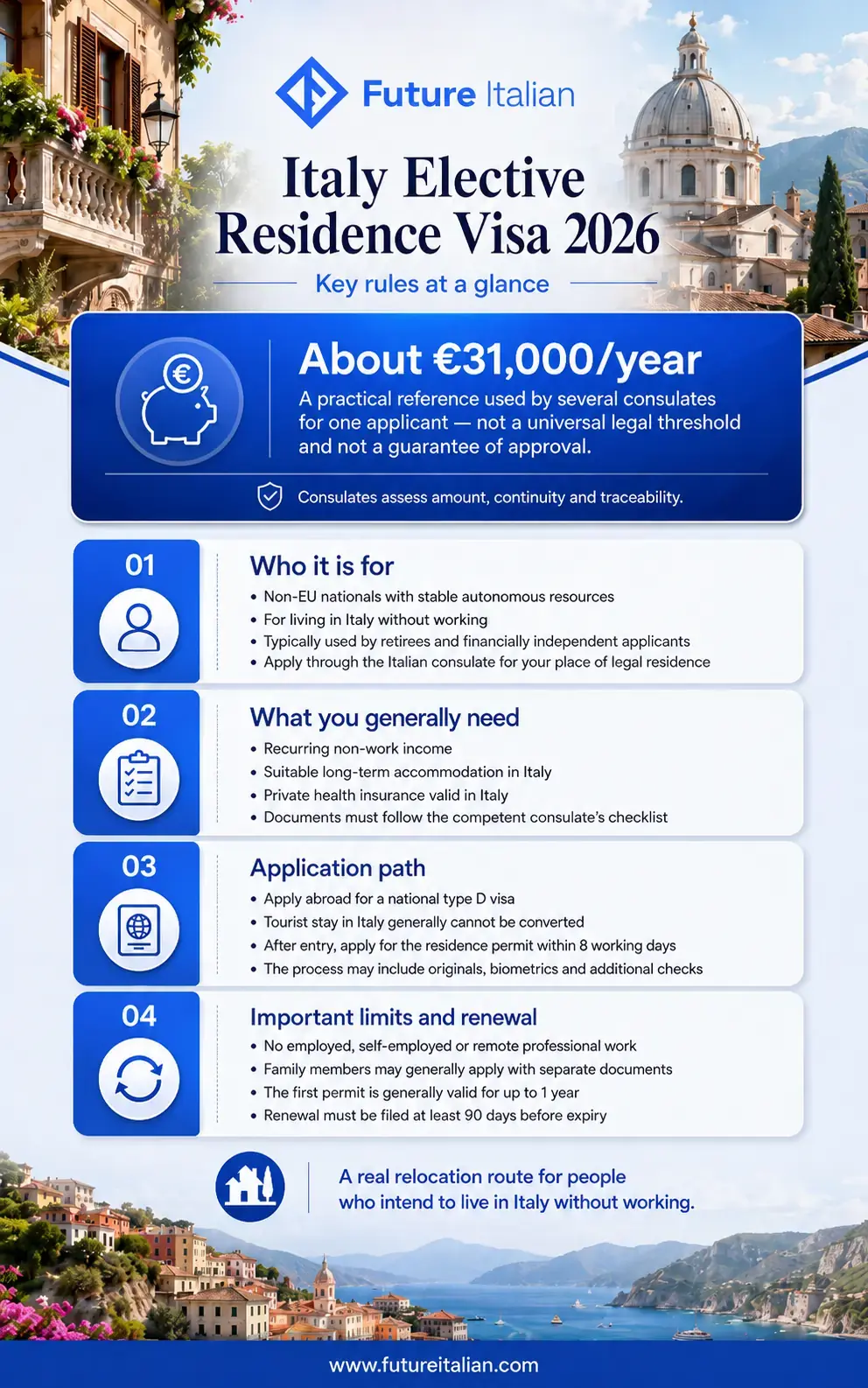
Italy’s Elective Residence Visa lets non-EU citizens live in Italy without working, using stable pensions or other independent recurring income. Plan around at least €31,000 a year for one applicant as a published consular benchmark, plus suitable long-term housing and comprehensive health insurance. Apply at the Italian consulate responsible for your legal residence.
The income figure is a starting point: Boston asks for more than €31,000 for each applicant, and family applications need higher resources. Follow your own consulate’s checklist and show where the income comes from, how regularly it is paid and why it will continue. Future Italian’s Elective Residence Visa service helps organize this evidence and the application.
| Question | Quick answer |
|---|---|
| How much income? | About €31,000 a year for one applicant; follow your consulate’s published rule |
| Can I work or work remotely? | No |
| Must I buy a property? | No; a qualifying registered long-term lease can be used |
| Visa fee | €116, or the consulate’s local-currency equivalent |
| Visa decision | Allow up to 90 days after filing; appointment waiting is separate |
| First residence permit | Usually up to one year |
| After entering Italy | Apply for the permit within eight working days |
| Renewal | Request at least 90 days before expiry |
How to Apply for Italy’s Elective Residence Visa
- 1
Confirm that elective residence matches your plans
Verify that you intend to live in Italy without employment, self-employment or remote professional activity.
- 2
Identify the responsible Italian consulate
Apply through the embassy or consulate with territorial jurisdiction over your legal residence and obtain its current checklist.
- 3
Build a documented income profile
Collect evidence showing the source, amount, ownership, payment history and expected continuity of each passive-income stream.
- 4
Secure suitable accommodation in Italy
Arrange housing that satisfies the consulate’s requirements, normally through property ownership or a qualifying registered lease.
- 5
Obtain compliant health insurance
Purchase medical coverage valid in Italy only after checking the duration, territory, limits and wording required by the consulate.
- 6
Prepare and submit the national visa application
Complete the forms, translations and legalizations required for your case and attend the consular appointment with originals and copies.
- 7
Apply for the residence permit after arrival
Submit the elective-residence permit application within eight working days and attend the Questura appointment for identification and fingerprints.
- 8
Maintain the conditions for renewal
Continue to document income, accommodation, insurance and genuine residence in Italy, and prepare the renewal application before the permit expires.
Italy Elective Residence Visa at a Glance
The Elective Residence Visa is intended for people who plan to make Italy their principal home and can support themselves without employment or self-employment.
- Applicant: a non-EU citizen who requires a national visa for a stay exceeding 90 days.
- Purpose: stable residence in Italy, not tourism or a temporary trial stay.
- Income: substantial, stable and autonomous resources not dependent on future work.
- Housing: suitable accommodation in Italy, usually demonstrated through ownership or a qualifying rental arrangement.
- Insurance: comprehensive medical coverage valid in Italy, according to the responsible consulate’s checklist.
- Work: employment and self-employment are not permitted under this immigration route.
- After arrival: application for an elective-residence permit within eight working days.
Who Can Apply for Italy’s Elective Residence Visa?
The visa is commonly used by retirees and financially independent applicants who receive reliable income from abroad. Age is not itself the legal test: the decisive issue is whether the applicant can demonstrate a durable financial position compatible with permanent residence in Italy without working.
Potentially suitable income sources include:
- Public or private pension payments.
- Annuities or comparable contractual payments.
- Rental income supported by ownership records, leases, tax documents and payment history.
- Dividends, interest or investment distributions that are regular, documented and sustainable.
- Royalties or other recurring non-employment income, where clearly evidenced.
The source matters as much as the amount. A large cash balance may strengthen an application, but savings alone may not demonstrate the recurring income expected by the consulate. Our dedicated guide on the Elective Residence Visa for passive-income earners explains how different income streams are usually documented.
How Much Income Is Required?
Several consulates publish approximately €31,000 a year for one applicant; Boston expressly requires more than that amount for each person. The visa requires substantial independent resources, so the published figure is a practical application benchmark rather than an automatic approval rule.
See Boston’s official income and document checklist for a concrete example. Use the requirements of the consulate responsible for your own residence.
A strong financial file normally demonstrates three separate points:
- Amount: the income is sufficient for the applicant’s household and intended lifestyle in Italy.
- Continuity: payments are recurring and reasonably expected to continue after relocation.
- Traceability: the source, ownership, payment history and tax treatment can be verified through consistent records.
Applicants should avoid building the case around a single recent transfer, an unexplained account balance or projected income that has not yet started. Consulates may request additional evidence even when the applicant exceeds a benchmark.
Accommodation Requirements in Italy
Applicants must show that they have suitable accommodation for the intended residence in Italy. A property deed or a registered long-term lease is generally the clearest evidence, although the precise form, duration and supporting documents vary by consulate.
A hotel booking or short holiday rental is often inconsistent with the purpose of establishing permanent residence. Before signing a lease, applicants should confirm that the contract can be registered, covers the household included in the application and satisfies the responsible consulate’s current instructions.
Housing costs differ substantially between cities and regions. Our 2026 cost-of-living guide for Elective Residence Visa holders helps applicants estimate a realistic relocation budget without treating the visa-income benchmark as a complete living budget.
Health Insurance Requirements
The visa application normally requires private health insurance that is valid in Italy and provides comprehensive medical and hospitalization coverage. Required duration, territorial wording, exclusions and minimum coverage may differ between consulates, so the policy should be checked against the current local checklist before purchase.
Short-trip travel insurance may be inadequate for a long-stay visa. After arrival, eligible elective-residence holders can apply for voluntary SSN enrollment when they are not entitled to mandatory enrollment. The ordinary annual contribution is income-based with a minimum of €2,000 under Law 213/2023. Confirm your entitlement and amount with the ASL; keep the visa-stage private policy until your new coverage takes effect.
Documents Required for the Application
The final checklist is issued by the consulate with jurisdiction over the applicant’s legal residence. A complete application commonly includes:
- National visa application form and compliant passport photographs.
- Valid passport and evidence of legal residence within the consular jurisdiction.
- Personal statement explaining the permanent relocation plan and confirming that no work will be performed.
- Tax returns, pension letters, brokerage statements, bank statements, leases, payment records and other evidence supporting each income source.
- Proof of accommodation in Italy.
- Private health-insurance policy and coverage certificate.
- Civil-status documents for an accompanying spouse or children, where applicable.
- Consular fee and any additional documents requested by the office.
Foreign civil documents may require an apostille or other legalization and an Italian translation, but not every financial document is automatically subject to the same formalities. The applicant should follow the specific checklist rather than legalizing every document by default.
Applicants filing in the United States should also read our Elective Residence Visa guide for retired Americans, which addresses U.S. pensions, retirement accounts, brokerage evidence and consular jurisdiction.
Application Process
The process starts outside Italy. The applicant files for a Type D national visa at the Italian embassy or consulate responsible for the place of legal residence; the application cannot normally be converted from tourist status inside Italy.
Consulates may require an in-person appointment, biometric data, original documents and an interview. They may also request supplementary evidence or verify the source and continuity of funds. Approval remains discretionary even when a checklist is formally complete.
After the visa is issued, the applicant enters Italy and applies for the corresponding residence permit within eight working days. The permit process generally includes the postal application kit where applicable, an appointment at the Questura, fingerprinting and production of original documents.
Elective Residence Visa vs Residence Permit
The Elective Residence Visa and the elective-residence permit are related but legally distinct. The visa is issued by an Italian consular authority abroad and authorizes entry for the approved purpose; the residence permit is requested after arrival and authorizes the continuing stay in Italy.
Visa approval does not eliminate the post-arrival procedure. The applicant must enter within the visa’s validity, start the permit application within eight working days, attend the Questura appointment and continue meeting the income, housing, insurance and no-work conditions during residence.
| Stage | Authority | Main purpose |
|---|---|---|
| National visa application | Italian embassy or consulate abroad | Assess eligibility and authorize entry |
| Entry into Italy | Border authorities | Confirm lawful entry under the issued visa |
| Residence-permit application | Postal system and Questura, where applicable | Authorize continuing residence in Italy |
| Annual renewal | Questura | Confirm that the original conditions still exist |
A Realistic Application Timeline
The process should be planned backwards from the intended relocation date. Financial records, civil documents, insurance and housing often take longer to organize than the visa form itself, and an appointment may not be immediately available.
A practical sequence is to verify jurisdiction and the current checklist first, then stabilize the income evidence, secure acceptable accommodation, purchase compliant insurance, complete any required apostilles or translations and only then attend the consular appointment. Non-refundable travel and relocation commitments should account for possible requests for supplementary documents.
| Stage | What to plan |
|---|---|
| Prepare the file | Collect established income records, suitable housing and insurance before the appointment |
| Consular appointment | Availability depends on the office; book through its official system |
| Visa decision | Up to 90 days after filing, separate from appointment waiting |
| Entry and permit | Begin the permit application within eight working days |
| Questura and card | Attend the scheduled appointment; timing depends on the office |
After approval, the applicant must coordinate entry, the residence-permit filing, municipal registration where applicable and the first year’s tax and healthcare decisions. A successful consular application is therefore the beginning of the relocation process rather than its final administrative step.
Processing Times and Costs
Allow up to 90 days for the visa decision after a complete application is filed. This does not include waiting for an appointment or preparing the financial, housing and insurance evidence. The residence-permit appointment and card are a later stage handled in Italy.
Government fees for one adult applying for a first permit of up to one year:
| Charge | Amount |
|---|---|
| National visa | €116 |
| Residence-permit revenue stamp | €16 |
| Postal submission | €30 |
| Electronic residence-permit card | €30.46 |
| Permit contribution: over three months, up to one year | €40 |
| Visa plus first permit: indicative official total | €232.46 |
The visa amount is published by the Italian Consulate in Paris; the permit breakdown comes from the government’s residence-permit guidance.
Insurance, rent and deposits, translations, apostilles and any professional assistance are additional. The visa is paid in the currency and method accepted by the consulate; permit charges depend on duration and any applicable exemption.
Can Family Members Apply?
A spouse and qualifying dependent children may generally apply together with the principal applicant, but each person requires the appropriate application and supporting documents. The household must demonstrate higher financial resources, suitable accommodation and health coverage for all applicants.
Marriage and birth certificates may need apostille or legalization and Italian translation. Consular practice differs on income calculations and dependent children, especially for adult children, so the family structure should be reviewed before applications are filed.
Can You Work on an Elective Residence Visa?
No. The Elective Residence Visa and the resulting permit are designed for residence supported by independent resources, not for employment, freelancing, consulting or operating an active business in Italy.
A person who intends to continue remote professional activity should assess the Italy Digital Nomad Visa instead. Applicants who genuinely intend to study may consider the University Student Visa, while investors who can satisfy a qualifying statutory investment may evaluate the Italian Golden Visa. These routes have different requirements and should not be used merely to bypass the Elective Residence Visa rules.
Residence Permit, Renewal and Time Outside Italy
The initial elective-residence permit is generally issued for up to one year and may be renewed if the original conditions continue to exist. Renewal commonly requires updated proof of autonomous resources, accommodation, insurance and actual residence in Italy.
Article 5(4) of the Immigration Code, amended by Legislative Decree 83/2026, requires the renewal request at least 90 days before the residence permit expires. Prepare early, especially if you need documents from abroad.
Extended or repeated absences can undermine renewal and later long-term residence or citizenship plans. An Elective Residence Visa is intended for genuine settlement in Italy, not as a renewable document for occasional visits.
Travel Within the Schengen Area
A valid Italian residence permit and passport generally allow short visits to other Schengen countries under the applicable 90-days-in-180 rule. They do not automatically grant the right to move permanently, work or establish residence in another Schengen state.
Tax Residence and Special Tax Regimes
The visa does not itself determine tax residence, but a person who relocates to Italy may become Italian tax resident under domestic rules. Tax residence can create Italian reporting and taxation obligations concerning worldwide income and foreign assets, subject to treaties and any applicable special regime.
U.S. applicants should review our guide to the U.S.–Italy tax treaty and 7% pensioner regime before relocating. The 7% substitute-tax regime may be available to eligible recipients of foreign pensions who transfer tax residence to a qualifying municipality, while high-net-worth individuals may consider the separate new-resident lump-sum regime. Immigration eligibility and tax eligibility remain separate analyses.
Common Reasons for Refusal
An application can be refused when the consulate is not satisfied that the applicant meets the purpose and conditions of elective residence. Recurring risk areas include:
- Income that is too low, irregular, recently created or dependent on future work.
- Unexplained deposits, inconsistent figures or weak evidence linking the applicant to the income source.
- Reliance on savings without a convincing recurring-income structure.
- Accommodation that appears temporary, unregistered or unsuitable for the household.
- Insurance that does not meet the responsible consulate’s requirements.
- A relocation plan suggesting remote work, active business activity or only intermittent residence in Italy.
- Missing, expired, untranslated or improperly legalized documents where formalities are required.
For a deeper review of avoidable weaknesses, see our guide to common Elective Residence Visa refusal risks. A prior refusal does not automatically prevent a new application, but the stated grounds should be addressed with new or stronger evidence rather than resubmitting the same file.
What to Do After a Visa Refusal
A refusal should be analysed against the written grounds rather than treated as a generic rejection. The correct response may be a new application with materially stronger evidence, an administrative or judicial challenge where legally available, or selection of a different immigration route when the original purpose is incompatible with elective residence.
Resubmitting the same financial narrative, insurance policy or housing evidence rarely resolves the problem. The applicant should identify whether the consulate questioned sufficiency, continuity, source of funds, credibility of the relocation plan, document formalities or the intention not to work, then address that specific weakness.
From Elective Residence to Long-Term Residence and Citizenship
Elective residence can form part of a long-term immigration plan, but neither permanent status nor citizenship is automatic. After five years of qualifying legal and continuous residence, a non-EU national may be eligible to apply for the EU long-term residence permit if the statutory income, language, accommodation and continuity requirements are met.
A non-EU citizen may generally apply for Italian citizenship after ten years of legal residence, subject to the full legal requirements and a discretionary administrative assessment. Our guide from the Elective Residence Visa to Italian citizenship explains the milestones, while the broader Italian citizenship by residency guide covers the naturalization requirements in detail.
Final Checklist Before Filing
Before the appointment, confirm that the application tells one consistent story across the form, personal statement and supporting documents:
- The competent consulate and its current checklist have been verified.
- Every income source is traceable, recurring and reconciled with tax and bank records.
- Housing and insurance satisfy the responsible office’s wording and duration requirements.
- Civil documents have the required apostille, legalization and Italian translation where applicable.
- The relocation plan is compatible with permanent residence in Italy and contains no intended employment or remote work.
- The household has planned the permit, renewal, tax and healthcare steps that begin after entry.
Completeness is not measured by the number of pages. The strongest file is the one in which each document supports a clear requirement and no material figure or intention contradicts another part of the application.
The Elective Residence Visa is therefore best treated as a genuine relocation route for financially independent people who intend to live in Italy without working. A successful application depends on a coherent combination of recurring income, credible housing, compliant insurance and a long-term residence plan. Meeting a single financial threshold is insufficient.
Frequently Asked Questions
Sources
- 1Consulate General of Italy in New York — Elective Residency Visa
consnewyork.esteri.it
- 2Consulate General of Italy in Los Angeles — Elective Residency Visa
conslosangeles.esteri.it
- 3Consulate General of Italy in Boston — Elective Residency Visa
consboston.esteri.it
- 4
- 5Legislative Decree No. 83/2026 — Residence Permit Renewal Timing
gazzettaufficiale.it
- 6Italian Consulate in Paris
consparigi.esteri.it