
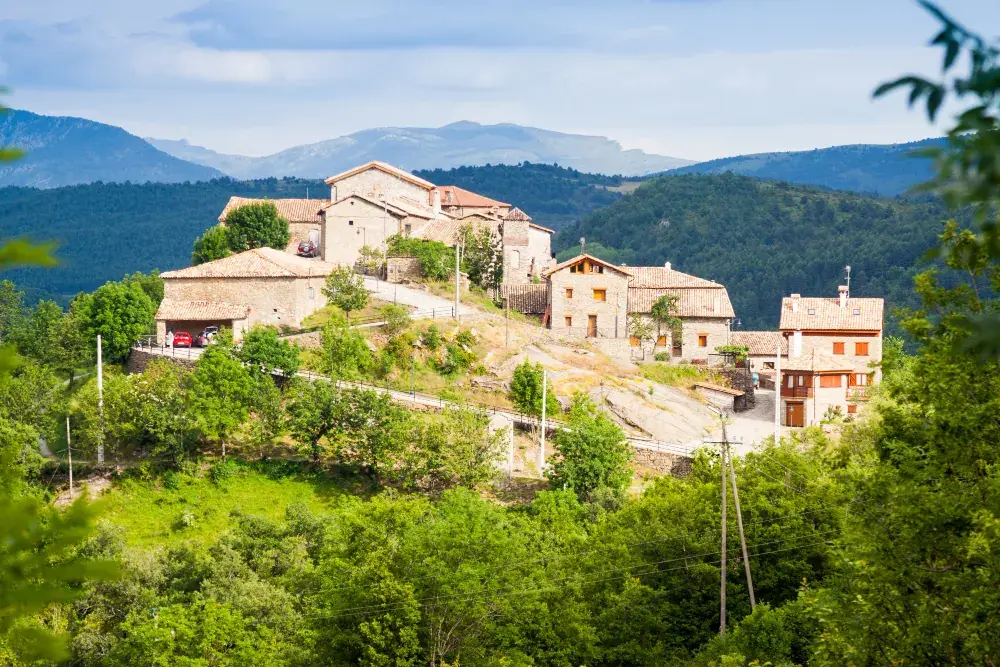
For retirees seeking lower housing costs in Italy, start by comparing Enna, Melfi and Isernia with better-connected alternatives such as Iglesias and Sulmona. The published rental benchmarks below put a notional 60 m² apartment at about €317–761 a month across these five towns. They give you a concrete starting point before the wider 24-town shortlist.
The cheapest property is not necessarily the cheapest place to live. A remote house may require two cars, expensive heating, frequent medical travel or major renovation, while a moderately priced town with a hospital, railway station and year-round rental market may produce a lower total cost.
How to read the comparison: we multiplied Immobiliare.it’s published residential asking rent per square metre by 60 m² and rounded to the nearest euro. Reference months are shown in each row; data were checked on 6 October 2026. These are city-level asking-price estimates, not quotations for an available apartment or proof of a registered annual lease. Utilities, condominium charges and other household costs are additional.
| Town | Region | Asking rent per m²/month | 60 m² estimate/month | Data month |
|---|---|---|---|---|
| Enna | Sicily | €5.29 | €317 | September 2026 |
| Melfi | Basilicata | €5.59 | €335 | September 2026 |
| Isernia | Molise | €7.06 | €424 | August 2026 |
| Iglesias | Sardinia | €7.84 | €470 | August 2026 |
| Sulmona | Abruzzo | €12.68 | €761 | September 2026 |
Original rental-market data: Enna · Melfi · Isernia · Iglesias · Sulmona
A low benchmark is useful only if a suitable home is available. Compare annual leases, heating, transport and hospital access before treating the rent estimate as your relocation budget.
Small rental samples can move sharply from month to month: the market pages showed only three advertised rentals in Iglesias and nine in Sulmona when checked. Use these benchmarks to compare towns, then inspect current listings before deciding what rent you can obtain.
This guide compares locations rather than calculating a complete household budget. Monthly expenditure is covered in the cost of living in Italy for Elective Residence Visa holders, while visa eligibility is explained in the Italy Elective Residence Visa complete guide.
What Makes an Italian Town Affordable for a Retiree?
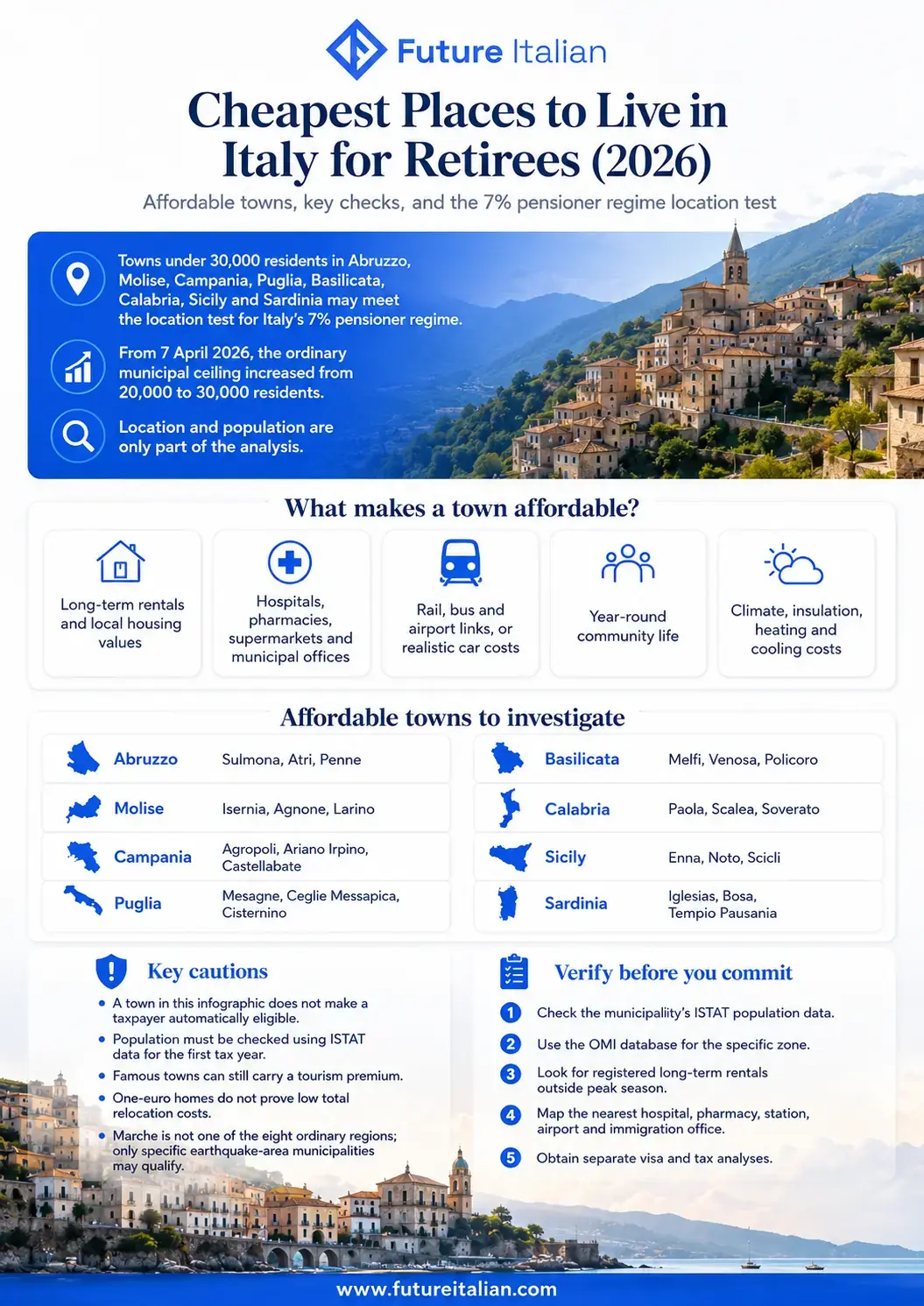
Affordability should be measured across the full year and against the life the resident will actually lead. The comparison in this guide gives weight to five factors:
- Long-term rental availability and local housing values, not short holiday prices.
- Access to hospitals, pharmacies, supermarkets and municipal offices.
- Rail, bus and airport connections, or the realistic cost of owning a car.
- Year-round community life rather than a town that closes after the tourist season.
- Climate, insulation and the likely cost of winter heating or summer cooling.
ISTAT household-spending data are useful for comparing broad regions, while the Agenzia delle Entrate OMI database is more useful for checking a specific municipality and neighbourhood. Neither source replaces an inspection of the actual property and local rental market.
Best Affordable Towns at a Glance
The southern towns in this shortlist fall within the 30,000-resident ceiling that applies in the eight ordinary Article 24-ter regions: Sicily, Calabria, Sardinia, Campania, Basilicata, Abruzzo, Molise and Puglia. The separate Central Italy earthquake route has a 3,000-resident ceiling. The shortlist considers housing, services and transport; an affordable town does not automatically qualify you for the tax regime.
| Region | Towns to investigate | Best suited to | Main trade-off |
|---|---|---|---|
| Abruzzo | Sulmona, Atri, Penne | Services, nature and access to coast or mountains | Cold winters and car dependence outside town centres |
| Molise | Isernia, Agnone, Larino | Low housing costs and quiet inland life | Smaller rental market and limited transport |
| Campania | Agropoli, Ariano Irpino, Castellabate | Coastal access or a functional inland town | Seasonal prices on the coast |
| Puglia | Mesagne, Ceglie Messapica, Cisternino | Historic centres, airports and Mediterranean lifestyle | Tourist premium in the Valle d’Itria |
| Basilicata | Melfi, Venosa, Policoro | Lower density and practical small-town living | Car use and fewer specialist services |
| Calabria | Paola, Scalea, Soverato | Coastal life with lower entry costs than major resort areas | Seasonal rentals and uneven services |
| Sicily | Enna, Noto, Scicli | Climate, culture and varied housing markets | Tourism and infrastructure vary sharply |
| Sardinia | Iglesias, Bosa, Tempio Pausania | Distinctive island communities and smaller-town costs | Flights, ferries and specialist healthcare travel |
A famous town is not necessarily a bargain. Noto, Scicli, Cisternino, Castellabate and Bosa can satisfy the population screen while still carrying a tourism premium in the historic centre or during high season.
Abruzzo: The Strongest Balance of Services and Nature
Sulmona is one of the most practical choices for a retiree who wants a genuine town rather than an isolated village. It has shops, healthcare, rail connections and access to the Majella and Abruzzo national parks, while remaining substantially smaller than the regional capitals.
Atri and Penne offer quieter historic centres and access to the Adriatic side of the region. They can provide better housing value than coastal resorts, but residents should test winter heating costs and the time required to reach hospitals, airports and railway stations.
All three towns sit within an ordinary Article 24-ter region and were below the current population ceiling when checked. That satisfies only the geographic screen, not the taxpayer-level requirements.
Molise: Low Costs with a Smaller Service Network
Isernia is the most functional Molise option on this shortlist. It offers a hospital, rail access and a broader range of daily services than the region’s smaller villages while remaining below the 30,000-resident threshold.
Agnone and Larino are better suited to residents who prioritize quiet, space and lower housing costs over transport frequency. Their limited long-term rental supply means that a low advertised price may not translate into an immediately available visa-compliant lease.
Campania: Look Beyond Naples and the Amalfi Coast
Agropoli offers rail connections, coastal living and year-round services without the price level of the most famous Amalfi Coast destinations. Demand rises in summer, so the availability and price of a registered annual lease should be tested outside the holiday market.
Ariano Irpino is an inland alternative with a larger service base and generally less tourist pressure. Castellabate offers exceptional coastal quality of life, but the historic and seaside areas can be expensive relative to other towns on this list and may require a car.
Puglia: Strong Value, but Tourist Towns Need Careful Screening
Mesagne is one of the most practical Puglia candidates because it combines a historic centre with rail access and proximity to Brindisi airport. It is less internationally famous than the Valle d’Itria towns, which can make the year-round housing market more functional.
Ceglie Messapica can offer a better price-to-lifestyle balance than the region’s best-known coastal destinations. Cisternino is attractive and remains below the population ceiling, but its international profile and seasonal demand mean it should not be described automatically as cheap.
Puglia recorded one of Italy’s lowest regional household-spending levels in the latest ISTAT comparison used for this cluster. Local differences remain decisive: a restored home in a tourist centre can cost more than a conventional apartment in a larger nearby town.
Basilicata: Affordable Inland Towns and a Small Coastal Market
Melfi and Venosa provide historic settings, ordinary local services and housing markets that are generally less exposed to international tourism. They suit residents comfortable with inland life and regular car use.
Policoro is the coastal alternative, with a flatter layout and a broader range of modern services than many small inland municipalities. Summer demand can affect rental availability, but it remains a more practical base than a very small beach village.
Matera may be in an ordinary Article 24-ter region, but it exceeds the municipal population ceiling and should not be assumed eligible merely because it is in Basilicata. The test applies to the exact municipality.
Calabria: Coastal Affordability with Seasonal Variations
Paola combines a railway station, coastal access and a functioning year-round town. It can be more practical for a retiree than a remote village because daily services and intercity connections reduce dependence on a car.
Scalea offers a larger supply of apartments and a lower-cost entry point than many nationally known coastal destinations, but some properties and neighbourhoods are highly seasonal. Soverato is smaller and serviceable, although demand near the sea can make the best locations more expensive than regional averages suggest.
Sicily: The Widest Range of Affordable and Tourist Markets
Enna is the strongest functional-value candidate in this section. Its inland location avoids much of the coastal tourism premium, while the town provides administrative, educational and healthcare services that are unavailable in very small villages.
Noto and Scicli are more visually famous and can offer an excellent lifestyle, but restored historic properties and central locations may be expensive. Their inclusion is based on population and quality-of-life potential, not on a claim that every part of either town is among Sicily’s cheapest.
Sardinia: Lower-Cost Towns Away from the Premium Resorts
Iglesias offers a useful combination of hospital access, rail connections and lower housing costs than the island’s premium coastal markets. It is a stronger practical base than an isolated village for residents who expect regular medical or administrative appointments.
Bosa provides historic character and coastal access, while Tempio Pausania offers an inland service town in northern Sardinia. Both require careful planning for airports, ferries and specialist healthcare; island travel can offset part of the housing saving.
How Italy’s 7% Pensioner Regime Changes the Shortlist
Article 24-ter allows qualifying recipients of foreign pensions to elect a 7% substitute tax on qualifying foreign-source income. From 7 April 2026, the ordinary municipal population ceiling increased from 20,000 to 30,000 residents, widening the number of potentially eligible locations. The regime is explained in detail in our guide to Italy’s 7% pensioner regime and U.S. tax rules.
The ordinary territorial route covers qualifying municipalities in Sicily, Calabria, Sardinia, Campania, Basilicata, Abruzzo, Molise and Puglia. Certain municipalities affected by the 2009 and 2016 earthquakes can qualify through a separate statutory route, including locations outside those eight regions.
A town appearing in this article does not make the taxpayer eligible automatically. The person must also receive qualifying foreign pension income, satisfy the prior non-residence condition, transfer Italian tax residence from a cooperating jurisdiction, exercise the option correctly and meet every other Article 24-ter requirement.
Population must be checked using the ISTAT data applicable to the first year of the option. Municipal populations and territorial classifications can change, so a shortlist prepared months before the move is not a final tax eligibility opinion.
Can Towns in Marche Qualify for the 7% Regime?
Marche is outside the eight ordinary Article 24-ter regions. For the special route covering the 2016–2017 Central Italy earthquake areas, the municipality must appear in Annex 1, 2 or 2-bis to Decree-Law 189/2016 and have no more than 3,000 residents.
Camerino and Offida exceed this 3,000-resident ceiling, so they are not suitable examples of eligible municipalities under this route. Before choosing another town, check both its statutory listing and the population criterion.
The same caution applies to earthquake-area municipalities in Lazio, Umbria and Abruzzo. This exception should never be simplified into a claim that the entire region qualifies.
Why a Town Under 30,000 Residents May Still Be a Bad Choice
The population threshold is a tax rule, not a quality-of-life certification. A municipality can pass the Article 24-ter screen while having scarce rentals, weak public transport, limited specialist healthcare or a property market distorted by tourism.
A town can meet the budget and tax criteria and still be a poor personal fit. Our guide to the pros and cons of retiring in Italy helps assess healthcare, transport, language, bureaucracy and distance from family before making the final choice.
One-euro-home programmes are not evidence of low total relocation costs. Renovation obligations, professional fees, structural work, utilities and temporary accommodation can make the completed project more expensive than purchasing or renting a habitable property.
Coastal towns also require an off-season check. A municipality may look active and well supplied in August but have reduced transport, closed businesses and very limited annual rentals during winter.
How to Verify a Town Before Committing
- Check the municipality’s population using the ISTAT reference data applicable to the intended first tax year.
- Use the OMI database to compare the specific zone rather than relying on a regional average or one online listing.
- Search for registered long-term rentals outside the peak tourist season and confirm that the housing works for the visa application.
- Map the nearest hospital, pharmacy, railway station, airport and immigration office, then calculate the cost of reaching them.
- Obtain separate immigration and tax analyses: the Elective Residence Visa and Article 24-ter have different legal requirements.
Housing should be chosen only after the income, visa, tax and practical-living assumptions work together. The immigration side can be assessed through the Elective Residence Visa service, while the tax option requires its own eligibility modelling.
Choose the Town First as a Home, Then as a Tax Location
The strongest shortlist is not simply the set of towns with the lowest asking prices. It contains places where the resident can secure compliant housing, reach essential services, maintain a realistic annual budget and still satisfy any intended tax-location requirement.
Article 24-ter can make an eligible municipality financially attractive, but it should confirm a sound relocation choice rather than rescue an unsuitable one. The best town is the one that remains workable after the tax calculation, tourist season and first medical appointment are all taken into account.
Frequently Asked Questions
Sources
- 1
- 2Agenzia delle Entrate: Circolare 21/E del 17 luglio 2020
agenziaentrate.gov.it
- 3
- 4
- 5Agenzia delle Entrate — Consultazione quotazioni OMI
www1.agenziaentrate.gov.it
- 6Decreto-legge 189/2016, allegati 1, 2 e 2-bis: aree del sisma 2016–2017
gazzettaufficiale.it