Retiring in Italy can offer walkable town centres, regional food, cultural life and a wide choice of climates and housing markets. The best fit is usually a specific town that works for your budget, healthcare and travel needs. The main trade-offs are learning Italian, managing local administration and finding a suitable year-round home.
Use this guide to compare everyday benefits and trade-offs. For permission to relocate, read the Elective Residence Visa complete guide; for application assistance, see the Elective Residence Visa service.
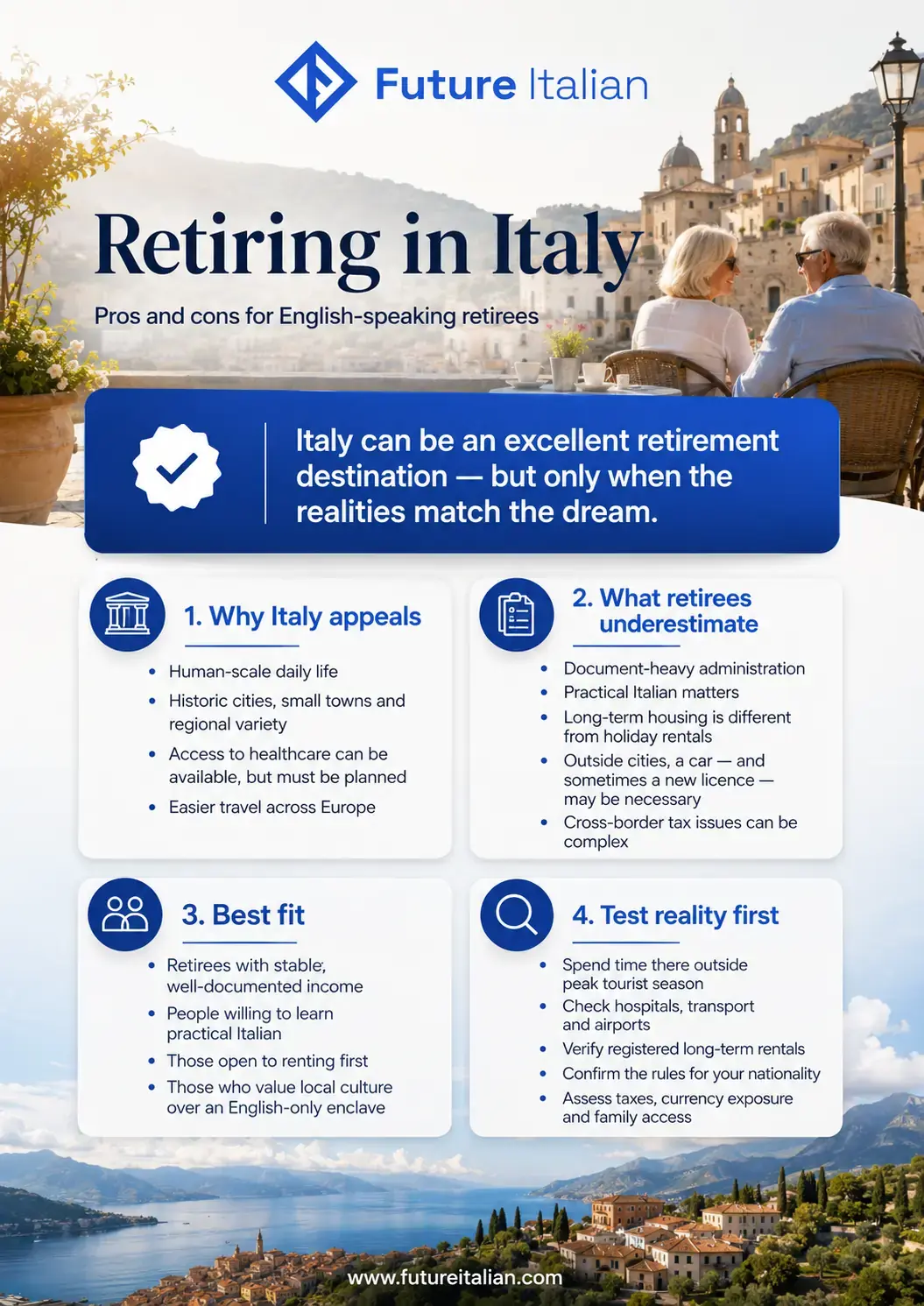
| Advantage | Trade-off to check | Practical test before moving |
|---|---|---|
| Smaller-town housing value | Low rent may come with limited rentals or car dependence | Compare registered annual leases and a full transport budget |
| Established healthcare services | Specialist access varies by location | Map the providers you need and the journey to them |
| Food, culture and community life | A holiday experience differs from an ordinary winter week | Visit outside peak season and try routine errands |
| Walkable historic centres | Stairs, parking and older buildings can affect comfort | Check the actual home for access, insulation and lifts |
| Access to Europe | Flights home and distance from family cost time and money | Price the trips you expect to make each year |
Is Italy a Good Place to Retire?
For the right person, yes. Italy offers a rare combination of historic cities, smaller communities, varied landscapes, established healthcare structures and access to the rest of Europe, but the experience changes sharply by region, municipality and personal circumstances.
The most successful moves are usually made by retirees who choose a specific place for practical reasons. Enjoying a holiday in Italy alone is rarely enough. A beautiful town can still be unsuitable if it lacks reliable transport, year-round rentals, nearby medical services or the social environment you need.
The Main Advantages of Retiring in Italy
Daily Life Can Feel More Human-Scale
Many Italian towns are organised around walkable centres, public squares, local shops and regular contact with neighbours. That can make daily life feel less isolated than retirement in a car-dependent suburb, especially for someone who enjoys routines built around cafés, markets and community spaces.
This advantage is not automatic. Tourist centres can feel crowded and impersonal, while very small villages may be quiet to the point of social isolation. The best fit is often a place with permanent residents, basic services and activities that continue outside the summer season.
Italy Offers Very Different Retirement Experiences
Retirement in Milan, a provincial city, a coastal town and a rural village creates four very different day-to-day experiences. Housing, transport, climate, healthcare access and the amount of English spoken can vary substantially. Compare realistic budgets in the cost of living in Italy guide and evaluate smaller destinations through the guide to affordable Italian towns.
Italy Offers Access to Public Healthcare, but Enrolment Is Not Automatic
Access to the Italian National Health Service depends on the resident’s legal status and circumstances. Some foreign residents are subject to mandatory registration; others must maintain private insurance or may be able to register voluntarily by paying the required annual contribution. Private insurance is also normally required for the visa stage, so public healthcare should be planned rather than assumed. For eligible retirees using ordinary voluntary SSN enrollment, budget at least €2,000 a year; the actual contribution is income-based.
Living in Italy Makes Europe Easier to Reach
A valid Italian long-stay visa or residence permit generally allows short visits to other Schengen countries for up to 90 days in any 180-day period. Italy must remain the genuine country of residence, and this travel right does not authorise permanent settlement or work in another state.
The Disadvantages Retirees Often Underestimate
Italian Administration Is Document-Driven
Residence permits, municipal registration, healthcare enrolment, tax filings, utilities and banking can involve separate offices and repeated requests for documents. Procedures are not always identical between municipalities, and a task that looks simple online may still require an appointment, a paper copy or an in-person visit.
English Helps, but Practical Italian Matters
It is possible to begin life in Italy with limited Italian in major cities and international areas. Long-term independence is harder without the language: medical appointments, condominium meetings, tradespeople, local contracts and public offices often operate mainly in Italian. Even a basic practical vocabulary can materially change the experience.
Long-Term Housing Is Different from Holiday Accommodation
A town with hundreds of short-term rentals may still have very few homes available for registered, year-round residence. Landlords can request guarantees, advance rent or extensive financial evidence from foreign retirees. Buying immediately can solve one problem while creating another if the location later proves unsuitable.
Small-Town Life May Require a Car and a New Driving Licence
Outside major urban areas, a car may be essential for groceries, hospitals and regional transport. A valid non-EU licence can generally be used for up to one year after acquiring Italian residence, together with the required international driving permit or official Italian translation. Conversion is available only where Italy has a reciprocity agreement; otherwise the resident must generally obtain an Italian licence by examination.
The Most Beautiful Homes Are Not Always the Easiest Homes
Historic properties can have stairs, no lift, uneven access, limited insulation or heating systems that are expensive to run. A country house may offer privacy but also require maintenance, a car and reliable local contractors. Retirees should evaluate accessibility and winter comfort as carefully as views and architectural character.
Cross-Border Taxation Can Be More Complex Than Expected
Becoming an Italian tax resident can bring worldwide-income taxation, foreign-asset reporting and coordination with the rules of the country of origin. Some qualifying foreign pensioners may access Italy’s 7% substitute-tax regime, but the visa itself does not create a tax exemption. Our U.S.–Italy tax guide for American retirees explains the U.S. position; retirees from Canada, the United Kingdom, Australia, New Zealand and South Africa need an analysis of the treaty and domestic rules applicable to their country.
Distance from Family Can Become the Decisive Factor
The emotional and financial cost of returning home is very different for a retiree from London, Toronto, Cape Town, Auckland or Perth. Flights, time zones, health changes and family emergencies matter more after the first year than they do during the planning stage. A move that works financially can still fail if the support network becomes too difficult to maintain.
Practical Differences for Retirees from Major English-Speaking Countries
United States
U.S. citizens generally continue to have federal filing obligations after moving abroad, so immigration and tax planning should be coordinated. The Italy visa guide for U.S. retirees covers the U.S.-specific immigration file. Ordinary U.S. driving licences are not convertible for private residents, making transport planning important outside major cities.
Canada
Canadian retirees face many of the same housing and transport adjustments as Americans, but their tax-residence position must be assessed under Canadian and Italian rules rather than inferred from the U.S. system. Ordinary Canadian driving licences are not convertible for private residents, so anyone considering a smaller town should plan for the possibility of taking the Italian driving examination.
United Kingdom
The United Kingdom offers short flights and a small time difference, but British citizens moving now normally need a non-EU residence route. The licence-conversion agreement runs until 30 March 2028. GOV.UK guidance says new arrivals must normally exchange a valid UK licence before six years of Italian residence; people protected by the Withdrawal Agreement may exchange at any time. Check your category before relying on conversion.
Australia and New Zealand
The main challenge is distance. Visiting family can require long journeys, substantial expense and careful planning around health or caregiving responsibilities. Australian and New Zealand licences are not currently listed among the ordinary non-EU licences convertible in Italy, making transport planning particularly important outside large cities.
South Africa
South African retirees may find the climate and outdoor lifestyle familiar in parts of Italy, but income and savings often need to support spending in euros while family remains an intercontinental flight away. South African driving licences are not currently included in the ordinary conversion list, so a rural destination should be evaluated together with the likely need to obtain an Italian licence.
City, Medium-Sized Town or Village?
The type of location often matters more than the region name. The comparison below describes the usual trade-offs rather than universal rules.
| Location type | Main advantages | Main drawbacks |
|---|---|---|
| Major city | Public transport, specialist healthcare, airports, more English-speaking services | Higher housing costs, noise, tourism, smaller homes |
| Medium-sized city | Balanced services, hospitals, rail links and more manageable daily life | Less international support and fewer direct flights |
| Small town or village | Quiet setting, community life and potentially lower housing costs | Car dependence, limited rentals, fewer specialists and greater need for Italian |
| Rural or isolated property | Privacy, space and landscape | Maintenance, accessibility, transport and emergency-service distance |
A medium-sized city or well-connected provincial town is often the safest first base. It allows a retiree to test Italian life without accepting the highest city costs or the logistical risks of an isolated property.
Who Is Likely to Enjoy Retirement in Italy?
- People who want daily contact with local culture rather than an English-speaking enclave.
- Retirees willing to learn practical Italian and handle a document-heavy administration.
- People whose income is stable, well documented and sufficient for the chosen location.
- Retirees comfortable renting first and changing municipality if the first choice is wrong.
- Retirees who can maintain family connections without needing frequent emergency travel.
Who Should Think Twice Before Moving?
- Anyone who expects every service, contract and medical interaction to be available in English.
- Retirees who need immediate access to highly specialised healthcare but are considering an isolated area.
- Anyone relying on future employment, because the Elective Residence Visa does not permit work.
- People planning to buy a remote property before testing the area in winter and outside the tourist season.
- Retirees whose budget works only if exchange rates, taxes and housing costs remain unusually favourable.
Test the Reality Before Committing
A retirement move should be tested as a daily routine, not as a holiday. Before committing to a long lease or purchase, examine the following points in the exact municipality you are considering:
- Spend meaningful time there outside the peak tourist season.
- Travel to the nearest hospital, supermarket, railway station and airport using the transport you would actually have.
- Check the supply of registered long-term rentals rather than holiday listings.
- Confirm the current visa, healthcare and driving-licence rules that apply to your nationality and residence.
- Model taxation and currency exposure before establishing Italian tax residence.
- Assess whether family and support networks remain realistically accessible as you age.
Italy Works Best When the Choice Is Specific
Italy is not automatically cheaper, easier or healthier than every English-speaking country. Its real strength is choice: a retiree can build a life around a major city, a provincial centre, the coast, the mountains or a small community. The move succeeds when the selected place, residence route, healthcare plan, tax position and support network work together. Basing the decision only on an idealised version of the dolce vita can lead to disappointment.
Frequently Asked Questions
Sources
- 1Italian Ministry of Foreign Affairs — Elective Residence Visa
vistoperitalia.esteri.it
- 2
- 3
- 4
- 5EU Schengen Borders Code, Article 6 — 90/180-Day Rule
eur-lex.europa.eu
- 6