

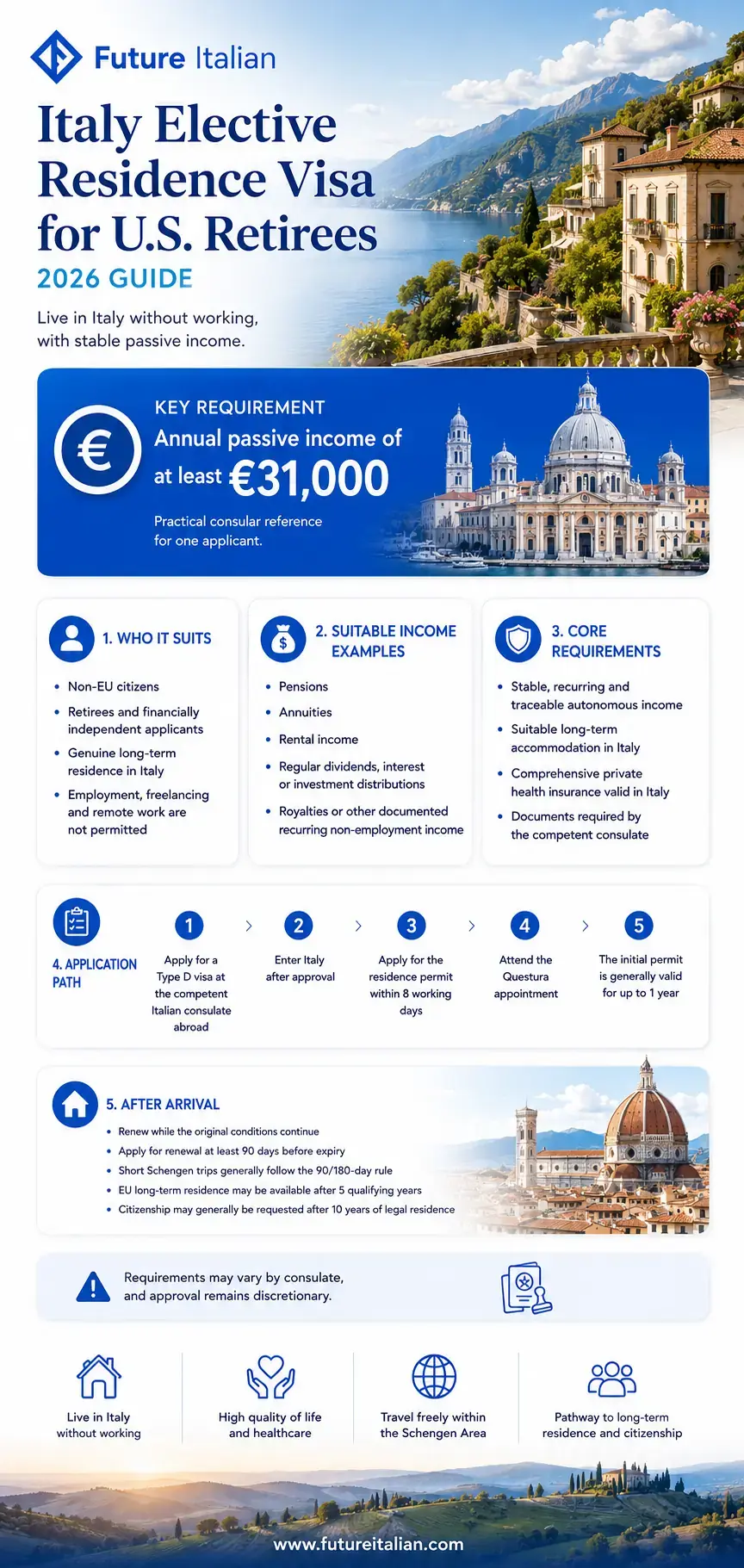
U.S. retirees can use Italy’s Elective Residence Visa to live in Italy without working. Stable Social Security, pensions, annuities and established investment or rental income can support the application. Start with a planning benchmark of about €31,000 per person annually and the checklist of the consulate responsible for your U.S. residence.
Boston publishes a requirement of more than €31,000 per applicant; New York refers to approximately €31,000 per person for family applications. €31,000 divided by 12 is about €2,583 a month before tax and expenses. It is a visa benchmark, not an after-tax spending budget or an approval guarantee.
This guide focuses on the evidence American retirees actually use, including Social Security records, pension letters, IRA and 401(k) distributions, brokerage statements and U.S. tax returns. For the full legal and procedural framework, read our Italy Elective Residence Visa complete guide. Eligibility analysis and document planning are available through our Elective Residence Visa service.
| Consulate | Financial records | Housing and additional checks |
|---|---|---|
| Boston | More than €31,000 yearly per applicant; official income letters; last two years’ tax returns | Registered lease or property deed |
| New York | Substantial steady income; last two years’ tax returns; family benchmark about €31,000 per person | Original registered lease or deed in the applicant’s name |
| San Francisco | Last three months’ bank statements; two full federal returns with all Schedules | Registered lease for at least 365 days in the applicant’s name; FBI check issued within six months |
Official checklists: Boston · New York · San Francisco. These examples show why you should build your file around your own consulate’s requirements.
How U.S. Retirees Can Apply for Italy’s Elective Residence Visa
- 1
Identify the competent Italian consulate
Confirm which U.S. embassy or consulate has jurisdiction over your legal residence and download its current Elective Residence Visa checklist.
- 2
Build a documented retirement-income file
Organize Social Security, pension, annuity, IRA, 401(k), investment and rental evidence into a clear summary supported by official records and tax returns.
- 3
Secure qualifying accommodation in Italy
Obtain the registered residential lease or property documents required by the competent consulate for the intended period of residence.
- 4
Purchase compliant private health insurance
Select a policy valid in Italy that satisfies the specific medical, emergency, evacuation and duration requirements published by your consulate.
- 5
Prepare and attend the visa appointment
Complete the national visa form, assemble originals and copies, pay the local fee and attend in person for the interview and fingerprints.
- 6
Enter Italy and apply for the residence permit
After approval and entry, submit the elective-residence permit application within eight working days and attend the Questura appointment.
- 7
Maintain the conditions for renewal
Keep stable income, suitable accommodation and health coverage, and address Italian residence and tax obligations before the permit expires.
Is the Elective Residence Visa an Italian Retirement Visa?
It is commonly called Italy’s retirement visa because many applicants are pensioners, but retirement age is not itself a legal requirement. The visa is a national Type D route for non-EU citizens who intend to establish their principal residence in Italy using sufficient independent resources.
The central restriction is equally important: the holder may not finance life in Italy through employment, self-employment, consulting or remote professional activity. A person who still needs to work after relocating should choose a work-authorizing immigration route before applying.
Who Can Apply as a Retired American
A credible U.S. retiree application normally shows all of the following:
- Legal residence within the jurisdiction of the Italian embassy or consulate receiving the application.
- Stable and adequate income from pensions, Social Security, annuities, investments, property or other autonomous sources.
- Suitable residential accommodation in Italy for the intended stay.
- Private health insurance that satisfies the competent consulate’s requirements.
- A genuine intention to make Italy the applicant’s principal place of residence without working.
Holding substantial savings or property can strengthen the overall financial profile, but wealth does not automatically replace recurring income. The application should explain how ordinary living expenses will be paid every month and why those resources will continue after the move.
How Much Income Does a U.S. Retiree Need?
There is no single statutory income figure that guarantees approval at every U.S. consulate. Boston currently asks for documented passive income totaling more than €31,000 per year for each applicant, while other offices describe the standard as substantial, stable or adequate income and retain broad discretion.
For a couple, do not assume that one applicant’s benchmark merely increases by a fixed percentage. Some U.S. offices assess each spouse as an applicant and may expect approximately the same level for each person, although the exact approach varies by jurisdiction.
The strongest case is not necessarily the one with the largest account balance. It is the one that makes the annual income easy to verify, demonstrates a reliable payment pattern and leaves a reasonable margin after taxes, housing, insurance and family expenses.
Which U.S. Retirement Income Can Support the Visa?
Consulates look for resources that are lawful, traceable, recurring and sufficiently predictable. Each source should be supported by official documents and connected to a clear annual income summary.
| Income source | Useful U.S. evidence | Practical assessment |
|---|---|---|
| Social Security | Benefit verification letter, SSA-1099, deposit records | Strong when current and recurring |
| Private pension or annuity | Administrator letter, payment statements, Form 1099-R | Strong when duration and frequency are clear |
| IRA or 401(k) distributions | Account statements, Form 1099-R, scheduled-withdrawal confirmation | Useful when distributions are established and sustainable |
| Dividends and interest | Brokerage statements, tax forms, portfolio-income history | More persuasive when consistent across several years |
| Rental income | Lease, ownership documents, tax returns, net-income schedule | Assessed on documented net and recurring income |
| Savings and portfolio assets | Bank and brokerage statements, adviser letter | Helpful financial support but usually weaker than recurring income alone |
Social Security Benefits
Social Security retirement benefits are among the clearest sources because they are recurring and supported by federal records. A current benefit verification letter should be paired with recent deposits, Form SSA-1099 and tax returns so the payment amount and history are immediately understandable.
Private Pensions and Annuities
Defined-benefit pensions and lifetime or long-term annuities can be persuasive when the administrator confirms the gross amount, payment frequency, commencement date and expected duration. The consulate should be able to see whether the payment is permanent, time-limited or subject to conditions.
IRA and 401(k) Distributions
An IRA or 401(k) balance shows wealth, but it does not necessarily prove recurring income. Regular distributions are stronger when they are evidenced by account statements, Forms 1099-R and a written scheduled-withdrawal arrangement that explains the amount and frequency.
The withdrawal plan must also be financially credible. A distribution that exists only for the visa appointment, or that would rapidly deplete the account, may raise questions about long-term sustainability and future renewals.
Dividends, Interest and Brokerage Income
Dividend and interest income may contribute to the application when the portfolio and payment history are well documented. Several years of brokerage statements and tax forms are generally more persuasive than a recent projection based on market performance or an unrealized capital gain.
Rental Income
Rental income should be presented on a net and documented basis. Include the lease, proof of ownership, tax returns, payment records and a schedule that distinguishes gross rent from mortgage payments, taxes, insurance, management fees and other recurring costs.
Savings and Net Worth
Cash reserves and investment assets can demonstrate resilience and may strengthen a well-supported income file. They should not be presented as if a large balance automatically satisfies the visa: the consulate still needs to understand the dependable resources available for ordinary living expenses.
For a broader analysis of pensions, investments, rental income and financial evidence, read our guide to passive income for Italy’s Elective Residence Visa.
Documents U.S. Retirees Should Prepare
The exact checklist depends on the competent consulate. The following documents are commonly requested or useful for a U.S.-based application:
- National visa application form, passport, photographs and proof of residence within the consular jurisdiction.
- A detailed financial summary supported by Social Security, pension, annuity, IRA, 401(k), brokerage, rental and bank records as applicable.
- Recent U.S. federal tax returns and the relevant information statements, such as SSA-1099, 1099-R, 1099-INT, 1099-DIV or rental schedules.
- Proof of suitable accommodation in Italy, normally through a residential lease or ownership documents acceptable to the consulate.
- Private health insurance valid in Italy and compliant with the duration and coverage requirements of the competent office.
- Marriage and birth certificates for accompanying family members, with apostille and translation when required by the checklist.
- Travel reservations, personal statement, civil-status documents and any additional evidence requested by the consulate.
San Francisco expressly requires an FBI Identity History Summary issued within the last six months. Prepare it early if you apply there; it is not a universal requirement established by every U.S. consulate’s Elective Residence Visa checklist.
If your consulate requires an apostille on the FBI certificate, the federal U.S. Department of State issues it, not a state Secretary of State. Follow the Department’s federal-document instructions and allow time for processing.
Do not assume that every U.S. civil or financial document must always be apostilled and translated. These formalities depend on the document and the competent consulate’s instructions. The safest approach is to build the file from that office’s current checklist rather than copying another jurisdiction’s requirements.
How to Present the Financial Evidence
A pile of statements is not the same as a coherent financial case. The application should contain a short annual-income schedule identifying each source, gross and net amounts, payment frequency, supporting document and expected continuation.
Example of a clear annual-income summary
Illustrative figures, not a previously approved case:
| Source | Annual amount in euros | Evidence |
|---|---|---|
| Social Security | €24,000 | Benefit letter, SSA-1099 and deposits |
| Private pension | €18,000 | Administrator letter, 1099-R and deposits |
| Total recurring income | €42,000 | Summary reconciled to tax returns and bank records |
If the originals are in dollars, show the original amount, the exchange rate and conversion date. State deductions separately so the consulate can see both the annual source amount and what remains available.
Where figures fluctuate, use a conservative and explainable calculation. Dividends, interest and rent should be supported by historical records, while planned IRA distributions should be evidenced by an established schedule rather than an informal intention to withdraw money later.
Amounts reported in U.S. dollars should remain consistent across the cover summary and supporting records. A conversion into euros may help the consulate understand the total, but the exchange rate and calculation date should be stated clearly.
Housing and Insurance Under U.S. Consular Checklists
U.S. consulates require suitable residential accommodation in Italy and private health insurance valid for the intended stay. The acceptable lease duration, registration evidence, policy wording, medical limit and repatriation coverage can differ by jurisdiction, so both documents must be checked against the competent office’s current checklist.
Medicare generally does not cover care in Italy, apart from narrow exceptions for treatment outside the United States. It cannot serve as your sole long-stay visa insurance; obtain a policy meeting your consulate’s requirements.
Buying property is not required and does not replace the income test. The broader accommodation, insurance and post-arrival rules are covered in the Italy Elective Residence Visa complete guide.
Where and How U.S. Citizens Apply
The application must be filed with the Italian embassy or consulate responsible for the applicant’s legal residence, not simply the office with the earliest appointment. Jurisdiction is usually demonstrated with a State ID, driver’s license, lease, utility bill or other locally accepted proof.
Use the Embassy of Italy’s U.S. consular network to find the office responsible for your home address, then open its visa checklist. Boston covers Massachusetts, Rhode Island, New Hampshire, Vermont and Maine. Some states, including New Jersey and California, are split by county or area; your state alone may not identify the correct consulate.
Procedures differ across New York, Boston, Los Angeles, Chicago and other jurisdictions. Appointment systems, document lists, accepted insurance wording, family-income expectations and interview practices can therefore vary even though all offices apply the same visa category.
The applicant should attend in person with originals, copies and the correct fee. The consulate may request supplementary documents or clarification, and approval remains discretionary even where the published checklist has been satisfied.
Timing and Application Costs
A national visa decision can take up to 90 days, while appointment availability, document verification and supplementary requests can extend the overall process. U.S. retirees should begin before committing to a non-refundable move date or activating a lease that cannot accommodate delay.
For one adult, budget a €116 national-visa fee, paid at the consulate’s current dollar equivalent, plus about €116.46 in official charges for a first residence permit of up to one year. Insurance, housing deposits, document formalities and professional fees are additional.
Applying with a Spouse or Dependent Children
A spouse and eligible dependent children may apply with the principal retiree, but each person normally files an individual visa application and needs a passport, insurance and the required civil-status records.
Financial expectations are not uniform. Some U.S. consulates expressly refer to approximately €31,000 for each applicant rather than using a simple percentage increase for dependents. A family should therefore confirm the rule applied by its own consular office before relying on one person’s income.
Marriage and birth certificates may need apostilles and Italian translations. Names, dates and marital status must match across passports, applications and civil records.
After the Visa Is Approved
Within eight working days of entering Italy, the holder must begin the application for the elective-residence permit and later attend the Questura appointment. The permit can be renewed while the applicant continues to show autonomous resources, accommodation, health coverage and genuine residence in Italy.
The Elective Residence Visa does not authorize employment, consulting, freelancing or remote work from Italy. A retiree who intends to continue active professional work should assess a work-authorizing route before applying.
Tax Planning Is a Separate Analysis
The visa does not determine tax residence or the treatment of Social Security, pensions, IRA distributions and investments. Those issues are addressed separately in our guide to the U.S.–Italy tax treaty and 7% pensioner regime.
Common Reasons U.S. Retiree Applications Fail
- Treating €31,000 as an automatic approval threshold rather than documenting a sustainable financial profile.
- Submitting large account balances without showing recurring income or a credible withdrawal strategy.
- Using gross rental receipts without disclosing expenses, debt and the actual net income.
- Relying on employment or remote-work income that conflicts with the visa’s no-work purpose.
- Following another consulate’s checklist instead of the office with jurisdiction.
- Providing housing or insurance documents that do not satisfy the competent office’s requirements.
- Leaving inconsistencies between tax returns, benefit letters, bank deposits and the financial summary.
- Failing to explain how a spouse or dependent will be supported.
These problems are examined in greater detail in our guide to common Elective Residence Visa rejection risks.
A Strong U.S. Retiree Application Is Built on Evidence
For a retired American, the decisive issue is not simply having enough wealth. The application must convert U.S. pensions, benefits, distributions and investments into a clear, traceable explanation of how life in Italy will be funded without work.
A well-prepared file aligns the competent consulate’s checklist with reliable financial records, suitable housing, compliant insurance and a realistic tax and residence plan. That structure also makes annual renewal more defensible after the move.
Frequently Asked Questions
Sources
- 1Consulate General of Italy in New York — Elective Residency Visa Requirements
consnewyork.esteri.it
- 2Consulate General of Italy in Boston — Elective Residency
consboston.esteri.it
- 3Consulate General of Italy in Los Angeles — Elective Residency Visa
conslosangeles.esteri.it
- 4
- 5
- 6Agenzia delle Entrate: Circolare 21/E del 17 luglio 2020
agenziaentrate.gov.it