

An Italy work visa for ordinary employment normally starts with an Italian employer, a real job offer and an available Decreto Flussi quota. The 2027 programme includes 76,200 non-seasonal employment entries, including 14,000 for family assistance. Defined routes such as the EU Blue Card operate outside these quotas.
The normal sequence is not “apply for an Italian work visa and then find a job.” An Italian employer first needs to establish that the proposed hire fits an available legal route and obtain the required work authorization. Our Employment Work Visa assistance covers the process from employer filing to the residence-permit stage.
For a 2027 hire, prepare in autumn 2026. Pre-completion on the ALI portal opens on 23 October 2026 at 09:00 and closes on 7 December at 20:00, Italian time. The 9–13 December reopening is only for completing, correcting and saving existing applications; you cannot create a new application then.
The 2027 application calendar in this guide comes from Joint Circular 7185 of 1 October 2026.
How to Apply for an Italy Work Visa
- 1
Identify the correct employment route
Determine whether the position falls under Decreto Flussi or a specific off-quota category.
- 2
Check the quota and employer requirements
Confirm that the worker, sector, nationality where relevant and proposed employment fit an available legal category.
- 3
Prepare and file the nulla osta application
The employer completes the required pre-filing steps and submits the work-authorization application through the Portale Servizi.
- 4
Complete the employer confirmation
Respond within the statutory period when the authorities ask the employer to confirm that the hiring intention still exists.
- 5
Apply for the national work visa
The worker submits the type D work-visa application to the competent Italian consulate.
- 6
Complete the contract of stay after entry
The employer and worker complete and transmit the contratto di soggiorno under the current digital procedure within the applicable deadline.
- 7
Complete the residence-permit procedure
Submit the required permit documentation and complete the Questura biometric process.
Who Needs an Italian Employment Work Visa?
This route primarily applies to non-EU nationals living abroad who have an Italian employer willing to hire them. EU, EEA and Swiss citizens do not use this immigration route because their right to work in Italy derives from EU free-movement law.
For a standard non-EU hire, the worker, employer, job, sector, applicable quota category and contractual conditions must all align. Finding an employer does not by itself guarantee that a visa route is available.
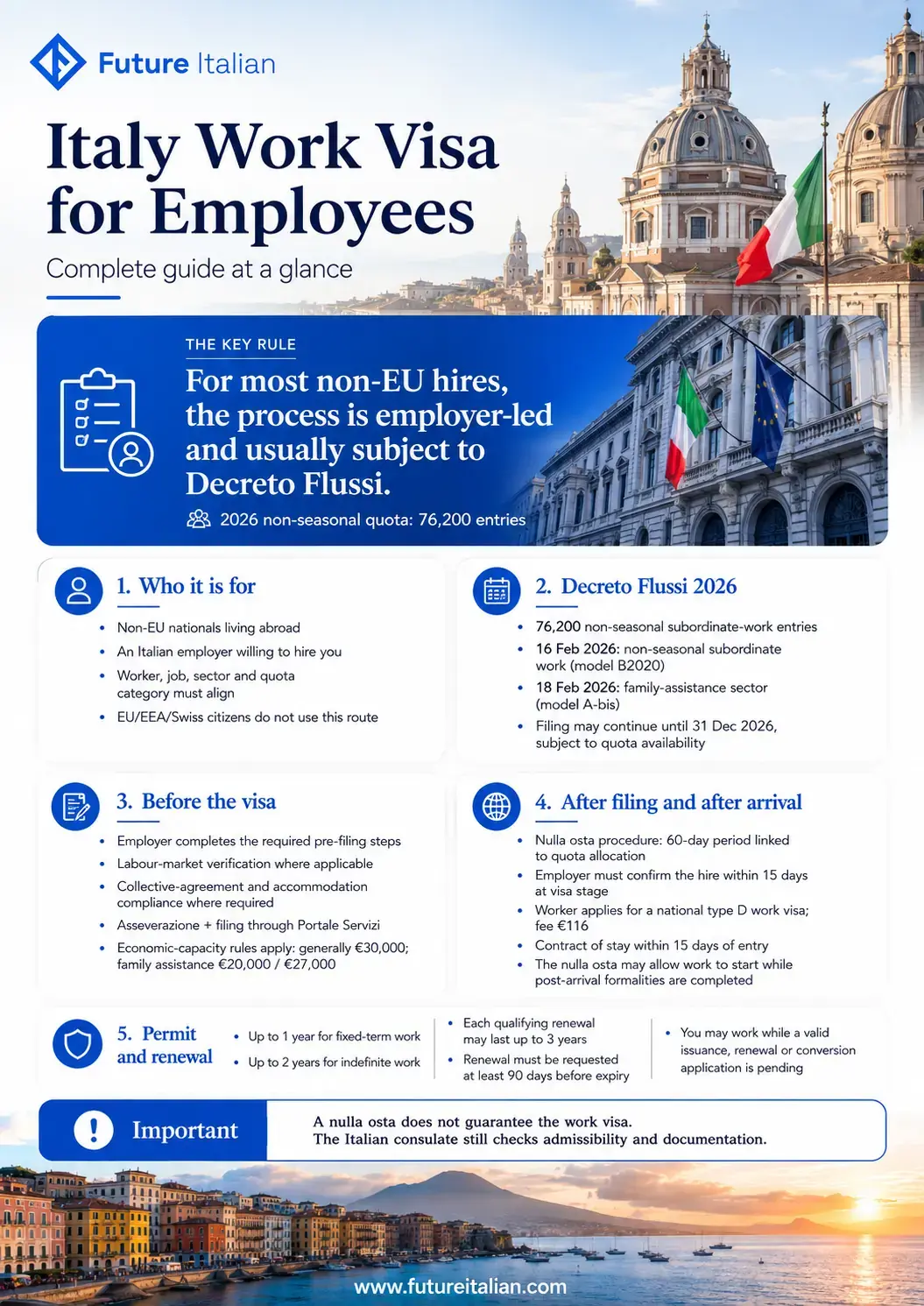
How Decreto Flussi Affects Employment Visas
The Decreto Flussi is not a separate visa category. It is the quota-programming framework that governs many ordinary entries from abroad for subordinate employment and also sets a distinct quota for self-employment. The DPCM of 2 October 2025 established the program for 2026–2028.
For non-seasonal subordinate employment, the decree provides 76,200 places in each of 2026, 2027 and 2028, distributed among the sectors, nationalities and reservations established by the decree.
The 76,200 non-seasonal employee places in 2027 are not a single pool open to every nationality. The allocation includes 10,900 non-reserved places and a separate 14,000-place family-assistance category. Many other places are nationality-reserved. An American or British applicant needs an employer and the correct eligible category, rather than assuming access to all 76,200 places.
- Construction, manufacturing, wholesale and retail.
- Accommodation, food services, tourism, transport, logistics and warehousing.
- Support services, healthcare, social assistance and other sectors expressly included in the decree.
Some allocations are reserved for nationals of countries with specified migration-cooperation arrangements, while other allocations cover defined categories such as family-assistance workers.
2027 Decreto Flussi Application Dates
| Stage | Date and time in Italy | Application |
|---|---|---|
| Pre-complete the application | 23 Oct 2026, 09:00 – 7 Dec 2026, 20:00 | ALI portal |
| Complete existing applications only | 9 Dec, 09:00 – 13 Dec 2026, 20:00 | No new applications |
| Agricultural seasonal click day | 12 January 2027, 09:00 | C-Stag agricolo |
| Tourism seasonal click day | 9 February 2027, 09:00 | C-Stag turistico |
| Non-seasonal employment click day | 16 February 2027, 09:00 | B2020 |
| Family-assistance click day | 18 February 2027, 09:00 | A-bis in quota |
Filing remains possible until 31 December 2027 while the relevant quotas remain available. A late filing window does not replace timely preparation.
Employment Routes Outside Decreto Flussi
Not every foreign worker enters through the ordinary quota system. One of the most important separate routes is the EU Blue Card Italy guide, which applies to qualifying highly skilled employees and operates outside Decreto Flussi quotas.
A separate route outside Flussi quotas exists for eligible descendants of Italian citizens who are nationals of the United States, Canada, Australia, Argentina, Brazil, Venezuela or Uruguay. It is employment-based under Article 27(1-octies) and the decree of 17 November 2025: an employer and proof of the qualifying Italian ancestry are still required.
Where the work is genuinely remote rather than tied to ordinary employment in Italy, the Italy Digital Nomad Visa may be the more appropriate route. If the person intends to live in Italy without working and relies on qualifying passive income, the Elective Residence Visa is a separate non-working immigration route.
What the Employer Must Do Before Filing
- Complete the labour-market availability verification where it applies and prepare the proposed employment conditions.
- Ensure compliance with the applicable collective agreement and prepare accommodation-related documentation where required.
- Prepare the required asseverazione and file through the Ministry of the Interior’s Portale Servizi.
The employer must also satisfy the economic-capacity rules applicable to the filing. For sectors other than family assistance, the 2026 implementing circular states that annual taxable income for an individual or sole proprietor, or annual turnover for an entity or company, must be at least €30,000.
Family-assistance applications use separate thresholds: the circular indicates at least €20,000 of annual taxable income for an employer whose registered household consists only of that person, rising to €27,000 where the household includes other cohabitants. Qualifying income of the spouse and relatives within the second degree may contribute to that requirement, and specific exceptions can apply where the employer is not self-sufficient.
The Nulla Osta for Subordinate Employment
The nulla osta al lavoro is the work authorization issued through the Sportello Unico per l’Immigrazione procedure. For ordinary non-seasonal quota-based employment, current legislation links the relevant 60-day procedural period to allocation of the application to the quota rather than simply to the date on which the employer first transmitted it.
Employer Confirmation Before the Visa Is Issued
Current law requires the employer to confirm that it still intends to hire the worker during the visa stage after the required checks are completed. The employer has 15 days to provide that confirmation. Without confirmation, the work authorization can be revoked and the visa procedure does not continue.
Applying for the Italian Work Visa
Once the work-authorization process permits the consular stage to proceed, the worker applies for a national type D work visa at the competent Italian diplomatic or consular office. The ordinary national work-visa fee is currently €116.
- National visa application, valid passport and photograph.
- Work-authorization details, employment documentation and any additional evidence requested by the specific consular jurisdiction.
What Happens After Entering Italy?
The old description of a worker simply arriving and later signing a paper contract at the Sportello Unico is no longer accurate. Under the current procedure, the employer and worker must complete the contratto di soggiorno within 15 days of entry. The worker can sign by hand, while the employer completes the required digital signature and electronic transmission through the Portale Servizi.
The nulla osta can allow employment to begin while the post-arrival formalities are being completed, provided the employer also complies with the ordinary mandatory employment communications.
Duration of the Residence Permit for Employment
- Up to one year for fixed-term employment.
- Up to two years for indefinite employment.
Current law allows each qualifying renewal to have a maximum duration of three years, where the relevant conditions continue to be satisfied.
Renewing an Employment Residence Permit
Article 5(4), amended by Legislative Decree 83/2026, requires renewal at least 90 days before expiry. The authorities reassess the conditions for lawful residence and employment, while a valid pending renewal benefits from the protections of Article 5(9-bis), including the right to continue working until the procedure is decided.
Can You Work While the Residence Permit Is Pending?
Yes, where a valid application for issuance, renewal or conversion is pending and the statutory conditions are satisfied. The official receipt proving submission of the application is evidence of the pending procedure. Those interim rights cease if the application is ultimately refused.
What Happens if You Lose Your Job?
Loss of employment does not automatically cause immediate cancellation of an ordinary employment residence permit. Italian law provides a protected period in which a non-seasonal worker can seek new employment, subject to the statutory conditions.
Can Family Members Join an Employment Permit Holder?
Family reunification may be available once the sponsor satisfies the requirements established by Italian immigration law, including the applicable residence status, family relationship, income and accommodation requirements.
What if You Are Already Legally Living in Italy?
Do not assume that you need to leave Italy and start a new Decreto Flussi visa application. Some existing permits allow work directly, while others may qualify for conversion. See our guide to residence permit conversion in Italy.
Employment Visa and Italian Taxation
A work visa determines immigration status, not tax residence. Employment physically performed in Italy will normally create Italian payroll and employment-law obligations, while personal tax residence depends on the separate tax-residence rules applicable during the relevant year.
Costs of the Employment Work Visa Process
- €116 national work-visa fee.
- €16 revenue stamp, €30 postal submission charge where applicable and €30.46 for the electronic residence permit.
- The applicable residence-permit contribution, plus any translations, apostilles, legalizations or employer-side professional documentation.
Common Reasons an Employment Work Visa Fails
- No relevant quota is available, or the worker does not fit the required nationality, sector or category.
- Employer requirements, labour-market checks or employment terms are incomplete or non-compliant.
- The employer fails to confirm the proposed hire during the visa process, or the worker does not satisfy the consular visa requirements.
The correct route should therefore be determined before the employer files. A standard work visa, EU Blue Card, special off-quota route and Italy Self-Employment Visa are legally different pathways.
From Work Permit to Long-Term Residence
Employment residence can contribute toward the period required for Italian EU long-term resident status where all statutory conditions are satisfied. Income, residence continuity, language and other requirements must still be checked independently; see the EU Long-Term Residence Permit guide.
The employment visa is the beginning of the immigration relationship rather than the final administrative step: quota, employer, visa and residence permit need to remain legally consistent throughout the process.
Frequently Asked Questions
Sources
- 1DPCM 2 October 2025 — Flows 2026–2028
gazzettaufficiale.it
- 2Integration of Migrants — Flussi 2026
integrazionemigranti.gov.it
- 3Integration of Migrants — Entry and stay for work
integrazionemigranti.gov.it
- 4Legislative Decree 286/1998 — Article 5
normattiva.it
- 5Integration of Migrants — Work while residence permit is pending
integrazionemigranti.gov.it
- 6Integration of Migrants — Residence permit costs
integrazionemigranti.gov.it