

Italy’s Self-Employment Visa allows qualifying non-EU nationals to enter and reside in Italy to carry out an eligible self-employed activity. Eligibility depends on the legal nature of the proposed work and on satisfying the professional, authorization, financial and accommodation requirements that apply to that specific route. After the visa is issued and the applicant enters Italy, the immigration process continues with the self-employment residence permit.
Eligibility therefore starts with the legal category of the proposed activity, not simply with having clients, savings or a Partita IVA business idea. Our Italy Self-Employment Visa assistance focuses on identifying the correct route and preparing the category-specific authorizations and visa dossier.
For 2027, the official programme retains 650 self-employment entries. The October–December pre-completion window and January–February employment click days do not automatically apply to a self-employment visa: follow the authorization and consular procedure for your eligible category. Source: official Flussi 2027 circular of 1 October 2026.
How to Apply for an Italy Self-Employment Visa
- 1
Identify the legal self-employment category
Determine the immigration basis for the proposed activity and whether it falls within a reserved or non-reserved quota category or another specific statutory route.
- 2
Verify quota and category requirements
Check the current Decreto Flussi allocation, quota availability and every category-specific financial, professional, corporate or authorization requirement.
- 3
Obtain the Italian authorizations and attestations
Secure the Questura, Chamber of Commerce, professional-body, labour-authority or other documents required for the specific activity.
- 4
Prepare financial and accommodation evidence
Separate prior lawful income, resources required for the activity and any category-specific investment requirement.
- 5
Submit the national visa application
Apply to the competent Italian consulate with the category-specific documentation.
- 6
Enter Italy and request the residence permit
Complete the post-arrival self-employment residence-permit procedure and the professional, tax and social-security registrations required for the activity.
Who Can Apply for a Self-Employment Visa?
Article 26 of the Italian Immigration Act governs entry for self-employed work, while the applicable Decreto Flussi determines the quota categories for ordinary quota-based entry.
Entrepreneurs
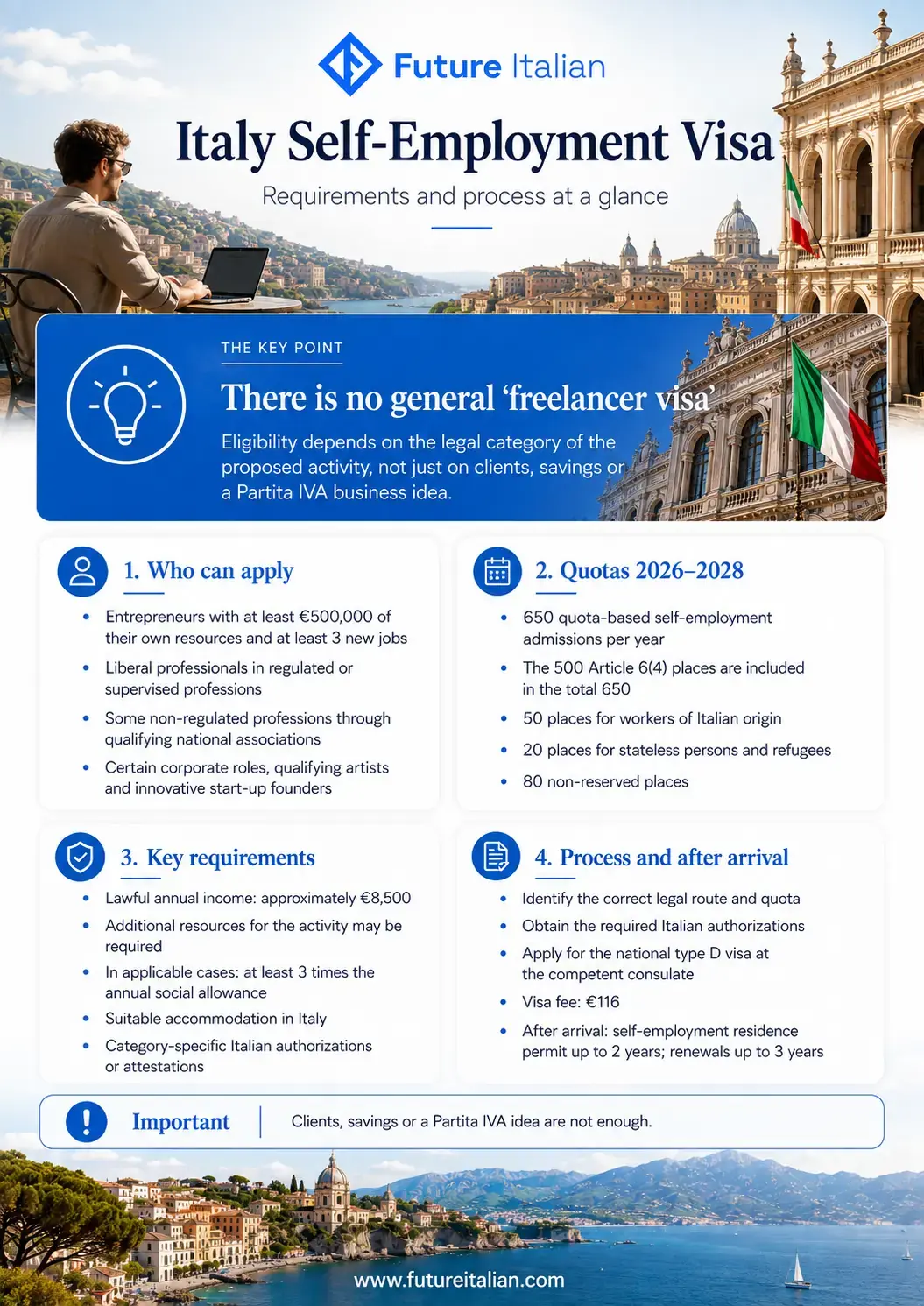
Applicants intending to implement an investment plan of interest to the Italian economy must use at least €500,000 of their own resources and create at least three new jobs.
Liberal professionals
The category covers professionals intending to practise regulated or supervised professions, and qualifying non-regulated professions represented at national level by associations included in public-administration lists and able to issue the required professional-quality certification. It does not mean that every person describing themselves as a freelancer or consultant automatically qualifies.
Corporate roles, artists and innovative start-up founders
Defined corporate administration or control roles can qualify. Artists of established reputation or high and recognized professional qualification may qualify when engaged by the entities contemplated by the rules. Innovative start-up founders may qualify where the statutory requirements are met and they have a self-employment relationship with the business.
How the 650 Self-Employment Quotas Are Allocated
For each of 2026, 2027 and 2028, the official implementing circular confirms a total of 650 quota-based admissions for self-employment. The 500 places for the five categories listed in Article 6(4) are part of that total, not an additional quota.
| Allocation | Places per year | Who it covers |
|---|---|---|
| Article 6(4) reserved categories | 500 | Qualifying entrepreneurs, liberal professionals, specified corporate officeholders, qualifying artists and innovative start-up founders |
| Workers of Italian origin | 50 | 10 residents of Venezuela and 40 residents of the other countries identified under the applicable ministerial measure |
| Stateless persons and refugees | 20 | Qualifying stateless persons and refugees covered by the applicable rules |
| Non-reserved self-employment | 80 | Not category-reserved, but Article 26 and the requirements applicable to the proposed activity still apply |
| Total | 650 | Annual quota-based self-employment admissions |
“Non-reserved” does not mean that anyone can obtain a visa simply by opening a company or declaring themselves a freelancer. The applicant must still satisfy Article 26, the implementing rules and the requirements applicable to the specific activity and consular case.
Separate off-quota self-employment situations do exist under other legal provisions, but each must be identified through its own statutory basis. A route should never be called off-quota merely because the applicant is highly qualified.
Is There a General Italian Freelancer Visa?
No general immigration right arises simply because a person is commercially self-employed, has clients or intends to open a Partita IVA. For quota-based entry, the proposed activity must fit the applicable legal framework, the applicant must obtain the required category-specific authorizations or attestations, and a relevant quota must be available where the route is quota-based. A highly qualified professional working remotely through digital tools should also compare the Italy Digital Nomad Visa guide, because that visa operates under a different legal framework.
Financial Requirements for the Self-Employment Visa
There is no single universal amount that correctly describes every financial requirement for every self-employment category. Different financial tests perform different legal functions.
Lawful annual income
Article 26 requires the applicant to demonstrate lawful annual income above the statutory level linked to exemption from healthcare co-payment. Current consular guidance commonly expresses that reference as approximately €8,500, but the legal rule is tied to the underlying threshold rather than to an immutable visa-specific euro amount.
Resources needed for the activity
Where the procedure requires an attestation from the Chamber of Commerce or another competent professional authority identifying the resources necessary to carry out the activity, that amount is separate from the lawful annual-income requirement. In the cases where the statutory formula applies, current official guidance requires resources of at least three times the annual social allowance.
Category-specific capital
Some categories impose much higher thresholds. The entrepreneur category under the current Decreto Flussi requires at least €500,000 of the applicant’s own resources plus the creation of three new jobs. These tests should never be collapsed into one supposed universal minimum bank balance.
For applicants whose objective is residence through a qualifying investment rather than personally carrying out the proposed self-employed activity, the Italian Golden Visa is a separate route and should be assessed independently.
Accommodation Requirement
An applicant must demonstrate suitable accommodation in Italy. Depending on the competent consulate and the case, evidence can include a qualifying lease, property documentation or another accepted form of accommodation evidence.
Which Nulla Osta or Authorization Is Required?
There is no single Chamber of Commerce authorization that applies to every self-employed applicant. The necessary preparatory documents depend on the proposed activity and may involve the Chamber of Commerce, a professional order, the Questura, a territorial labour authority, the innovative start-up procedure or another competent authority.
A Chamber of Commerce attestation of the resources considered necessary for an activity is not the same thing as the Chamber evaluating and approving the commercial viability of a business plan.
Documents for an Italian Self-Employment Visa
Personal documents
- National visa application, valid passport and passport photograph.
- Proof of legal residence in the consular jurisdiction where required.
Professional and activity documents
- Professional qualifications, registrations, contracts, letters of engagement or corporate documentation, depending on the category.
- Evidence of the proposed investment or innovative start-up authorization where applicable.
Italian authorization documents
- Questura clearance, Chamber of Commerce or professional-body resource attestation, declaration of no impediment and any other category-specific authorization where applicable.
Financial and accommodation evidence
- Evidence of lawful income, funds for the activity, any category-specific investment capital and suitable accommodation in Italy.
Foreign documents may also require translation, legalization or apostille according to their nature and the authority receiving them.
How the Self-Employment Visa Process Works
First classify the proposed activity and identify the correct immigration basis. For an Article 26 application, determine whether the case falls within a reserved or non-reserved self-employment quota under the current Decreto Flussi, or whether a different statutory route applies. For 2026–2028, the overall self-employment quota is 650 per year.
Next obtain the category-specific Italian authorizations, attestations or clearances. The self-employment procedure should not automatically be described as the same employer filing used for subordinate employment.
Once the Italian-side conditions are established, the applicant prepares and submits the national type D Self-Employment Visa application to the competent Italian consulate. The standard national visa fee is currently €116.
After arrival, the applicant proceeds to the residence-permit stage. For the detailed post-arrival procedure, see our guide to the self-employment residence permit in Italy.
How Long Is the Self-Employment Residence Permit Valid?
Current Article 5 of the Immigration Act provides that the first self-employment residence permit can have a maximum validity of two years. Each qualifying renewal may now be issued for up to three years. The visa authorizes entry; the permit regulates continuing residence in Italy.
Can You Take an Employee Job With a Self-Employment Permit?
Yes. Official Italian guidance confirms that a valid self-employment residence permit can also be used for subordinate employment without first converting the permit. At renewal, the applicant can request the permit corresponding to the activity actually being carried out.
Partita IVA, Tax and Social Security
Obtaining an immigration visa does not by itself complete the legal setup of an Italian self-employed activity. Depending on the activity, the person may need a Partita IVA, Chamber of Commerce registration, professional registration, INPS or another social-security position, invoicing and accounting compliance, and a separate assessment of Italian tax residence.
Bringing Family Members
A holder of a qualifying self-employment residence permit may use the ordinary family-reunification framework when the statutory requirements are met. Family eligibility, income and accommodation should be assessed independently from the original visa application.
Applying From Inside Italy
A person who already legally resides in Italy should not automatically follow the visa-from-abroad procedure. Depending on the existing permit, the correct solution may involve an existing right to work or a conversion. Students can read our guide to conversion from study to self-employment.
Costs
- €116 national type D visa fee.
- €16 residence-permit revenue stamp, €30 postal submission charge where applicable and €30.46 electronic permit production charge.
- The applicable residence-permit contribution and any category-specific certifications, translations, apostilles, legalizations or professional registrations.
Common Reasons a Self-Employment Visa Is Refused
- The applicant does not fall within a legally admissible category or assumes that any freelancer qualifies.
- No relevant quota or statutory route is available, or the necessary Italian authorization has not been obtained.
- The applicant confuses the lawful annual-income requirement, resources needed for the activity and category-specific investment capital.
- The professional, business, accommodation or foreign-document evidence is inconsistent or incomplete.
The decisive question is not simply whether the applicant can support themselves financially. It is whether the proposed work fits a legal self-employment immigration route and every requirement attached to that route can be proved.
Frequently Asked Questions
Sources
- 1DPCM 2 October 2025 — Article 6
gazzettaufficiale.it
- 2Legislative Decree 286/1998 — Article 26
normattiva.it
- 3Italian Embassy in Asunción — Self-Employment Visa requirements
ambassunzione.esteri.it
- 4Portale Immigrazione — Self-Employment Residence Permit
portaleimmigrazione.it
- 5Legislative Decree 286/1998 — Article 5
normattiva.it
- 6