

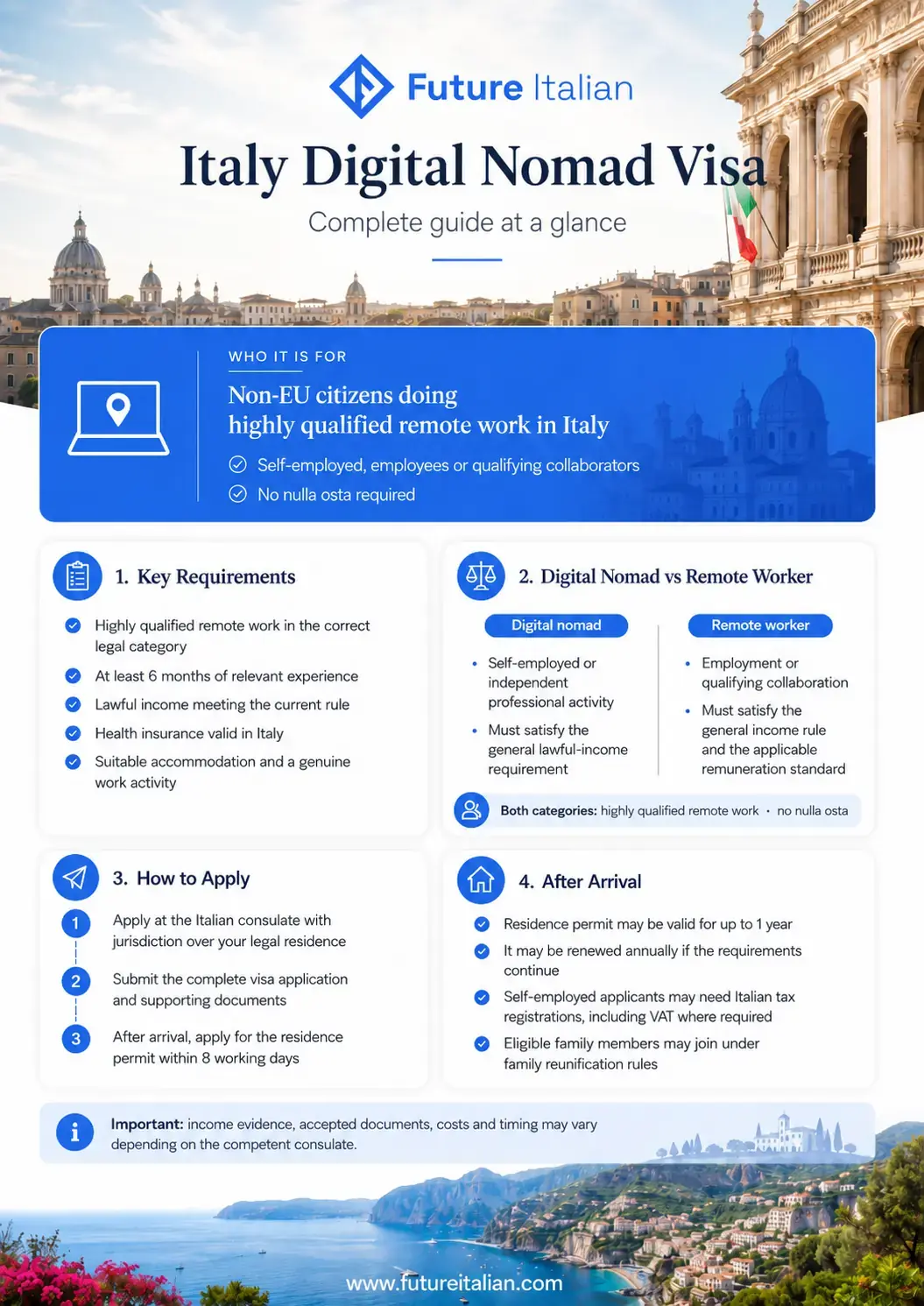
Italy's Digital Nomad Visa lets non-EU remote professionals live in Italy on a residence permit of up to one year, renewable. You need highly qualified remote work, at least six months of experience in it, about €25,000 a year of lawful income (the Italian Consulate in New York publishes €24,789), health insurance valid in Italy and suitable housing. Employees must also pass a separate salary test. No Italian work permit (nulla osta) is needed.
You apply at the Italian consulate that covers your place of legal residence, for example in the United States, the United Kingdom, Canada or Australia, and then request the residence permit within eight working days of arriving in Italy. For the detailed evidence rules, see our Italy Digital Nomad Visa requirements guide. US applicants should also read our guide for US citizens.
How to Apply for Italy’s Digital Nomad Visa
- 1
Choose the correct work category
Decide whether you apply as a self-employed digital nomad or as an employed remote worker, because the documents and income tests differ.
- 2
Confirm highly qualified status
Identify your qualification route (degree, regulated profession, five years' experience or the ICT route) and collect proof of at least six months in the activity.
- 3
Check the income figure
Confirm the figure your consulate publishes (about €25,000 a year) and, for remote workers, the separate pay test.
- 4
Find the competent consulate
Use the Italian consulate that covers your legal residence and download its current checklist.
- 5
Prepare and legalize the documents
Collect professional, financial, insurance and housing evidence, then add apostilles and Italian translations where required.
- 6
File the visa application
Attend the appointment, pay the fee and answer any request for extra documents.
- 7
Request the residence permit
Within eight working days of entering Italy, apply for the digital nomad or remote worker residence permit.
- 8
Complete tax and contribution set-up
Register for tax, open a VAT number if self-employed and keep records for the annual renewal.
Italy Digital Nomad Visa at a Glance
| Point | What applies in 2026 |
|---|---|
| Who can apply | Non-EU citizens, including US, UK, Canadian, Australian, New Zealand and South African nationals |
| Work | Highly qualified work done remotely with digital tools, as a freelancer (digital nomad) or an employee (remote worker) |
| Experience | At least 6 months in the activity you will carry out from Italy |
| Minimum income | About €25,000 a year: €24,789 (New York, 2024 figure) or €25,500 (London) |
| Employee salary test | Remote workers' pay must meet the Italian collective agreement and an ISTAT benchmark; several consulates set €33,000 gross a year |
| Health insurance | Cover for medical treatment and hospitalization valid throughout Italy; many consulates ask for at least €30,000 |
| Housing | A lease or other accommodation evidence accepted by your consulate |
| Work permit (nulla osta) | Not required |
| Visa fee | €116, paid in local currency |
| Consular decision | Up to 90 days for employees (30 at some consulates) and up to 120 days for the self-employed |
| After arrival | Residence permit request within 8 working days |
| Permit length | Up to 1 year, renewable |
| Family | Spouse and children under 18; a spouse who joins later waits two years; travelling together may avoid this, but confirm it first |
Who Qualifies for the Digital Nomad Visa?
You must be a non-EU citizen who works remotely through digital tools and counts as a highly qualified worker. Italy takes the definition of highly qualified from Article 27-quater of its Immigration Act, so you need one of these four routes:
| Route | What you must show | Example |
|---|---|---|
| Degree | A degree from a course of at least three years, or a qualification at level 6 of Italy's qualifications framework | A bachelor's degree in computer science, with a Declaration of Value or CIMEA statement |
| Regulated profession | The qualifications Italy requires to practise that profession | A licensed architect or engineer whose qualification is recognized in Italy |
| Professional experience | At least five years of experience comparable to a degree, relevant to your field | A product designer with seven years of client work and no degree |
| ICT experience | For listed ICT managers and specialists, three years of relevant experience in the last seven | A software architect without a degree |
If you rely on a degree, consulates usually ask for an official document on its level. New York and San Francisco, for example, ask for a Declaration of Value (Dichiarazione di Valore) or a statement of comparability from CIMEA, Italy's recognition center, and London asks UK applicants for a Declaration of Value. These documents describe the degree for the visa; they are not a formal recognition of it in Italy. Start early: they can take several weeks.
Separately, every applicant must show at least six months of experience in the activity they will carry out from Italy. A degree proves your level; it does not replace that work history. A graduate who started freelancing three months ago does not qualify yet, even with a master's degree.
Digital Nomad or Remote Worker: Which Category Fits You?
The category depends on how you are paid, not on your job title. It changes the documents you file and the income tests that apply.
| Point | Digital nomad | Remote worker |
|---|---|---|
| Work structure | Self-employed or freelance | Employee or qualifying collaborator |
| Typical evidence | Client contracts, invoices, tax returns, business registration | Employment contract or binding offer, employer letter, payslips |
| Income test | The general income threshold | The general threshold plus a pay test: pay in line with the Italian collective agreement and an ISTAT salary benchmark; the Embassy in Washington and the consulates in Sydney and Melbourne set it at €33,000 gross a year |
| Employer declaration | Not applicable (no employer) | The employer declares it has no convictions in the past five years for specified labor-immigration offences |
| Nulla osta | Not required | Not required |
A software engineer paid a salary by a Texas company applies as a remote worker. A UX designer invoicing clients in London and Toronto applies as a digital nomad. If you are both, for example an employee with a side consultancy, the file must make clear which activity the visa is based on.
How Much Income Do You Need?
Italian law sets the threshold as three times the minimum income used for exemption from healthcare co-payments, not as a fixed euro amount. In practice that means about €25,000 a year. Consulates publish their own figure:
| Consulate | Published minimum | How it is calculated |
|---|---|---|
| New York, Washington and most US consulates | €24,789 a year | 3 × €8,263.31; New York dates the figure to 2024 |
| Miami | about €25,200 a year | 3 × €8,400 |
| London | €25,500 a year | 3 × €8,500 |
| Sydney and Melbourne | €25,500 a year | 3 × €8,500 |
| Toronto and Ottawa | €24,780 a year | As published |
| Johannesburg | more than €25,000 a year | As published |
Many online guides quote about €28,000, and a few Italian consulates outside the English-speaking world, such as Paris and Buenos Aires, publish that figure. The legal formula gives €24,789.93, and the consulates serving the United States and the United Kingdom publish €24,789 to €25,500, so check the figure on your own consulate's page.
Income must come from lawful sources. In New York it must also come from the remote work itself, so passive income such as Social Security, rent or dividends does not count. Savings help show stability but do not replace recurring professional income.
For example, a freelancer whose tax return shows €26,400 of annual professional income (€2,200 a month) clears the London figure. One showing €22,800 (€1,900 a month) does not, whatever their savings.
What Documents Do You Need?
The exact checklist depends on your consulate and category. A complete file usually includes:
- the national visa application form, photographs and a passport with the validity your consulate requires;
- proof of legal residence in the consulate's district, such as a driver's license or utility bill;
- evidence of your qualification route (degree, professional license or experience letters) and of six months in the activity;
- for freelancers: client contracts, invoices, business registration and tax returns;
- for employees: the employment contract or binding offer, an employer letter and payslips;
- bank statements showing the income arriving;
- a health insurance certificate showing cover in Italy for the whole stay;
- accommodation evidence, such as a registered lease or property deed;
- a criminal-record certificate where your consulate asks for one.
Public documents from the United States, the United Kingdom, Canada, Australia, New Zealand and South Africa are legalized with an apostille, because all six countries belong to the Hague Apostille Convention. Most also need a certified Italian translation. We handle both through our Apostille service and certified document translation service.
How to Apply: Step by Step
- Choose your category: digital nomad (self-employed) or remote worker (employee).
- Confirm your qualification route and gather proof of six months in the activity.
- Find the consulate that covers your legal residence and download its current checklist. Earlier appointments elsewhere are not a reason to use another consulate.
- Collect the documents, then apostille and translate the ones the checklist requires.
- Book and attend the visa appointment and pay the fee.
- Wait for the decision and answer any request for extra documents.
- Enter Italy with the visa and request the residence permit within eight working days.
- Register for tax and keep the records you will need for renewal.
Checklists differ between consulates even though the law is national. Before booking, check five points on your consulate's page: the income figure, the fee, passport validity, the accepted housing evidence and whether a criminal-record check is required. For an eligibility review and a document plan for your consulate, see our Digital Nomad Visa support service.
How Much Does the Italy Digital Nomad Visa Cost?
Government fees are modest. Insurance and document preparation make up most of the budget. Typical costs for one applicant:
| Item | Amount | Note |
|---|---|---|
| National visa fee | €116 | Charged in local currency; about $135–$136 in the 2026 US fee tables |
| Revenue stamp (marca da bollo) | €16 | For the residence permit request |
| Electronic permit card | €30.46 | |
| Permit contribution | €40 | For a permit of up to one year |
| Health insurance | about €300–€2,500 a year | Planning estimate; consulates usually ask for at least €30,000 of cover |
| Apostilles, translations and degree documents | about €300–€900 | Planning estimate for a typical file |
Government fees therefore come to about €202 per person. Professional assistance, if you use it, is separate.
How Long Does the Process Take?
Allow three to six months from starting your documents to holding the visa. This is a planning estimate, not a legal deadline; the slowest steps are usually consular appointments and document legalization.
| Stage | Typical time | Basis |
|---|---|---|
| Documents, apostilles, translations and degree documents | 4–10 weeks | Planning estimate |
| Consular appointment | Depends on availability at your consulate | Varies by consulate |
| Consular decision | Up to 90 days for employees (30 at some consulates), up to 120 days for the self-employed | Published consular deadlines |
| Residence permit request | Within 8 working days of arrival | Legal deadline |
| Permit card | Several weeks to a few months | Planning estimate; varies by city |
Keep the receipt you get when you apply for the permit with your passport: it proves your lawful stay while the card is being produced.
After Arrival: Residence Permit, Tax Registration and Renewal
Within eight working days of entering Italy, request the residence permit at the Questura (the police immigration office) of the province where you are staying: the decree requires the request to be made there directly. Check that Questura's current instructions, and bring the documents you filed for the visa, stamped by the consulate. The permit is issued for digital nomads and remote workers and is valid for up to one year. The visa lets you enter; the permit lets you stay.
You need an Italian tax code (codice fiscale) for a lease and a bank account. If you sign a lease before your visa, get the code first: some consulates issue it, London for example, and from anywhere a representative in Italy can request it for you from the Italian Revenue Agency (Agenzia delle Entrate). If you arrive without one, it is assigned during the permit process. Self-employed digital nomads must then open an Italian VAT number (partita IVA). Employees paid by a foreign company should check with their employer whether Italian payroll or social-security filings are needed.
Renewal is a new assessment, not an automatic extension. You must still show qualifying remote work, income at or above the threshold, insurance, housing and compliance with Italian tax and contribution rules. Review any change of employer, clients or work structure before it happens, because the permit depends on the basis on which it was issued.
After five years of continuous legal residence you can apply for the EU long-term residence permit, which also requires sufficient income, A2-level Italian and suitable housing. See our EU Long-Term Residence Permit guide.
Do You Pay Tax in Italy on a Digital Nomad Visa?
Usually yes, once you live in Italy for most of the year. The visa gives no tax exemption. Since 2024 you are Italian tax resident if, for most of the tax year (183 days, or 184 in a leap year, counting part-days), your habitual residence or your main personal and family ties are in Italy, or you are physically present there. Registration with an Italian municipality creates a presumption of residence. Residents are taxed on worldwide income and must report foreign accounts and investments in the RW section of the tax return.
Two Italian regimes matter to most digital nomads:
- Flat-rate regime (regime forfettario): self-employed people with revenue up to €85,000 pay a 15% substitute tax on a fixed share of revenue set for their activity, instead of progressive income tax. The 5% start-up rate requires no business or professional activity in the previous three years and a new activity that is not a mere continuation of earlier work. Because digital nomads must already have experience in their work, many should expect 15%. You are excluded if you had more than €35,000 of employment or pension income in the previous year (unless that job has ended), or if you mainly invoice your current employer or one you worked for in the previous two years.
- Impatriate regime: if you move your tax residence to Italy after at least three years abroad (six or seven if you keep working for the same employer or group), 50% of your income from work done in Italy is exempt (60% with a minor child), up to €600,000 a year, for five years. You must be highly qualified and stay resident for at least four years.
Example: a freelance UX designer with €60,000 of revenue from US and UK clients who qualifies for the flat-rate regime pays 15% on the share of revenue set for that activity. Under the impatriate regime, the same person would pay ordinary rates on only half of their professional income. Which option costs less depends on expenses, family and social-security position, so we compare both before you move.
Social security follows its own rules. Under the US–Italy agreement, US citizens employed by a US employer, and self-employed US citizens, generally stay in US Social Security with a certificate of coverage instead of paying Italian INPS contributions. Italy also has social-security agreements with Canada and Australia, and UK nationals are covered by the EU–UK social-security protocol. Where no agreement applies, INPS contributions are generally due.
US citizens keep filing US returns while living in Italy; the tax section of our guide for US citizens covers the foreign earned income exclusion, foreign tax credits and FBAR. For a plan built around your income, see our tax services.
Italy vs Spain vs Portugal: Which Digital Nomad Visa Is Better?
| Point | Italy | Spain | Portugal |
|---|---|---|---|
| Minimum income, single applicant (2026) | About €2,066 a month (€24,789 a year) | €2,442 a month at the Spanish consulates in the US (200% of the monthly minimum wage); about €2,849 where the annual figure is spread over 12 months | €3,680 a month (4 × the minimum wage) |
| Qualification test | Highly qualified worker, plus 6 months in the activity | Degree or professional qualification, or 3 years' experience | Proof of remote work and income; no degree test |
| First permit | Up to 1 year, renewable annually | Visa up to 1 year; residence authorization up to 3 years, renewable for 2 | Residence permit for 2 years, renewable for 3 |
| Tax regime for newcomers | Impatriate regime: 50% exemption for 5 years, if you qualify | Inbound-worker regime: 24% flat rate up to €600,000, if you qualify | IFICI regime (20% rate) for qualifying professions |
| Family | Spouse and children under 18; a spouse joining later waits two years | Family can be included, with extra income | Since October 2025, waiting periods apply to some family members; minor children can join earlier |
Italy asks for the least income of the three, but only highly qualified workers can apply. Spain grants the longest permits once you are in the country. Portugal asks for the most income. In all three, family rules and tax regimes have their own conditions, so check them with each country's consulate before you choose. Figures for Spain and Portugal are for 2026.
Can Your Family Join You?
Yes, but timing matters. Your children under 18, including your spouse's children with the other parent's consent, can come with you or join you later. Your spouse (aged 18 or over and not separated) may be able to come with you as an accompanying family member, applying once your visa is issued. A spouse who joins you later must wait until you have held legal residence in Italy for two years, a rule in force since December 2024. Family members receive a family residence permit that lasts as long as yours and allows them to work. Parents and adult children are not covered.
In practice, the family clearance (nulla osta) is requested from the immigration desk (Sportello Unico per l'Immigrazione) of the prefecture where you will live, and a representative in Italy can file it for you; your family then apply for their visas at the consulate. Both routes use the same income and housing tests. Specialist immigration lawyers read the two-year wait as applying only to a spouse who joins later, not to one who travels with you (Article 29(4) of the Immigration Act); we found no official guidance on this point for this permit, so confirm it for your case. If that route is confirmed, moving together is usually the simplest plan for a couple. Marriage and birth certificates need apostilles and Italian translations. We coordinate this step through our Family Reunification Visa service.
Why Digital Nomad Visa Applications Are Refused
Before you file, check for these common weaknesses:
- Wrong consulate: applying in New York because appointments are sooner while your driver's license and tax return show a Florida address.
- Wrong category: an employee filing invoices, or a freelancer presenting one client as an "employer".
- Qualification not proven: a degree in an unrelated field with no letters showing the relevant experience.
- Income below the figure or from the wrong source: counting dividends toward the threshold where the consulate accepts only work income.
- Weak housing evidence: a seven-day booking instead of a lease covering the stay.
- Insurance gaps: a travel policy that stops after 90 days, or cover below the €30,000 many consulates require.
- Missing document formalities: a degree without the Declaration of Value or CIMEA statement your consulate asks for, or a public document without its apostille.
After the visa is issued, the permit can be refused, not renewed or revoked if the qualifying conditions end or tax and contribution obligations are ignored. A refusal can be fixed with a new application or challenged, depending on its reasons. Our guide to appealing a visa or residence-permit refusal explains the routes and deadlines.
Frequently Asked Questions
Sources
- 1Ministerial Decree of 29 February 2024 on digital nomads and remote workers
gazzettaufficiale.it
- 2
- 3
- 4Consulate General of Italy in New York, Digital Nomad / Remote Worker Visa
consnewyork.esteri.it
- 5
- 6Consulate General of Italy in London, Remote Worker Visa for Employees
conslondra.esteri.it