

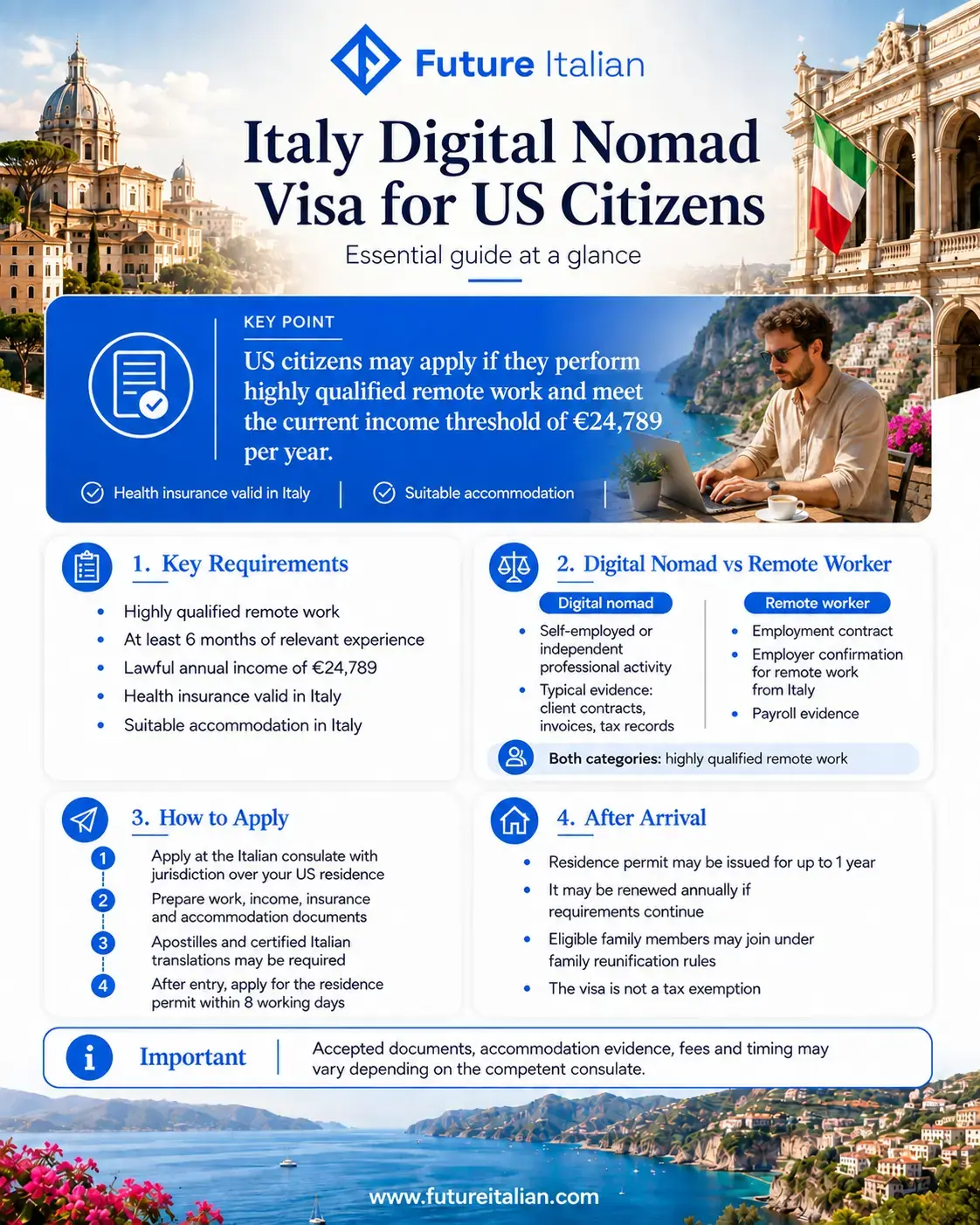
Yes, US citizens can get Italy's Digital Nomad Visa if they do highly qualified remote work, as freelancers or as employees, with at least six months of experience in it. You apply at the Italian consulate that covers your state and show about €25,000 a year of income from that work: New York publishes €24,789 (a 2024 figure), roughly $28,500 at $1.15 per euro. Employees must also meet a separate salary test. You then live in Italy on a renewable permit of up to one year and keep filing US tax returns, so plan the tax side before you move.
For the full legal framework, read our complete Italy Digital Nomad Visa guide. For the evidence rules in detail, see our Italy Digital Nomad Visa requirements guide.
How US citizens can apply for Italy’s Digital Nomad Visa
- 1
Find your consulate
Identify the Italian consulate that covers your state of residence and download its current Digital Nomad or Remote Worker checklist.
- 2
Choose your category
Typically, W-2 employees apply as remote workers and 1099 contractors and business owners as digital nomads; the contract, not the tax form, decides.
- 3
Check income and salary
Make sure your income is about €25,000 a year or more: gross salary if you are employed, profit after business expenses if you are self-employed. Employees also check that the contract meets the salary test.
- 4
Prove your qualification and legalize documents
Prepare evidence for your qualification route, including a Declaration of Value or CIMEA statement if you rely on a degree, then apostille and translate the documents your checklist requires.
- 5
File the visa application
Attend the appointment, pay the fee in dollars and answer any request for extra documents.
- 6
Request the residence permit
Within eight working days of entering Italy, apply for the digital nomad or remote worker residence permit.
Which Italian Consulate Covers Your State?
You must apply where you legally reside, not where appointments are faster. The consulate can ask for a driver's license, state ID, lease or utility bill to prove your address.
| Italian office | States and areas covered |
|---|---|
| Embassy, Washington DC | District of Columbia; Montgomery and Prince George's counties (MD); Arlington and Fairfax counties and the cities of Alexandria, Falls Church and Fairfax (VA) |
| Boston | Maine, Massachusetts, New Hampshire, Rhode Island, Vermont |
| Chicago | Colorado, Illinois, Iowa, Kansas, Minnesota, Missouri, Nebraska, North Dakota, South Dakota, Wisconsin, Wyoming |
| Detroit | Indiana, Kentucky, Michigan, Ohio, Tennessee |
| Houston | Arkansas, Louisiana, Oklahoma, Texas |
| Los Angeles | Arizona, Nevada, New Mexico and Southern California (Imperial, Kern, Los Angeles, Orange, Riverside, San Bernardino, San Diego, San Luis Obispo, Santa Barbara and Ventura counties) |
| Miami | Alabama, Florida, Georgia, Mississippi, South Carolina, Puerto Rico and the US Virgin Islands |
| New York | New York, Connecticut and 13 northern and central New Jersey counties (listed below) |
| Philadelphia | Pennsylvania, Delaware, North Carolina, West Virginia, 8 southern New Jersey counties (listed below), and Maryland and Virginia outside the Washington area |
| San Francisco | Alaska, Hawaii, Idaho, Montana, Oregon, Utah, Washington and the rest of California |
All US offices book visa appointments through Prenot@mi, the Italian foreign ministry's free online system, and you must attend in person. The Embassy in Washington and the Consulate in Los Angeles, for example, let you book up to six months ahead and no later than 15 days before departure; check your own consulate's page. In New Jersey, New York covers Bergen, Essex, Hudson, Hunterdon, Mercer, Middlesex, Monmouth, Morris, Passaic, Somerset, Sussex, Union and Warren counties; Philadelphia covers Atlantic, Burlington, Camden, Cape May, Cumberland, Gloucester, Ocean and Salem.
Freelancer or Employee: Which Category Applies to You?
Typically, W-2 employees apply as remote workers, while 1099 contractors, business owners and anyone invoicing clients apply as digital nomads. The contract, not the tax form, decides the category, so check borderline cases with your consulate. The two categories need different evidence and employees face an extra salary test; our complete guide compares them side by side.
How Much Income Does a US Applicant Need?
New York publishes €24,789 a year, a figure dated 2024. Other US consulates use the same legal formula, so expect about €25,000. At an illustrative rate of $1.15 per euro that is about $28,500. Check the dollar equivalent on the day you file, because the threshold is set in euros.
The income must come from the remote work itself: New York does not count dividends, rental income or other passive income. Typical evidence is your last federal return (Form 1040, with Schedule C if you are self-employed), W-2 or 1099 forms, recent pay stubs and bank statements showing the money arriving.
Consulates do not say whether they look at gross receipts or profit. For the self-employed, the cautious approach is to plan on your Schedule C profit after business expenses clearing the threshold. A 1099 contractor with $60,000 of receipts and $36,000 of profit is comfortably above it. One with $40,000 of receipts but $24,000 of profit after expenses (about €20,900) is at real risk of refusal and should confirm with the consulate before filing.
Remote Workers on a US Payroll: Employer Letter and Salary Test
Employees face a second test. New York's checklist requires the employment contract to show pay at least equal to the Italian collective-agreement level for the role and no lower than the median annual salary published by ISTAT, Italy's statistics office. The Embassy in Washington's 2026 checklist sets that floor at €33,000 gross a year, about $38,000 at $1.15 per euro. Other consulates refer to the collective agreement and ISTAT without giving a figure. Treat €33,000 as a minimum, not a guarantee: if the collective agreement for your role sets a higher salary, that higher figure applies.
Ask HR for a letter or contract addendum that states:
- your job title, duties and annual salary;
- that you may work remotely from Italy, and for how long;
- your working hours and the start date of the arrangement;
- the name and position of the person signing, with a copy of their ID.
New York also asks the employer to sign a declaration that it has had no convictions for specified offences in the previous five years, attached to the signatory's ID. Large companies can take weeks to produce it, so request it first.
Raise one more point with your employer: an employee working long-term from Italy can, in some cases, create Italian payroll or corporate-tax obligations for the company. Most employers will want their tax team to approve the arrangement before they sign.
Does a US Bachelor's Degree Count as Highly Qualified?
Not on its own. New York and San Francisco ask for a Declaration of Value (Dichiarazione di Valore) or a statement of comparability from CIMEA, Italy's recognition center, to document the degree's level. Miami's checklist refers only to a bachelor's degree from a certified US institution, but check with the consulate before relying on that. Request these documents early, because they can take several weeks.
Without a degree, five years of professional experience comparable to a degree also qualifies, documented with employer letters or client records. ICT managers and specialists need three years of relevant experience in the last seven. Whatever the route, you must also show at least six months in the activity you will do from Italy.
Documents Checklist for US Applicants
- national visa application form and recent photos;
- US passport with the validity and blank pages the consulate requires;
- proof of residence in the consulate's district, such as a driver's license, state ID, lease or utility bill;
- employment contract and employer letter, or client contracts and invoices;
- résumé, plus your degree, professional license or experience letters;
- your last federal tax return, W-2 or 1099 forms and recent bank statements;
- international health insurance valid throughout Italy;
- a lease or other accommodation evidence accepted by the consulate;
- a criminal-record check only if your consulate's checklist asks for one;
- apostilles and certified Italian translations where required;
- the visa fee: €116, charged in dollars at the consulate's quarterly rate (about $135–$136 in 2026).
Apostilles, Translations and the FBI Check
US documents follow two apostille routes. State documents, such as birth and marriage certificates or notarized copies of degrees, are apostilled by the Secretary of State of the issuing state. Federal documents, including the FBI Identity History Summary, are apostilled by the US Department of State's Office of Authentications.
The US consulates' Digital Nomad checklists we reviewed do not ask for an FBI background check; the criminal-record declaration they require concerns the employer of remote workers. If your consulate does ask for one, request the paper Identity History Summary with the FBI seal ($18), because only the Department of State can apostille it.
Only apostille and translate what your consulate's checklist requires. An apostille from the wrong authority, such as a state apostille on a federal document, makes the document unusable. We handle both steps through our Apostille service and certified document translation service.
Health Insurance and Housing
US health plans, including employer plans and ACA marketplace plans, rarely cover a long stay in Italy. US consulates ask for an international policy with at least €30,000 (or $50,000) of cover for medical treatment, hospitalization and medical repatriation throughout Italy for the whole stay. Submit the full policy certificate rather than a membership card; Los Angeles calls inadequate insurance the number one reason for refusals.
For housing, US consulates generally expect a lease or equivalent document covering the intended stay. A short hotel or vacation-rental booking is usually not accepted.
After You Arrive in Italy
Request the residence permit within eight working days of entry. The permit is valid for up to one year and can be renewed each year while you still qualify. Allow three to six months from the start of your paperwork to holding the visa (a planning estimate), plus the time your local Questura needs to issue the permit card.
You need an Italian tax code (codice fiscale) for a lease, a bank account and, if you are self-employed, the VAT number (partita IVA) that digital nomads must open. If you sign a lease before your visa, get the code first: a representative in Italy can request it for you from the Italian Revenue Agency (Agenzia delle Entrate), and the Consulate General in New York issues it to applicants who cannot appoint a representative. If you arrive without a code, it is assigned during the permit process.
US Taxes While Living in Italy
Moving to Italy does not end your US tax obligations. As a US citizen you file Form 1040 every year wherever you live, and you usually become Italian tax resident too once you spend most of the year in Italy. These tools prevent or reduce double taxation:
- Foreign earned income exclusion (FEIE): excludes up to $132,900 of foreign earned income for tax year 2026, if you meet the physical-presence or bona fide residence test.
- Foreign tax credit: a credit against US tax for Italian income tax paid. Italian rates are often higher than US rates, so many Americans in Italy use the credit rather than the exclusion.
- US–Italy tax treaty: sets tie-breaker and relief rules, but its saving clause means the US still taxes its citizens.
- Social security: under the US–Italy agreement, US citizens employed by a US employer, and self-employed US citizens, generally stay in US Social Security instead of paying Italian INPS contributions. You prove this with a certificate of coverage from the Social Security Administration, which you keep to show the Italian authorities; employers request it for employees, and the self-employed request it themselves. The foreign earned income exclusion does not reduce US self-employment tax, so self-employed Americans covered by US Social Security keep paying it.
- Reporting: an FBAR (FinCEN Form 114) if your foreign accounts exceed $10,000 combined at any point in the year, and Form 8938 above higher thresholds. Italy has its own foreign-asset reporting (the RW section of the Italian return) for your US accounts.
- State taxes: some states, such as California, may keep treating you as a resident unless you clearly cut your ties. Check your state's rules before you move.
Example: a US employee on a US payroll who moves to Rome usually files an Italian return as a resident, files a US return claiming foreign tax credits, and stays in US Social Security with a certificate of coverage, so no Italian INPS contributions are due on that salary.
The Digital Nomad Visa does not guarantee access to Italy's impatriate regime, which can exempt half of qualifying income for five years; eligibility is assessed separately. For a combined US and Italian plan, see our tax services for foreigners in Italy.
Can Your Family Join You?
Yes, but plan the timing. Children under 18 can come with you or join you later. A spouse (18 or older and not separated) who joins you later must wait until you have held legal residence in Italy for two years. Your spouse may be able to come with you instead as an accompanying family member, applying once your visa is issued, but we found no official guidance on that route for this permit, so confirm it before you plan to travel together. Family income and housing tests apply either way, and the family clearance (nulla osta) is requested from the immigration desk of the prefecture where you will live; a representative in Italy can file it. Family members receive a permit that lasts as long as yours and allows them to work; parents and adult children cannot be sponsored on this visa. Marriage and birth certificates need apostilles and Italian translations, and our Family Reunification Visa service can coordinate the process.
Common Mistakes in US Applications
- Applying at a consulate with sooner appointments instead of the one covering your state.
- An address mismatch, such as a Nevada driver's license and a California lease, with no explanation.
- Counting 1099 gross receipts when profit after expenses is below the threshold.
- An employer letter that leaves out the salary or the permission to work from Italy.
- A US degree submitted without a Declaration of Value or CIMEA statement, where the consulate requires one.
- A domestic US health plan presented as cover in Italy.
- A signed lease that is not registered, where the consulate asks for a registered contract.
A strong US file tells one consistent story across your tax return, contract, bank statements and address. If you want it checked before your appointment, see our Digital Nomad Visa support service.
Frequently Asked Questions
Sources
- 1Ministerial Decree of 29 February 2024 on digital nomads and remote workers
gazzettaufficiale.it
- 2
- 3Consulate General of Italy in New York, Digital Nomad / Remote Worker Visa
consnewyork.esteri.it
- 4Consulate General of Italy in San Francisco, Digital Nomad / Remote Worker Visa
conssanfrancisco.esteri.it
- 5
- 6