

Italy's Digital Nomad Visa requires highly qualified remote work, at least six months of experience in that work, lawful annual income of about €25,000, health insurance valid in Italy and suitable accommodation. In practice the income figure is €24,789 at the Italian Consulate in New York (a 2024 figure) and €25,500 in London. Remote workers also need a contract or binding offer and must pass a separate salary test.
This article focuses on eligibility and documentary proof. For the complete visa-to-residence-permit process, read our complete Italy Digital Nomad Visa guide. Applicants filing in the United States should also consult our US-specific Digital Nomad Visa guide.
How to verify Italy Digital Nomad Visa requirements
- 1
Choose the correct work category
Determine whether the activity is self-employed digital-nomad work or subordinate employment or collaboration as a remote worker.
- 2
Identify the highly qualified worker route
Confirm whether eligibility relies on a tertiary qualification, a regulated profession, five years of comparable experience or the specific ICT experience route.
- 3
Verify the current income figure
Check the figure your consulate publishes (about €25,000 a year) and, for remote workers, the separate salary test.
- 4
Document work and prior experience
Collect contracts, invoices, employer records, tax documents and evidence of at least six months of relevant activity.
- 5
Arrange insurance and accommodation
Obtain health insurance covering medical treatment and hospitalization in Italy and prepare accommodation evidence accepted by the consulate.
- 6
Check legalization and local filing rules
Review the current consular checklist for forms, fees, passport rules, apostilles, certified copies, translations and any additional declarations.
Italy Digital Nomad Visa Requirements at a Glance
The requirements are cumulative: strong income does not replace the highly qualified worker requirement, and a degree does not replace the six months of experience.
| Requirement | What it means | Typical proof |
|---|---|---|
| Non-EU citizenship | Any nationality outside the EU, including US, UK, Canadian and Australian citizens | Passport |
| Highly qualified work | One of four routes: degree, regulated profession, five years' experience or the ICT route | Degree, license or experience letters |
| Remote work | Work performed through digital tools for clients or an employer, in Italy or abroad | Contracts, job description |
| Six months' experience | At least six months in the activity you will carry out from Italy | Earlier contracts, invoices, payslips |
| Income | About €25,000 a year from lawful sources | Tax returns, payslips, invoices, bank statements |
| Salary test (remote workers) | Pay in line with the Italian collective agreement and the ISTAT benchmark; €33,000 gross a year at some consulates | Employment contract and payslips |
| Health insurance | Medical treatment and hospitalization throughout Italy for the stay | Policy certificate and terms |
| Accommodation | Suitable housing for the intended stay | Registered lease or property deed |
| Contract (remote workers) | Employment or collaboration contract, or a binding offer | Contract plus employer letter |
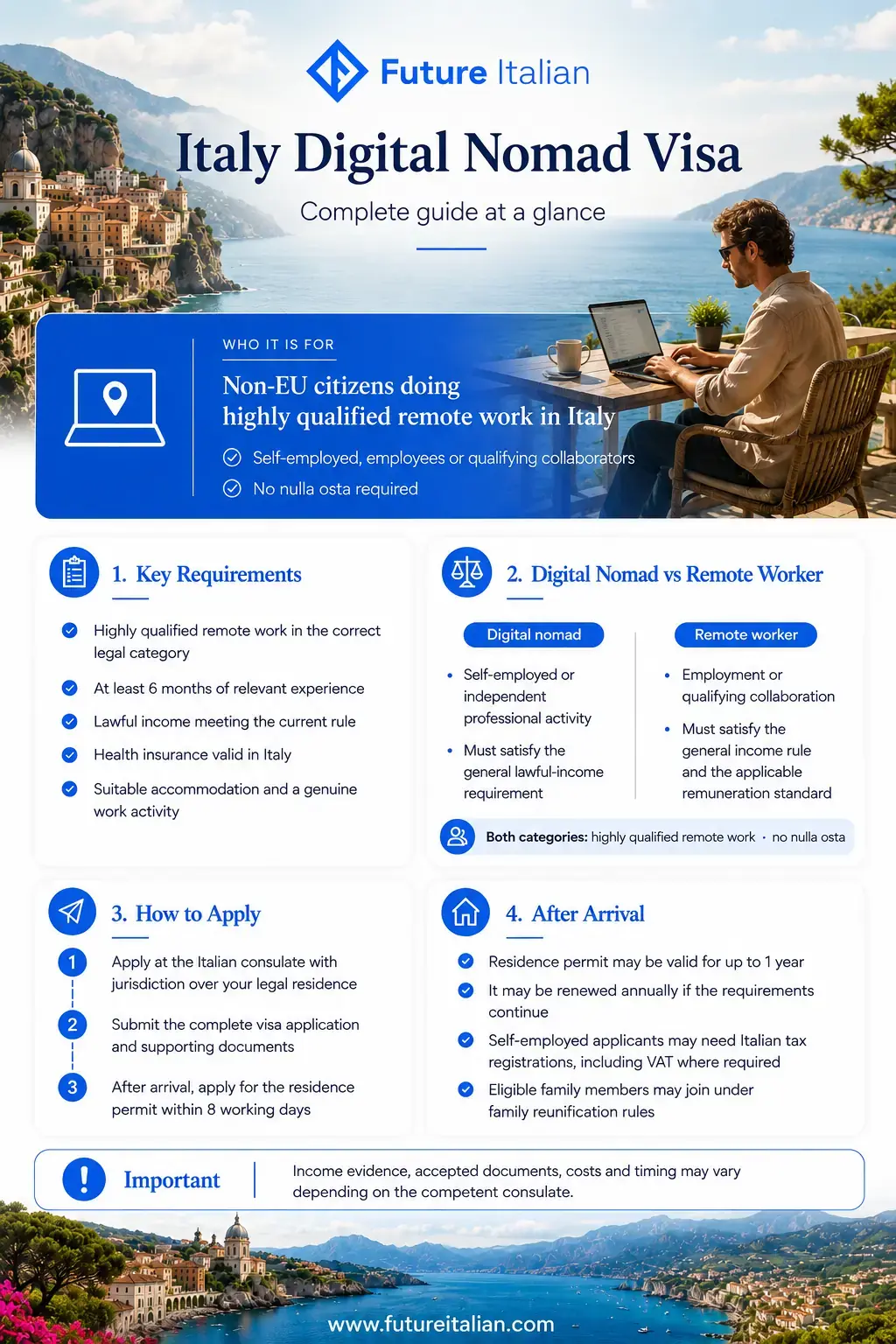
Digital Nomad or Remote Worker: Which Requirements Apply?
Freelancers apply as digital nomads; employees and qualifying collaborators apply as remote workers. The category decides which documents below you need and whether the extra salary test applies. Our complete guide compares the two categories side by side.
The decree does not require the employer or client to be foreign: it refers to an enterprise that may also be established outside Italy. Where the employer or client is resident in Italy, additional declarations and statutory checks may apply, so the case should be reviewed against the exact consular checklist.
The Highly Qualified Work Requirement
Remote work alone is not enough. The applicant must satisfy one of the alternative qualification routes incorporated from Article 27-quater of the Italian Immigration Act:
- a tertiary higher-education qualification based on a course lasting at least three years, a post-secondary professional qualification lasting at least three years, or a qualification corresponding to at least level 6 of Italy's National Qualifications Framework;
- the qualifications required under Italian rules for a regulated profession;
- at least five years of professional experience comparable to a tertiary-level qualification and relevant to the profession or sector;
- for managers and specialists in information and communications technology covered by the specified ISCO-08 categories, at least three years of relevant experience acquired during the previous seven years.
The six-month experience rule in the implementing decree is separate from these qualification routes. An applicant relying on a degree must still document at least six months of prior experience in the activity to be performed.
Minimum Income Requirement in 2026
Italian law requires annual income from lawful sources of at least three times the minimum amount used for exemption from participation in healthcare costs. The decree does not set a fixed euro figure, so each consulate publishes its own calculation:
| Consulate | Published minimum | Base amount × 3 | Date stated |
|---|---|---|---|
| New York | €24,789 a year | €8,263.31 | Figure current when the guidance was written in 2024 |
| Washington (Embassy) | €24,789 a year | €8,263.31 | 2026 checklist |
| Miami | about €25,200 a year | €8,400 | 2024 checklist |
| London | €25,500 a year | €8,500 | Current consular page |
| Sydney and Melbourne | €25,500 a year | €8,500 | 2026 checklists |
| Toronto and Ottawa | €24,780 a year | Not stated | As published |
| Johannesburg | more than €25,000 a year | Not stated | 2025 checklist |
Because the formula is linked to an external benchmark, the euro amount can change. Rely on the figure published by the consulate covering your residence and show income that clearly exceeds it. Consulates do not say whether they assess gross receipts or profit, so self-employed applicants should take the cautious approach and plan on profit after business expenses clearing it.
For example, an applicant whose tax return shows €26,400 of professional income (€2,200 a month) clears the London figure. One showing €22,800 (€1,900 a month) does not, whatever their savings.
The Salary Test for Remote Workers
For employees, meeting the general income figure is only the first check. New York's consular checklist also requires the employment contract to show pay at least equal to the applicable Italian collective-agreement (CCNL) level and no lower than the median annual salary published by ISTAT. New York gives no euro figure, but the Embassy in Washington (2026 checklist) and the consulates in Sydney and Melbourne set the floor at €33,000 gross a year. London instead requires pay not lower than the average net salary in the sector, as published by ISTAT.
The contract or binding offer should identify the role, working hours, annual remuneration and remote-work arrangement, with payroll evidence where available. The employer must also declare that it has had no convictions in the previous five years for specified labor-immigration offences; New York asks for this declaration signed, with the signatory's identity document. The 2024 decree states only the general income formula, so applicants outside New York must follow their own consulate's checklist on salary evidence.
Which Income Counts
The decree refers broadly to income from lawful sources, but consulates may apply more specific documentary standards. New York states that the income must derive from the work to be performed in Italy and excludes passive income from its calculation. London's self-employed checklist focuses on steady, declared professional income supported by tax records.
A file should therefore be built around recurring professional income, supported by evidence such as:
- filed tax returns and official tax calculations;
- employment contracts, collaboration agreements or binding offers;
- payslips, payroll records or employer letters;
- client contracts, invoices and business records;
- bank statements showing the receipt of the declared income.
Savings, investments, property or passive income may strengthen the broader financial picture, but do not assume these assets satisfy the income requirement at every consulate.
Six Months of Relevant Experience
Every applicant must demonstrate at least six months of previous experience in the activity that will be performed as a digital nomad or remote worker. The evidence must relate to the actual field of work, not merely to general employment history.
Self-employed applicants may use earlier contracts, invoices, tax returns, client letters, professional registrations or association records. Remote workers may use employment contracts, payslips, tax records, employer letters and detailed job descriptions. This requirement is separate from the five-year or three-year experience routes used to establish highly qualified status.
Health Insurance Requirement
The policy must be valid throughout Italy and cover medical treatment and hospitalization for the period required by the consulate. The documents should clearly show the insured person, territorial coverage, dates, benefits and exclusions. The decree sets no minimum amount, but many consulates do: New York, Los Angeles, Washington, Houston, Miami, Sydney and Melbourne ask for cover of at least €30,000, and the US posts accept $50,000 and expect medical repatriation to be included.
A membership card or brief confirmation may not prove all required elements. Submit the policy certificate and the terms the consulate asks for, and avoid travel policies that stop after 90 days or exclude long stays.
The insurance is a visa requirement. Enrollment in Italy's national health service (SSN) is a separate question for after arrival: Italian rules make it compulsory for some workers and voluntary for others, and we found no official guidance on this permit specifically. If voluntary enrollment applies, the minimum yearly contribution has been €2,000 since 2024, calculated on income and covering dependent family members. Ask the local health authority (ASL) which category applies to you before dropping private cover.
Accommodation Requirement
The national decree requires suitable documentation of the applicant's accommodation but does not prescribe one document for every consulate.
Published checklists may require a lease, a registered rental agreement, proof of property ownership or another form of accommodation evidence covering the intended stay. London, for example, specifically lists a registered rental agreement or registered property documents. A short hotel booking should not be treated as sufficient.
Documents for Self-Employed and Remote Worker Applications
The exact checklist depends on the consular post and the applicant's category. The following groups of documents are commonly relevant.
Self-Employed Digital Nomads
- visa application form, passport, photographs and proof of residence in the consular district;
- evidence of the chosen highly qualified worker route;
- proof of at least six months of relevant experience;
- client contracts, invoices, professional or business registrations and tax records;
- income evidence, health insurance and accommodation documents;
- apostilles, legalizations and Italian translations where required.
Remote Workers
- visa application form, passport, photographs and proof of residence in the consular district;
- evidence of the chosen highly qualified worker route and six months of relevant experience;
- employment or collaboration contract, or a binding offer;
- employer confirmation of the role, duties, remuneration and remote-work arrangement;
- payroll, tax and banking records supporting the income declared;
- health insurance, accommodation and any employer declarations required by the decree or the consulate.
Apostilles and Italian Translations
Documents issued outside Italy may need an apostille or legalization and an Italian certified translation. This matters most for qualifications, regulated-profession evidence, civil records and other public documents used to prove a legal requirement. The United States, the United Kingdom, Canada, Australia, New Zealand and South Africa all use the apostille, so documents from those countries do not need consular legalization.
Do not process every document automatically. The issuing country, document type, qualification route and consular checklist determine whether an apostille, certified copy or translation is required.
What to Recheck With Your Consulate Before Filing
The national requirements are the same everywhere, but consulates control local filing and may ask for different proof. Before you submit, check the current version of:
- the income figure or base amount the consulate publishes;
- the visa fee and accepted payment method;
- passport-validity and blank-page requirements;
- the accepted proof of legal residence in the consular district;
- the form and appointment procedure;
- the evidence accepted for qualifications, experience, insurance and accommodation;
- apostille, certified-copy and translation requirements.
The rules are still those of the decree of 29 February 2024, in force since April 2024. We have found no official change to the visa requirements in 2026, although several consulates updated their checklists this year. Our Digital Nomad Visa support service covers eligibility review and document strategy for your consulate.
Next Steps After Meeting the Requirements
File the application with the Italian consulate that covers your legal residence, then request the residence permit within eight working days of entering Italy. Costs, timing, taxes and family options are covered in our complete guide.
Frequently Asked Questions
Sources
- 1Ministerial Decree of 29 February 2024 on digital nomads and remote workers
gazzettaufficiale.it
- 2
- 3
- 4Consulate General of Italy in New York, Digital Nomad / Remote Worker Visa
consnewyork.esteri.it
- 5
- 6Consulate General of Italy in London, Remote Worker Visa for Employees
conslondra.esteri.it