

As of July 2026, having an Italian ancestor is no longer enough by itself to qualify for Italian citizenship by descent. A person born abroad who holds another citizenship must first fall within one of the exceptions introduced by the 2025 reform and must then prove that Italian citizenship passed through every generation without a legally relevant interruption.
Italian citizenship by descent is a recognition of citizenship held from birth under the principle of ius sanguinis, commonly referred to in English as jure sanguinis. It is not a naturalization process, and applicants are not generally required to pass an Italian-language test.
Since the 2025 reform, however, proving Italian ancestry is no longer sufficient by itself. Applicants must first satisfy the requirements of Article 3-bis and then prove an uninterrupted citizenship chain, including the relevant naturalization records, maternal-line rules, and filing authority. For case-specific support, see our Italian citizenship by descent assistance.
How to Apply for Italian Citizenship by Descent
- 1
Identify the applicable legal gateway
Confirm whether Article 3-bis applies and whether the case relies on exclusive Italian citizenship, qualifying parental residence, lack of another citizenship, or a protected pre-27 March 2025 filing.
- 2
Reconstruct the citizenship chain
Map every birth, marriage, naturalization, loss, renunciation, adoption, and parentage event from the Italian ancestor to the applicant under the law in force at each date.
- 3
Obtain citizenship and naturalization evidence
Request official naturalization, non-naturalization, citizenship-status, residence, and non-renunciation evidence from every relevant Italian and foreign authority.
- 4
Collect and correct civil-status records
Obtain long-form birth, marriage, divorce, death, adoption, and parentage records and resolve discrepancies that affect identity or the legal family line.
- 5
Authenticate and translate the documents
Complete the required apostille or consular legalization and prepare Italian translations using the method accepted by the competent authority.
- 6
File with the competent authority
Submit the complete application to the territorially competent Consulate or Comune, the central MAECI office when operational, or the competent Italian court where a judicial route is required.
- 7
Complete review and registration
Answer requests for additional evidence and, after recognition, complete civil-status transcription, AIRE registration where applicable, and passport procedures.
Italian Citizenship by Descent After the 2025 Reform
Decree-Law no. 36/2025, converted with amendments by Law no. 74/2025, inserted Article 3-bis into Law no. 91/1992. The provision applies even to people born before the reform. It states that a person born abroad who possesses another citizenship is considered never to have acquired Italian citizenship unless at least one statutory exception applies.
This changed the old practical model. Under the previous framework, a claim could often reach a distant Italian ancestor if the line remained legally uninterrupted. Under current law, descent from a great-grandparent or earlier ancestor may still be relevant to reconstruct the historical chain, but it does not by itself satisfy the new gateway.
The Constitutional Court confirmed the operative force of the reform in Judgment no. 63/2026. It rejected the main constitutional challenges concerning the retroactive structure of Article 3-bis and treated the provision as a rule limiting acquisition where citizenship had not previously been legally ascertained. The reform must therefore be applied unless a later law or judgment changes the framework.
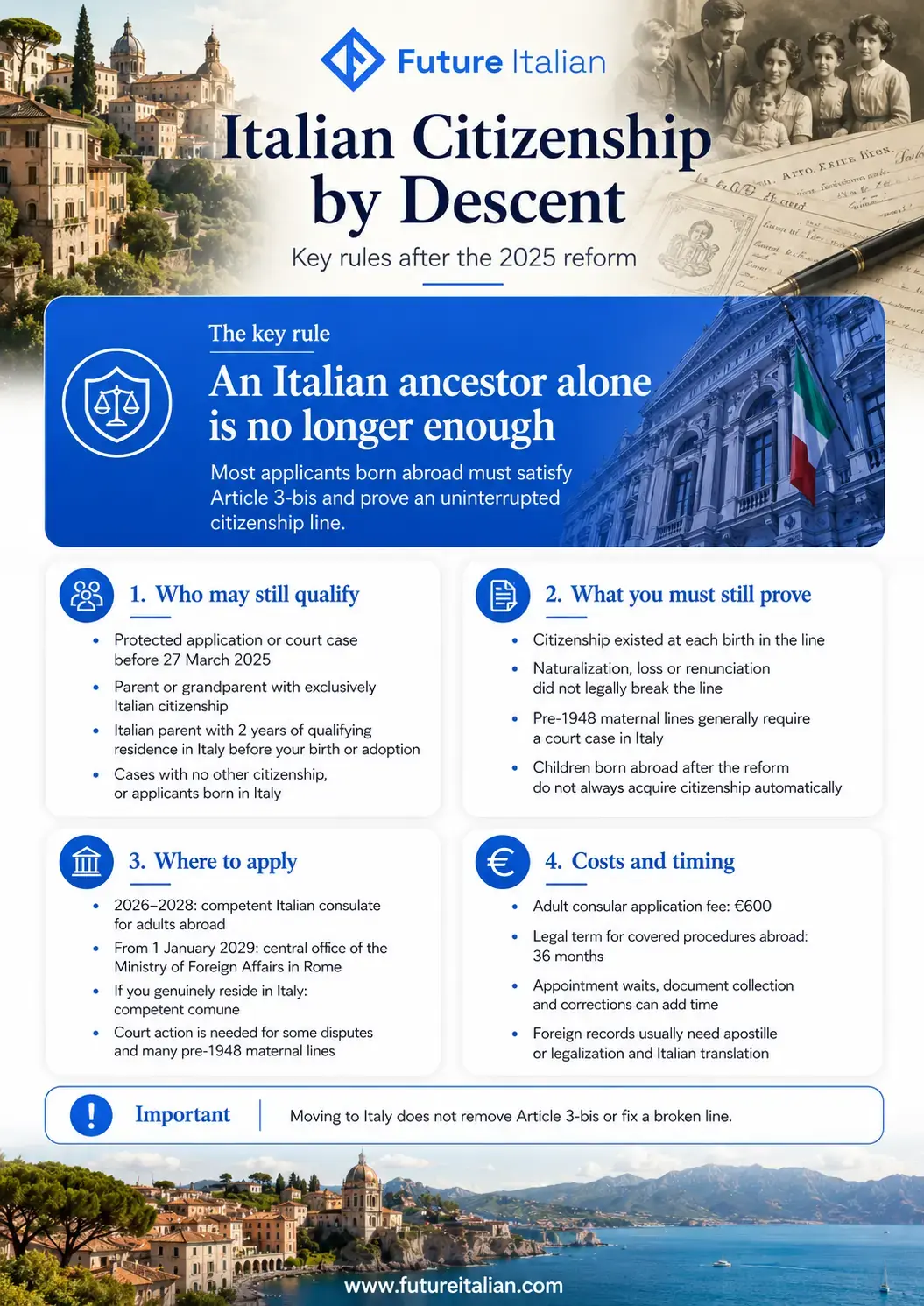
Who Can Qualify Under Current Law?
For a person born abroad who also holds another citizenship, recognition is possible only if at least one of the following situations applies. Meeting one gateway does not finish the analysis; the applicant must still prove a valid citizenship chain.
1. A protected application or court case existed before the cutoff
The previous rules continue to govern certain cases connected to the cutoff of 23:59, Rome time, on 27 March 2025. Protection may apply where:
- a complete administrative application, supported by the required documentation, was submitted to the competent Consulate or Comune by the cutoff;
- the application was presented on a later appointment date, but the competent authority had communicated that appointment by the cutoff; or
- a judicial claim for recognition was filed by the cutoff.
A booking attempt, waiting-list registration, incomplete file, informal email, or intention to apply is not automatically equivalent to a protected application. The exact evidence and procedural history must be examined.
2. A parent or grandparent was exclusively Italian
An applicant may qualify if a first- or second-degree direct ascendant—that is, a parent or grandparent—currently possesses only Italian citizenship or possessed only Italian citizenship at the time of death. The law does not say that this person must have been born in Italy. The decisive issue is exclusive Italian citizenship.
This condition often requires negative evidence from every country connected to the parent or grandparent. A simple personal declaration that the relative never became a foreign citizen is generally not enough. Consulates may request non-naturalization certificates, citizenship-status records, electoral records, immigration files, renunciation records, or other official evidence depending on the country.
3. A parent completed two years of qualifying residence in Italy
An applicant may also qualify if an Italian parent or adoptive parent resided continuously in Italy for at least two years after acquiring Italian citizenship and before the applicant’s birth or adoption. Residence before the parent acquired Italian citizenship does not satisfy this condition.
The normal evidence is a historical residence certificate issued by the competent Comune, but the authority may examine whether the registration reflected genuine and continuous residence. The residence of a grandparent or of the non-Italian parent does not replace the statutory requirement.
4. The applicant does not possess another citizenship
Article 3-bis is directed at people born abroad who possess another citizenship. A person who genuinely has no other citizenship is not caught by that restriction. This is not a paperwork shortcut: the applicant must prove the absence of another citizenship and must still establish the underlying Italian citizenship chain.
5. The applicant was born in Italy
The Article 3-bis restriction concerns people born abroad. A person born in Italy to an Italian parent is assessed under the ordinary citizenship-by-birth rule and the historical continuity of the parent’s citizenship. Birth in Italy alone, however, does not generally grant Italian citizenship to a child of two foreign parents.
The New Gateway Does Not Replace the Citizenship Chain
A parent or grandparent who satisfies Article 3-bis opens the door to recognition; that fact does not prove that the family line was legally Italian. The applicant must reconstruct the chain from the relevant Italian ancestor to the applicant and show that citizenship existed at each birth.
The analysis normally asks:
- When and where was the Italian ancestor born, and under which territorial and citizenship law?
- Did the ancestor acquire a foreign citizenship, and on what exact date and legal basis?
- Was the next person in the line already born when naturalization or loss occurred?
- Was that child a minor, and did the child already possess a foreign citizenship from birth?
- Did any person formally renounce Italian citizenship after reaching adulthood?
- Does the line pass through an Italian woman whose child was born before 1 January 1948?
- Do treaties, border changes, adoption, recognition of parentage, or marriage rules affect the line?
These questions are governed by the law in force when each event occurred. Law no. 555/1912, Law no. 91/1992, earlier Civil Code provisions, Constitutional Court judgments, and international treaties may all matter in one family file.
Naturalization and the Minor Issue After Cassation no. 24045/2026
Naturalization cannot be reduced to the slogan “before the child’s birth breaks the line; after the birth preserves it.” Naturalization before the next descendant’s birth normally prevents transmission from that ancestor, but naturalization after the birth requires a separate analysis of the child’s age, nationality, residence, and the law then in force.
On 26 July 2026, the Joint Sections of the Italian Supreme Court issued Judgment no. 24045/2026 on the so-called minor issue. The Court held that, under Article 7 of Law no. 555/1912, a non-emancipated child born abroad in a country granting citizenship by birth and therefore already holding both Italian and foreign citizenship retained Italian citizenship when the Italian parent later naturalized or lost Italian citizenship, unless a special treaty rule applied or the child formally renounced after adulthood.
The Court also held that Article 12 of Law no. 555/1912 could transmit the parent’s loss only to a minor who held exclusively Italian citizenship and could acquire the foreign citizenship derivatively. It confirmed that the same principles apply whether citizenship came through the father or the mother.
The judgment is especially important for judicial claims filed before the 27 March 2025 cutoff, because the Court expressly confirmed that Article 3-bis does not apply to those protected claims. It does not abolish Article 3-bis for new applications, automatically reopen every rejected case, or guarantee that all consular checklists will change immediately. A file must first be classified under the old or current regime.
Ministry of the Interior Circular no. 65050 of 10 August 2026 adds an important administrative consequence. If an earlier citizenship application was denied exclusively under the former Articles 7/12 interpretation based on Cassation Order no. 17161/2023, the applicant may request re-examination of the original application rather than file a new one. If the original application was filed before 27 March 2025, or was based on an appointment communicated by the competent office by that date, Article 3-bis does not apply to that re-examination. See our 2026 minor-issue re-examination update for the eligibility filters, naturalization dates, and the distinction between administrative denials and court judgments.
Maternal Lines and Cases Before 1948
Italian administrative authorities generally recognize transmission through an Italian woman where the child in the citizenship line was born on or after 1 January 1948. If that child was born before 1948, recognition normally requires a judicial claim in Italy based on the constitutional case law that ended sex discrimination in citizenship transmission.
The 2025 reform created a second question for these cases. A judicial claim filed by 23:59, Rome time, on 27 March 2025 remains governed by the earlier framework. A new claim filed after that cutoff must be assessed under current Article 3-bis and cannot rely only on the existence of a pre-1948 maternal line.
A maternal-line case may also involve historic rules on women who acquired a husband’s nationality through marriage, loss of citizenship without a voluntary act, the nationality of minor children, and later constitutional judgments. These files should not be screened using a family-tree diagram alone.
Citizenship for Children Born Abroad After the Reform
Italian citizenship is no longer automatically transmitted to every child born abroad to an Italian citizen. Automatic citizenship depends on whether the child falls outside the Article 3-bis restriction or satisfies one of its exceptions, including the exclusive-citizenship or parental-residence conditions.
A minor who does not receive citizenship automatically may be able to acquire it by benefit of law under Article 4(1-bis) if at least one parent is an Italian citizen by birth. The parents or guardian must declare the intention to acquire citizenship and one of these conditions must be met:
- the declaration is submitted within three years of the child’s birth or the later establishment of legal parentage, including adoption; or
- after the declaration, the child legally resides in Italy for at least two continuous years.
A transitional route is available until 23:59, Rome time, on 31 May 2029 for people who were minors on 24 May 2025 and are children of citizens by birth whose recognition is protected by Article 3-bis letters a), a-bis), or b). This is an acquisition procedure, not proof that citizenship was automatically transmitted from birth in every case.
Parents should distinguish three separate operations: registering the birth of a child who is already Italian, applying for recognition of automatic citizenship, and making a declaration for acquisition by benefit of law. Using the wrong procedure can waste a deadline.
Where to Apply in 2026–2028 and From 2029
Adults residing abroad in 2026–2028
Until 31 December 2028, adult applicants residing abroad continue to submit applications through the Italian Consulate with territorial jurisdiction over their genuine permanent residence. Law no. 11/2026 introduced annual intake limits: each Consulate may receive no more adult recognition applications per year than the number of procedures it completed during 2025, subject to a statutory minimum of 100.
This quota affects access to appointments, not substantive eligibility. Some offices may release very few slots or suspend new bookings after reaching capacity. Applicants must follow the current instructions of their own Consulate rather than copying the procedure used in another country.
Adults residing abroad from 1 January 2029
From 1 January 2029, adult applications from residents abroad are to be presented to a central directorate within the Ministry of Foreign Affairs in Rome. The law provides for original paper documents and proof of payment to be sent by post, while later communications are handled electronically. Consulates will continue processing applications received before the transition and will retain functions concerning minors and persons already recognized.
The statutory transition is clear, but the operational forms, postal channel, document-return arrangements, and implementing instructions for the 2029 system may still be refined before it begins. Until official guidance is issued, those technical details should be treated as provisional.
Applicants genuinely residing in Italy
A person who has established actual legal residence in Italy may apply through the competent Comune. Residence must be genuine, not a short hotel stay or a fictitious registration created only to bypass a consular queue. The Comune verifies residence and the citizenship file and may request confirmations from foreign consulates.
Moving to Italy does not remove Article 3-bis or repair a broken citizenship chain. It changes the competent administrative authority, not the substantive eligibility rules.
Judicial proceedings
A court case may be necessary for a pre-1948 maternal line, a dispute over the interpretation of historic citizenship law, an unlawful administrative refusal, or another issue that cannot be resolved administratively. A lawsuit is not a general alternative for someone who simply fails the Article 3-bis requirements. The legal basis, transitional regime, evidence, jurisdiction, and litigation risk must be assessed before filing.
Documents Required for Italian Citizenship by Descent
There is no single worldwide checklist. Each Consulate, Comune, or court may require country-specific evidence, forms, validity periods, and presentation rules. A complete file commonly includes:
- a recent extract of the Italian ancestor’s birth record issued by the competent Comune;
- long-form birth records for every person in the direct line, including the applicant;
- marriage, divorce, adoption, parentage, and death records where relevant to the line;
- naturalization certificates, petitions, declarations of intention, alien files, or official non-naturalization statements for the Italian ancestor and any other relevant ascendant;
- evidence that no person in the line formally renounced Italian citizenship;
- documents proving the Article 3-bis gateway, such as proof of exclusive Italian citizenship or a historical certificate of two years of qualifying residence in Italy;
- the applicant’s passport, civil-status documents, and proof of residence in the competent consular district;
- the authority’s application forms, declarations, appointment confirmation, and proof of payment; and
- court orders or amended records where material discrepancies cannot be resolved through ordinary civil-status documentation.
Naturalization research must cover every country in which the relevant ancestor lived. A certificate from one country does not prove that the person never acquired citizenship elsewhere.
Apostille, Legalization, Translation, and Record Corrections
Foreign civil-status records generally need an apostille when issued in a country participating in the Hague Apostille Convention, or another form of document legalization when the Convention does not apply. Legalization confirms the origin of the public document; it does not translate the document or prove that the facts recorded are legally sufficient.
The document must also be translated into Italian under the rules accepted by the competent authority. Depending on the issuing country and filing office, this may involve consular certification, a translator’s certification, or a sworn translation completed in Italy. Apostille and translation are separate steps, not alternatives.
Name changes, anglicized surnames, inconsistent dates, missing acknowledgments of parentage, and clerical errors must be assessed across the entire line. Not every harmless variation requires litigation, but a discrepancy that creates doubt about identity, filiation, or citizenship events may require an amendment, declaratory judgment, or supporting record. Correcting documents before the authority identifies the problem is usually safer than explaining an avoidable contradiction after filing.
How the Application Process Works
The administrative steps differ by authority, but a legally sound application follows the same order. Eligibility should be analyzed before collecting dozens of expensive certificates.
- Identify the Article 3-bis gateway or the protected pre-reform regime that applies to the applicant.
- Reconstruct every birth, marriage, naturalization, loss, renunciation, and residence event in the direct line.
- Obtain the Italian records and foreign civil-status and citizenship records from the competent authorities.
- Resolve material discrepancies and confirm that each record identifies the same people and legal relationships.
- Complete apostille or legalization and the accepted Italian translation procedure.
- File with the competent Consulate, Comune, central office when operational, or court, using the current local instructions.
- Respond to requests for additional evidence and, after recognition, complete civil-status transcription, AIRE registration where applicable, and passport procedures.
Recognition is declaratory: when granted, the authority confirms that the applicant was an Italian citizen from birth under the applicable rules. Acquisition by benefit of law for a minor is different because citizenship begins under the acquisition procedure rather than being recognized as automatically existing in every case.
Processing Times
Law no. 11/2026 sets a 36-month term for the adult recognition procedures covered by the reformed system for residents abroad. That term should not be confused with the time required to obtain an appointment. Annual quotas, consular backlogs, incomplete files, foreign verification requests, and corrections can make the total practical timeline much longer.
Comune processing varies according to the complexity of the file, residence verification, foreign confirmations, and local workload. Judicial timing depends on the competent court, service of documents, evidence, hearings, appeals, and the legal issue involved. A universal promise such as “six months” or “one year” is not reliable.
Applicants should separate four timelines: document collection, appointment waiting time, formal processing after acceptance, and post-recognition registration. The authority’s legal term normally addresses only part of that sequence.
Costs
An adult application submitted through an Italian Consulate is subject to a €600 consular fee. The fee is charged for processing the application and is normally non-refundable even if recognition is refused. Payment is often collected in local currency at the consular exchange rate and through the method specified by the individual office.
Applications through a Comune may be subject to a local administrative contribution where the municipality has adopted one. Court fees and professional costs apply separately to judicial proceedings.
The largest variable costs are usually civil-status certificates, archive searches, naturalization records, apostilles or legalization, translations, document corrections, shipping, travel, and legal assistance. A family with a short, clean line may spend far less than a family spanning several countries and court systems, so there is no honest universal total.
Common Reasons Applications Fail
- The applicant has a distant Italian ancestor but no Article 3-bis gateway.
- The parent or grandparent was not exclusively Italian, and the file does not satisfy the two-year parental-residence condition.
- Naturalization occurred before the birth of the next descendant.
- The applicant assumes the 2026 minor-issue judgment removes the 2025 reform from a new case.
- A pre-1948 maternal line is filed administratively when a judicial route is required.
- The naturalization search covers only one jurisdiction or uses an informal database result instead of official evidence.
- Civil-status records contain unresolved identity or parentage discrepancies.
- Documents are translated but not apostilled or legalized, or apostilled but not translated under the accepted procedure.
- The application is filed with an authority that lacks territorial competence.
- The applicant claims residence in Italy or a consular district without genuinely living there.
A refusal may be challengeable where the authority misapplied the law, ignored evidence, or failed to provide a legally adequate decision. It is not automatically appealable with good prospects merely because the applicant invested heavily in documents.
What If You Do Not Qualify Under Article 3-bis?
A person who cannot satisfy the current citizenship-by-descent gateway should not assume that there is no lawful path to Italian citizenship. The correct alternative depends on the family history and the person’s plans.
Possible routes may include reacquisition for certain former Italian citizens, acquisition by benefit of law for eligible minors, the special residence rules available to some descendants of Italians, Italian citizenship by residency, or Italian citizenship by marriage. These are separate legal routes with different eligibility conditions, residence requirements, language rules, and legal effects.
The useful question is not whether an Italian ancestor exists. It is which legal route applies today, what evidence proves it, and whether the expected result justifies the cost and time of the process.
What Recognition Gives You
A successful recognition confirms Italian citizenship and, with it, citizenship of the European Union. The person can obtain Italian civil-status registration and, once the relevant registrations are complete, apply for an Italian passport and exercise rights of residence and work under Italian and EU law.
Recognition does not automatically solve every administrative matter. A person living abroad must generally be registered with AIRE, civil-status events must remain updated, and children born later must be assessed under the transmission rules in force at their birth. The 2025 reform makes it particularly dangerous to assume that citizenship will pass automatically to every future generation.
Conclusion
Italian citizenship by descent remains available, but the legal test changed fundamentally in 2025. A valid case now requires both a current Article 3-bis gateway and an uninterrupted historical citizenship chain; protected pre-reform cases, minor-issue disputes, maternal lines, and children born abroad each follow different rules.
The sensible order is legal screening first, citizenship and naturalization research second, civil-status preparation third, and filing only after the correct authority and procedure are confirmed. That sequence prevents the most expensive mistake in this field: building a perfect document file for a claim that does not satisfy the law.
Frequently Asked Questions
Sources
- 1
- 2Decree-Law no. 36/2025 coordinated with Law no. 74/2025
gazzettaufficiale.it
- 3Ministry of the Interior — Circular no. 65050 of 10 August 2026 on the minor issue and re-examination
libertaciviliimmigrazione.dlci.interno.gov.it
- 4Law no. 11/2026 — procedures for adult applicants residing abroad
gazzettaufficiale.it
- 5Italian Constitutional Court, Judgment no. 63/2026
cortecostituzionale.it
- 6Italian Supreme Court, Joint Sections, Judgment no. 24045/2026
cortedicassazione.it