

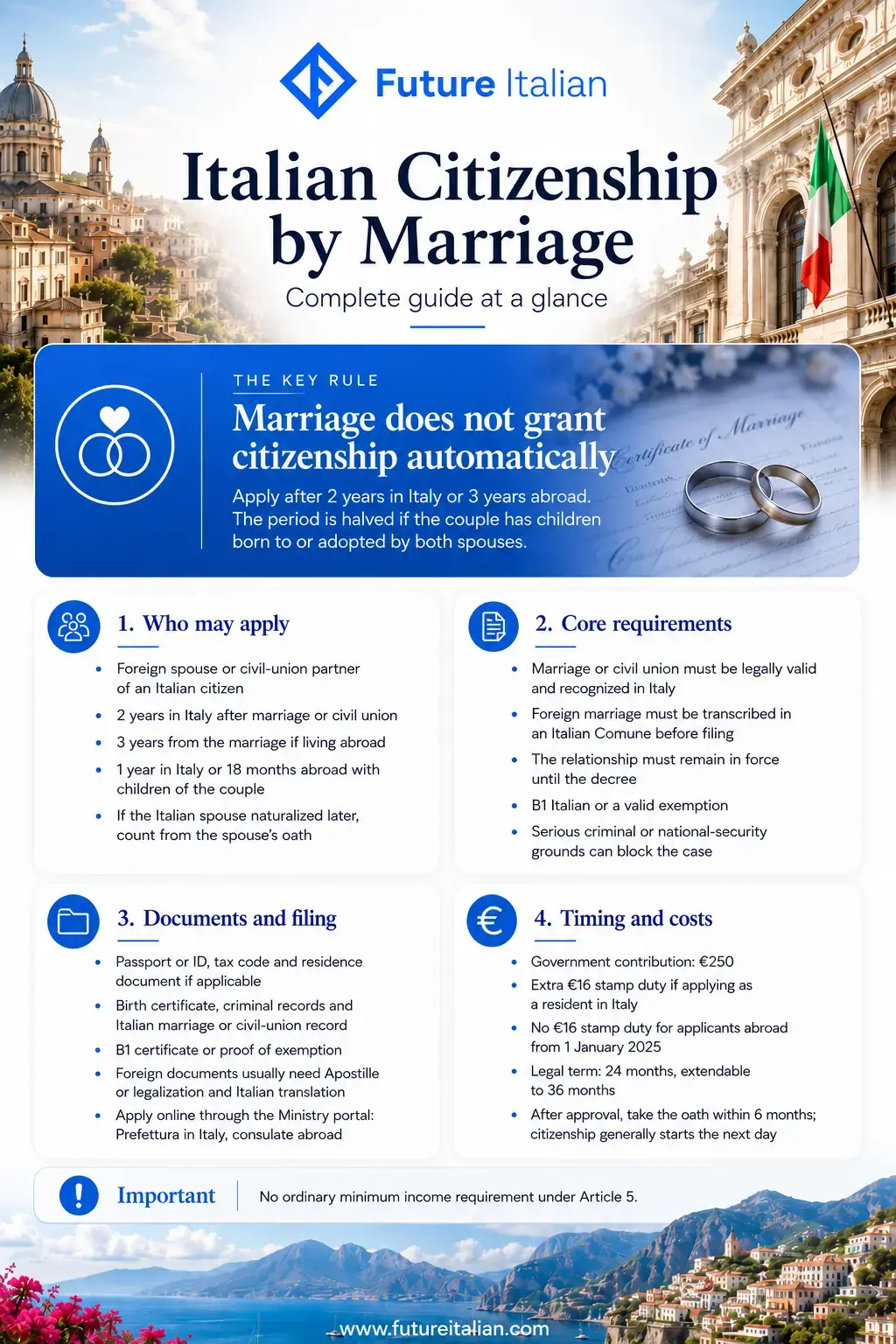
A foreign spouse or civil-union partner of an Italian citizen may generally apply after 2 years of legal residence in Italy following the marriage, or after 3 years from the marriage when living abroad. The waiting period is reduced by half when the couple has children born or adopted by both spouses.
Marriage does not grant Italian citizenship automatically. The relationship must be legally valid and recorded in Italy, the waiting period must be calculated from the correct date, the applicant must normally prove B1 Italian, and the marriage or civil union must remain in force through the date of the citizenship decree.
The marriage route does not ordinarily require a minimum income, but document, criminal, language, residence, and relationship defects can still stop the case. For an individual assessment and end-to-end support, see our Italian citizenship by marriage service.
How to Apply for Italian Citizenship by Marriage
- 1
Confirm the legal relationship and waiting period
Verify that the marriage or civil union is valid, determine whether the Italy or foreign-residence rule applies, and calculate from the wedding or the Italian spouse’s later oath.
- 2
Complete Italian civil-status registration
If the relationship was formed abroad, ensure that it is transcribed in the competent Italian Comune before filing.
- 3
Verify B1 Italian or an exemption
Obtain an accepted language certificate or educational title, or prepare the documents proving a recognized statutory or constitutional exemption.
- 4
Collect and authenticate the documents
Prepare birth and criminal records, the Italian marriage record, identity and residence evidence, Apostilles or legalization, and accepted Italian translations.
- 5
Submit the online application
File through the Ministry of the Interior portal using exact identity and civil-status data and pay the applicable government charges.
- 6
Respond to Prefettura or consular requests
Monitor the portal and email, provide requested supplementary documents promptly, and ensure that the marriage or civil union remains legally in force through the decree.
- 7
Complete notification and oath
After approval, supply any final documents and take the oath within six months so citizenship can take effect.
Who Can Apply for Italian Citizenship by Marriage?
Article 5 of Law no. 91/1992 applies to a foreign or stateless spouse of an Italian citizen. Under Law no. 76/2016, the same citizenship rules also extend to a party to a civil union with an Italian citizen.
A registered cohabitation, domestic partnership, religious ceremony without civil effect, engagement, or long-term relationship is not enough. The legal marriage or civil union must be recognized in the Italian civil-status system.
| Applicant’s situation | Waiting period before filing | Starting point |
|---|---|---|
| Living legally in Italy | 2 years | Legal residence in Italy after the marriage or civil union |
| Living abroad | 3 years | Marriage or civil-union date |
| Living legally in Italy with children of the couple | 1 year | Legal residence in Italy after the marriage or civil union |
| Living abroad with children of the couple | 18 months | Marriage or civil-union date |
| Italian spouse acquired citizenship after the wedding | Same 2-year or 3-year rule | The Italian spouse’s oath, not the original wedding date |
The reduction applies when the spouses have children born to or adopted by both members of the couple. A child from a previous relationship does not automatically produce the same reduction unless the legal condition concerning the couple is satisfied.
The Marriage Must Be Registered in Italy
If the marriage was celebrated outside Italy, it must be transcribed in the civil-status records of the competent Italian Comune before the citizenship application is filed. A foreign marriage certificate that has never been recorded in Italy is not enough for the Article 5 procedure.
Transcription and citizenship are separate operations. First, the foreign marriage record must be accepted and entered into the Italian civil-status system. Only then should the applicant build and submit the citizenship file.
The exact authentication, translation, and transmission procedure depends on where the marriage occurred and where the Italian spouse is registered. See our complete guide to registering a foreign marriage in Italy.
Couples who have not yet married can review the separate guide to getting married in Italy.
Requirements for Applicants Living Abroad
An applicant living abroad files online and the competent Italian consulate handles the local part of the procedure. The Italian spouse should normally be correctly registered with AIRE, and the marriage must already appear in the Italian civil-status records.
Many consulates also request evidence that both spouses genuinely reside in the same consular district and at the same address, or an explanation supported by documents when they do not. These requirements should be described as consular operating instructions and evidence of a real marital relationship—not as identical statutory wording applied in every country.
The applicant must follow the current checklist of the consulate with jurisdiction over the actual place of residence. A checklist copied from another country may use different payment methods, document formats, translations, or appointment procedures.
The Relationship Must Remain in Force
From filing until the citizenship decree is adopted, there must be no annulment, dissolution, termination of the civil effects of the marriage, or personal separation. A formal marriage certificate does not preserve eligibility when the legal and factual marital bond has ended.
A reconciliation after separation may not simply revive the old waiting period. Current official guidance indicates that the applicable periods may begin again from the reconciliation date, so the procedural consequences must be evaluated before continuing the file.
The death of the Italian spouse while the application is pending does not automatically require refusal under current official Ministry guidance. Death must be distinguished from separation or divorce, which are expressly relevant to Article 5. The authority may still request documentation establishing the procedural facts.
Is There an Income Requirement?
Italian citizenship by marriage does not ordinarily have the minimum-income requirement applied to discretionary naturalization by residency. The Article 5 requirements focus instead on the qualifying relationship and waiting period, B1 Italian or an exemption, criminal and security grounds, identity records, and the online procedure.
This distinction matters because many applicants mistakenly apply the income rules from the wrong citizenship route. A spouse does not normally need to meet the Article 9 income benchmarks merely to file under Article 5.
Applicants whose eligibility is based on years of life in Italy rather than marriage should use the separate Italian citizenship by residency guide.
Italian Language Requirement: B1 and Exemptions
Applicants under Article 5 generally must prove Italian-language knowledge at level B1 of the Common European Framework of Reference. A marriage to an Italian citizen does not itself create a language exemption.
The requirement may be satisfied through a qualifying educational credential issued by an Italian public or officially recognized institution, or through a B1 certificate from an accepted certifying body. The document must match the applicant’s identity data and satisfy the portal’s requirements.
A separate B1 certificate is generally not required for holders of an Italian EU long-term residence permit or applicants who have fulfilled the integration agreement requirements. The exemption is document-based: the relevant status must be proven correctly in the application.
Constitutional Court Judgment no. 25/2025 also requires an exemption for applicants with serious, objectively documented limitations in language learning caused by age, illness, or disability. The limitation must be certified through appropriate public-health documentation. Ordinary exam anxiety, limited study time, illiteracy by itself, or repeated failure does not automatically establish the constitutional exemption.
Criminal Convictions and National Security
Citizenship by marriage is subject to specific statutory criminal grounds for refusal under Article 6. These include certain offenses against the Italian State, a final conviction for an intentional offense carrying a statutory maximum sentence of at least three years, and certain foreign convictions for nonpolitical offenses when the sentence and recognition conditions established by Italian law are met.
Rehabilitation, the precise classification of the offense, recognition of a foreign judgment, the sentence imposed, and later legal developments can change the analysis. Applicants must not rely on the label used by a foreign criminal system or assume that an old record is irrelevant.
Serious national-security grounds may independently prevent acquisition. The government conducts its own checks, so omitting an arrest, conviction, alias, nationality, or prior residence is usually more damaging than disclosing it accurately and evaluating the legal consequences before filing.
Documents Required
The exact checklist depends on whether the applicant lives in Italy or abroad and on the competent Prefettura or consulate. A standard file commonly includes:
- A valid passport or foreign identity document, Italian tax code, and Italian residence document where applicable.
- The applicant’s full birth certificate, unless the birth is already registered in Italy or an official substitute is permitted for a protected category.
- Criminal record certificates from the country of origin and any relevant third countries of residence.
- The Italian marriage or civil-union record, and any additional foreign civil-status documents required to explain names or prior marriages.
- A qualifying B1 certificate or the documents proving an accepted alternative or exemption.
- Proof of payment of the €250 Ministry contribution.
- The €16 stamp duty for applications filed as residents in Italy; foreign-resident applications have not required this stamp duty since January 1, 2025.
- Residence, AIRE, address, or consular-jurisdiction evidence requested for the applicant’s filing route.
Foreign criminal records are generally treated as valid for six months from issue unless the document itself or a specific rule provides otherwise. Birth certificates normally do not expire merely because time has passed, but the competent authority may still require a format that contains complete and current identity information.
Apostille, Legalization, and Italian Translation
A foreign document must first be accepted as authentic for use in Italy and then made understandable in Italian. Depending on the issuing country, authentication may occur through an Apostille, consular legalization, an EU public-document rule, or another applicable convention.
The translation method also varies. It may involve consular certification, a qualified translator under an applicable EU rule, or a sworn translation completed in Italy. Apostille and translation are not alternatives; they solve different problems.
For a detailed explanation, read our guides to the Apostille and sworn translation.
Where and How to Apply
The application is submitted online through the Ministry of the Interior citizenship portal. Applicants living in Italy generally access the system through SPID or CIE and the file is associated with the competent Prefettura. Applicants living abroad register through the route provided for foreign residents, after which the competent consulate handles local verification.
The portal data must reproduce the civil-status documents exactly. Names, surnames, transliterations, places of birth, citizenships, addresses, prior residences, marriage dates, and the Italian spouse’s citizenship date must be entered consistently.
After submission, the authority may accept the application for processing, reject it at the document-control stage, or request corrections and additional evidence. Acceptance into the system is not approval on the merits.
Processing Time
For applications filed from December 20, 2020 onward, the legal processing term is 24 months and may be extended to a maximum of 36 months. Older applications may remain governed by the previous 48-month term.
The statutory period concerns the administrative decision and should not be confused with the time needed to transcribe a marriage, obtain criminal records, pass a language exam, correct documents, schedule the oath, or update Italian civil-status records afterward.
If the term expires without a decision, the appropriate response depends on the file. A formal request for action, access to records, or judicial remedy may be justified, but escalation should be based on the actual procedural status and outstanding checks.
Costs
The principal government charge is the €250 contribution payable for the citizenship application. Applicants filing as residents in Italy also generally pay €16 stamp duty through the domestic procedure.
Since January 1, 2025, applicants residing abroad no longer pay the €16 stamp duty for naturalization applications filed through the consular route. The €250 contribution remains due.
Additional costs depend on the country and the file: civil-status certificates, criminal records, Apostilles or legalization, translations, certified copies, corrections, and professional assistance. A universal total would be misleading.
What Happens After Approval?
A favorable decree does not make the applicant an Italian citizen immediately. The decree must be notified, any final documents requested by the Comune or consulate must be produced, and the applicant must take the oath within six months.
Before the oath, some authorities request an updated Italian marriage record and other evidence confirming that the legal conditions continue to exist. These are operational requirements that can vary, so the instructions accompanying the decree must be followed precisely.
Citizenship generally takes effect on the day after the oath. Missing the six-month oath deadline causes the decree to lose effect. The new citizen can then complete the relevant civil-status, identity, electoral, AIRE, and passport procedures.
Common Mistakes That Damage Applications
- Counting the waiting period from the wedding when the Italian spouse became a citizen only later.
- Filing before a foreign marriage or civil union has been transcribed in Italy.
- Assuming children reduce the period when they are not legally children born to or adopted by both spouses for this purpose.
- Using an expired criminal record or omitting a country of origin, nationality, or prior residence.
- Submitting documents with inconsistent names, dates, transliterations, or marital-status information.
- Claiming a B1 exemption without the required supporting document.
- Failing to monitor the portal, email, Prefettura, or consular communications.
- Allowing separation, divorce, or another event affecting the marital bond to occur without evaluating its effect on the pending case.
A refusal or pre-refusal notice must be analyzed against the exact legal ground. Some problems can be corrected with evidence; others eliminate Article 5 eligibility and cannot be cured by a better cover letter.
Residence Rights Before Citizenship
Citizenship and the right to reside in Italy as the family member of an Italian citizen are separate matters. A spouse may have a family-based residence right long before becoming eligible for citizenship, but holding a residence card does not replace the citizenship waiting period or application.
A spouse who first needs to regularize residence in Italy should review the FAMIT residence card guide.
Minor Children and Future Citizenship Transmission
A spouse’s successful Article 5 application does not automatically make every child Italian. Under the current Article 14, a cohabiting minor child of the naturalizing parent generally must have legally resided in Italy for at least two continuous years at the time the parent acquires citizenship, or since birth if the child is younger than two.
The child’s relationship to the applicant, age, cohabitation, legal residence, and the date of the parent’s oath must be examined separately. A child who does not satisfy Article 14 may need another acquisition or residence route.
Children born after the parent becomes Italian are assessed under the citizenship-transmission rules applicable at their birth. For children born abroad, the 2025 reform makes a separate review essential; see the Italian citizenship by descent guide.
What Italian Citizenship Gives You
Once citizenship takes effect, the applicant becomes an Italian and European Union citizen, with access to an Italian passport, EU free-movement rights, political rights where legally eligible, and Italian consular protection.
Citizenship does not automatically change tax residence, guarantee every social benefit, or override the nationality law of another country. Applicants who may lose an existing citizenship should obtain advice under that country’s law before taking the Italian oath.
Conclusion
Italian citizenship by marriage has shorter waiting periods than ordinary naturalization by residency, but it is not an automatic benefit arising from marriage and the passage of time. A successful file depends on a marriage or civil union recognized in Italy, the correct starting date, a relationship that remains legally intact through the decree, B1 Italian or a proven exemption, accurate criminal and civil-status documents, and disciplined follow-up through the oath.
The strongest sequence is simple: register the relationship first, calculate eligibility from the legally correct date, investigate language and criminal issues before ordering documents, file a fully consistent application, and continue meeting every requirement until citizenship takes effect. This reduces avoidable risk and keeps the procedure legally controlled.
Frequently Asked Questions
Sources
- 1
- 2
- 3
- 4Law no. 173/2020 — current 24-to-36-month procedural term
gazzettaufficiale.it
- 5Italian Constitutional Court, Judgment no. 25/2025 — B1 language exemption
cortecostituzionale.it
- 6